



Lay the connecting rods out in cylinder number order. The bosses on the lower head and cap of the connecting rod should face the front of the engine (or according to the marking during disassembly).
Remove the covers and liners, set them aside to avoid confusion. Remove the bolts.
The arrows on the piston crowns should point towards the front of the engine. Rotate the piston ring joints 120°. Figure 70 shows how the piston ring joints should be positioned in relation to the piston pin axis.
Place a clamp on the piston rings as shown in Figure 78 and press the rings into the grooves. Check that the rings are fully seated in the grooves. Wrap the lower connecting rod head in polyethylene to prevent damage to the cylinder bore surface.
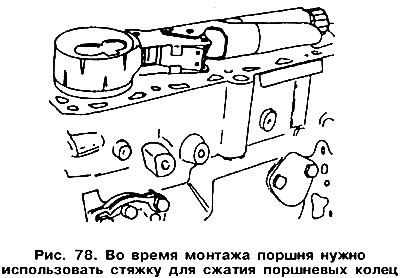
Rotate the crankshaft so that the crankpin of the desired cylinder is at BDC. Insert the connecting rod into the cylinder from above. The cylinder block should be laid on its side so that the lower head of the connecting rod can be brought to the abundantly lubricated crankpin of the crankshaft, removing the protective material (polyethylene). This method eliminates the possibility of damaging the cylinder bore or the crankshaft journal. The connecting rod insert must already be in the lower connecting rod head with the protrusion installed in the groove of the lower connecting rod head.
Insert the piston into the cylinder, the rings will also enter the cylinder one by one, and the lower head of the connecting rod will come into contact with the connecting rod journal of the crankshaft.
Generously lubricate the connecting rod bearing cap with engine oil. Place the cap on the connecting rod bolts and tap it lightly. Check again that the lugs on the lower head and connecting rod cap (see figure 66) ended up on the same side. This is the last chance to correct a possible mistake.
Lubricate the lid where the nuts meet. Tighten the nuts as follows:
- in the first phase, alternately with a torque of 30 Nm,
- in the second phase, turn them by 90°.
After installing the connecting rods, turn the crankshaft several times to check the quality of the assembly.
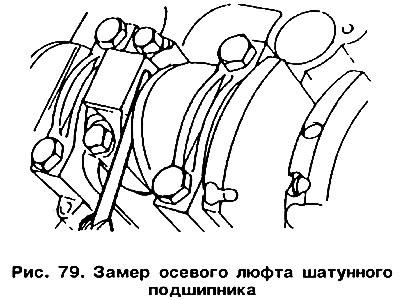
Check the markings on all connecting rods and the correct installation of the pistons again. Check the clearance between the side surface of the connecting rod bearing cap and the crank cheek with a feeler gauge (figure 79). This is the axial clearance of the connecting rod bearing, its value should not exceed 0.40 mm.
Perform the remaining operations in the reverse order of disassembly, completing the assembly by installing the oil pan.
This operation must be performed before assembling the engine.
The normal surface wear pattern is shown by line "a", while line "1" shows excessive wear caused by lack of oil.
[The information is posted on this resource www.VWmanual.ru]
Visitor comments