



Valve springs
Accurately checking the valve springs requires the use of a special measuring tool. If you do not have one, you can do the following:
Compare the removed spring with the new one. If the old spring is shorter than the new one, it is worn out and must be replaced along with the others.
Place the springs on a flat surface (glass) with the compressed coils facing down. Place a square against the spring and measure the distance from the upper edge of the spring to the square. If it is more than 2.0 mm, the spring is unacceptably bent and requires replacement.
Place the springs on a flat surface (glass) with the compressed coils facing down. Place a square against the spring and measure the distance from the upper edge of the spring to the square. If it is more than 2.0 mm, the spring is unacceptably bent and requires replacement.
Valve guide bushings
Clean the valve guides with a rag soaked in gasoline or acetone. After cleaning, insert the appropriate valve into the holes.
Attach the indicator to the mating surface of the cylinder head using a special clamp (figure 46). Pull the valve out of the sleeve until the end of the valve stem is hidden in the hole in the sleeve.
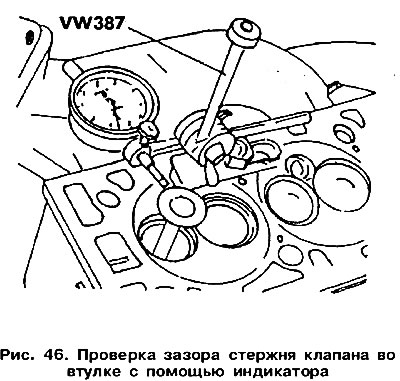
By rocking the valve in a direction perpendicular to the axis of the valve stem, take the sensor readings. If they exceed 1.0 mm for intake valves and 1.3 mm for exhaust valves, the bushings must be replaced.
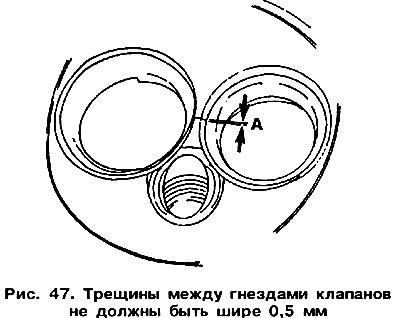
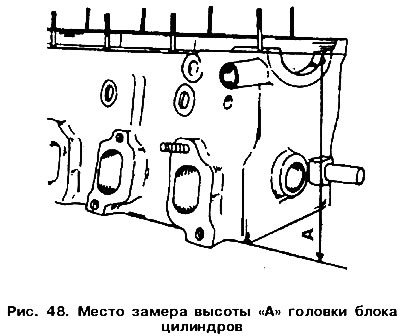
Before replacing the bushings, the general condition of the cylinder head should be assessed. Head with small cracks between the valve seats (figure 47) or between the valve seat and the first thread in the spark plug hole can be reused or ground if the cracks are no wider than 0.5 mm. Size "A" after repair grinding (figure 48) cannot be less than 135.6 mm.
 |
 |
Caution! If the valve bushing has been replaced, the valve seats must be milled.
Before pressing the guide bushing out of the cylinder head, check to see if there is a support flange on its end (see arrow in figure 45). The flanged bushing is pressed out from the combustion chamber side, and the flangeless one is pressed out from the camshaft side. The old guide bushing is pressed out using a rod of a suitable diameter. To make the job easier, you can heat the head. The rod should end with a thinner shank, which is inserted into the bushing hole.
At the same time as replacing the guide bushings, the valves should also be replaced. The valve seats should be reground.
Lubricate the new bushings generously with oil and press them into the cold head from the camshaft side until the support flange is flush with the mating surface of the cylinder head. Do not press them in any further, as you may cut off the flange.
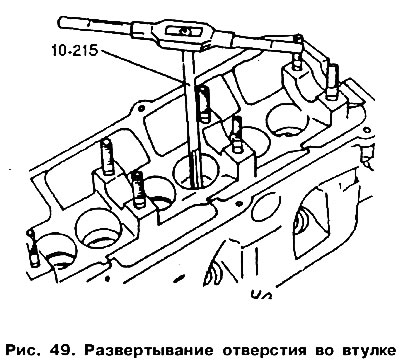
After pressing, the bushing holes should be reamed using a special reamer "10-215" (figure 49). The bushing holes for the inlet and outlet valves must be expanded to 8.0 mm. In this case, the standard gap will be maintained between the bushing and the valve.
Valve seats
If the camshaft bed is worn out, then you can use a restored cylinder head. In this case, no valve seat preparation is required.
 |
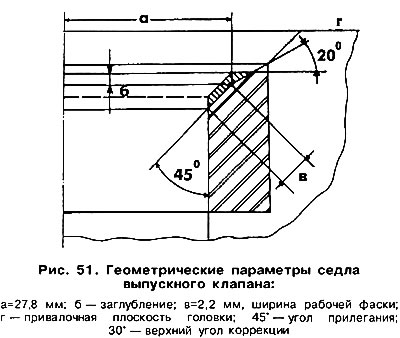 |
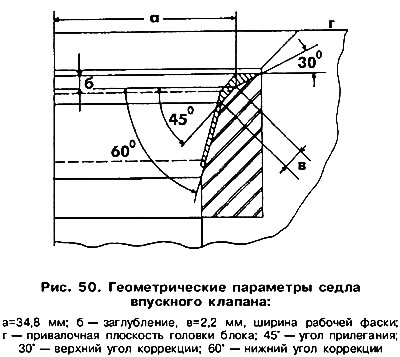
Check the degree of wear of each valve seat. Minor surface wear can be corrected with a 45° conical cutter. Badly worn seats must be reground. The values of the geometric parameters of the valve seats are shown in Figures 50 and 51. The design of the valve seats in carburetor engines and engines with fuel injection is the same. It should be ensured that the working chamfer is not excessively deepened into the body of the cylinder head. To ensure this, perform the following steps:
- insert the valve into the guide bushing, pressing the valve head against the seat in the chamfer area;
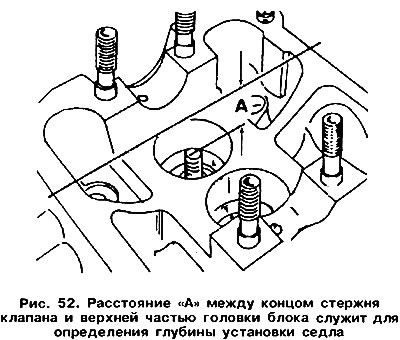
- measure the distance "A" (figure 52) between the end of the valve stem and the upper mating surface (see figure 50, 51) cylinder heads.
- determine the permissible valve recess depth (designated as "b" in Figures 50 and 51) based on the measured distance "A" and the fact that the minimum distance from the end of the valve stem to the upper mating plane of the cylinder head is 35.8 mm for the intake valve and 36.1 mm for the exhaust valve.
When processing, it is necessary to adhere to the following recommendations.
When replacing the valve guide bushings, it is necessary to process the valve seats, which is done as follows. The surface of the belt itself is processed with a milling cutter with an angle of 30° (inlet valve) or 45° (exhaust valve), and then the required width of the working belt (2.2 mm) is formed by processing the upper part with a 45° cutter (inlet valve) or 30° (exhaust valve) and the lower part with a cutter with an angle of 60° (for intake valves only).
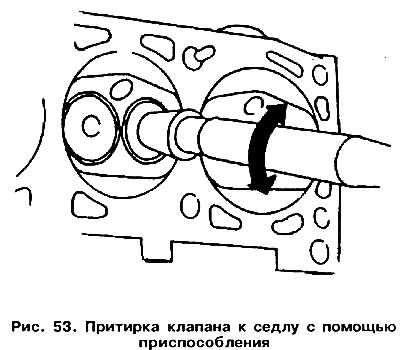
After processing the working chamfers of the seats, the valves should be lapped to them. To do this, cover the surface of the seat with lapping paste mixed with engine oil and insert the valve into place, lubricating its stem with engine oil. Attach a lapping device to the valve and rotate the valve in both directions (figure 53), gently pressing the valve against the seat. The work at the initial stage can be made easier if the valve is rotated with a drill. Finish grinding using only clean motor oil.
After finishing the grinding, remove the paste and clean all surfaces. Inspect the working surfaces of the seat and valve. Both surfaces should have a continuous matte ring with a width equal to the width of the working chamfer.
On the working chamfer of the valve, make several marks in a circle with a pencil approximately every 1 mm. Insert the valve into the sleeve and press it into the seat. Pressing lightly on the valve, turn it 90°.
Remove the valve and make sure that the pencil marks on the working belt have disappeared. Proceed with the assembly of the head. Otherwise, continue processing the mating surfaces and, as a last resort, install a new or restored cylinder head.
Valves
Minor damage to the valve seat surface can be removed by grinding the valve to the seat in the manner described earlier.
Check the valve wear (figure 55), taking into account the differences between the intake and exhaust valves. Valves with severe wear must be replaced.
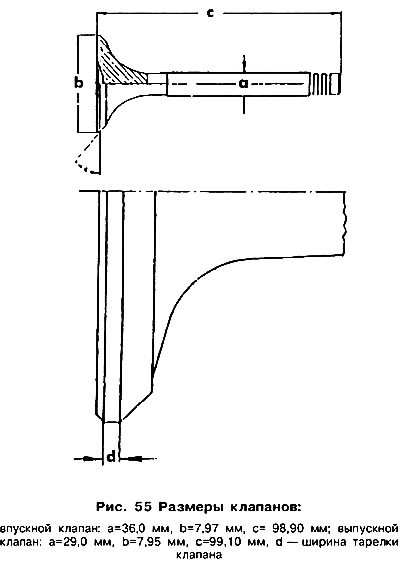
If signs of wear appear on the end of the valve stem, it can be ground, remembering that the layer of metal removed should not exceed 0.5 mm.
Valve plates should not be ground. Damaged valves can only be lapped or replaced with new ones.
Cylinder head
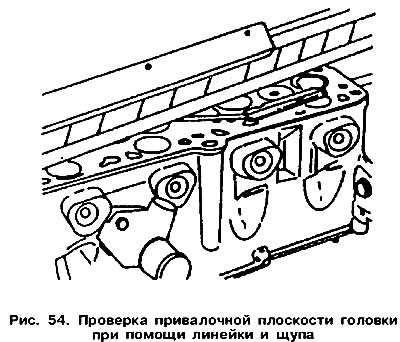
Carefully clean the mating surfaces of the cylinder head and engine block, and then check whether the cylinder head is deformed. To do this, place a special rail on the mating surface of the cylinder head, as shown in Figure 54, and use feeler gauges to determine the degree of warpage of the cylinder head along, across and diagonally along the mating surface. If the gap does not significantly exceed 0.10 mm, the head should be given for grinding. If the surface is very uneven, the head must be replaced. After grinding, the height of the cylinder head should not be less than 135.6 mm. The location for measuring the height of the cylinder head is shown in Figure 48.
Camshaft
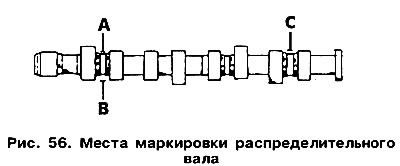
The camshaft is marked in a specific manner, shown in Fig. 56, depending on the engine type:
- in a carburetor engine of the "HZ" type, the camshaft is not marked;
- in the carburetor engine "MN" and type "NU" the camshaft has between the cams of the first cylinder a cast belt, of a larger diameter than the bearing journal, designated in Figure 56 by the letter "D";
- in an engine with an injection system, the camshaft has two cast belts between the cams of the first cylinder, designated in Fig. 56 by the letter "B", but on this shaft there is no cam "C" for driving the fuel pump.
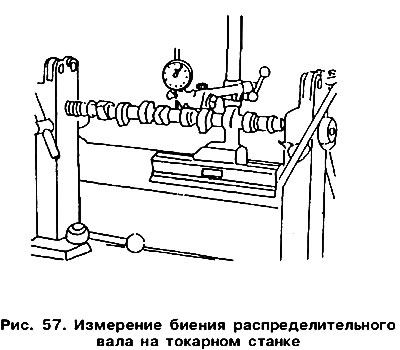
Mount the outer journals of the camshaft on two prisms located on the measuring plate, or clamp it in the centers on a lathe (Fig. 57). Attach an indicator to the central journal of the shaft. Slowly rotate the camshaft and read the indicator. If the readings exceed 0.10 mm, the shaft is deformed and requires replacement. Check the shaft for visible defects.
In order to check the radial clearance in the shaft bearings, it is necessary to use a calibrated plastic wire "Plasligage".
The check should be carried out without installing the tappets as follows:
Clean the camshaft covers and bed and install the shaft in place.
Place a piece of calibrated wire along the shaft axis on each shaft bearing journal and install the bearing caps according to their numbers (see figure 42). Tighten the cover mounting nuts evenly, starting from the middle to the edges, with a force of 6 Nm, and then turn them another 90°. The camshaft cannot be rotated after this.
Loosen the bearing cap fastening nuts in the reverse order and remove the caps. Compare the width of the calibrated wire sections with the available template ruler. If the gap in any bearing exceeds 0.10 mm, then the bearing and camshaft have reached the limit of wear, which will require replacing the shaft, and often the cylinder head.
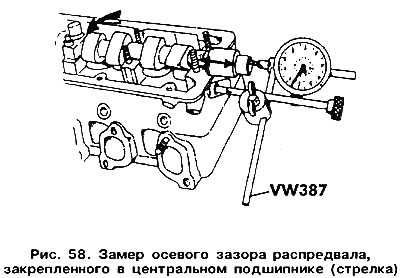
To determine the axial clearance, the camshaft must be installed in the cylinder head (without pushers) and secure with the center bearing cap. Install the cylinder head on a flat surface and, having secured the indicator to the front of the cylinder head, (figure 58) move the shaft along the axis. The axial clearance should not exceed 0.15 mm. A higher value indicates wear of the thrust surface of the bearing cap.
Visitor comments