



Contents: Valve springs and valve guides ↓ Valve guide bushings ↓ Valve seats ↓ Valves ↓ Cylinder head ↓ Camshaft ↓
Valve springs and valve guides
Valve springs should not have cracks and should be sufficiently elastic. For a full check of valve springs, a special spring testing tool should be used. If you do not have one, then install the springs in a row on a smooth surface so that the closed knurling is at the bottom. Place a steel angle next to the spring and measure the gap between the upper part of the spring and the angle. The gap should not be more than 2.0 mm. Otherwise, the spring is skewed.
Valve guide bushings
Check the valve guide bushing in the following order:
- clean the valve guide bushing from carbon deposits by dragging a rag soaked in gasoline back and forth through the bushing;
- clean the valve stem thoroughly and insert the valves into the guide bushings in order;
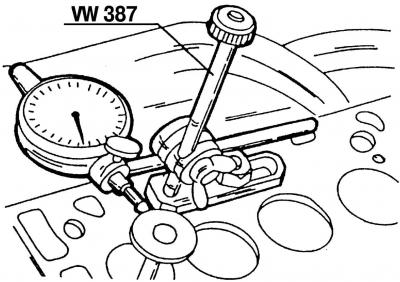
Fig. 113. Checking the valve stem runout inside the guide bushing using the VW387 measuring device
- check the valve stem runout inside the guide bushing using the VW387 measuring device (Fig. 113) as follows:
- install the VW387 measuring instrument with the appropriate bracket on the upper part of the cylinder head;
- pull the valve out of the hole as far as possible until the end of the valve stem is finally stopped by the guide bushing;
- rock the valve disc from side to side at the top and check the readings on the gauge. If the reading is greater than 1.0 mm on the intake valves or 1.3 mm on the exhaust valves, the valve guide should be replaced.
The general condition of the cylinder head should also be checked. The cylinder head can be used after grinding. If there are small scratches between the valve seats or between the valve seat and the first thread of the spark plug hole, provided that the scratches are no wider than 0.5 mm, the cylinder head can be reground and reused.
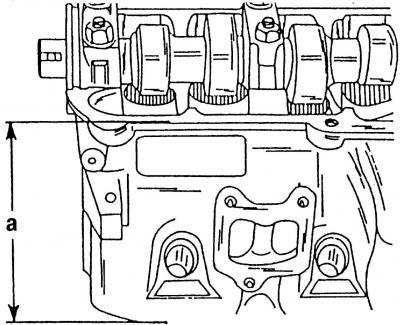
Fig. 114. Measuring the height of the cylinder head
After regrinding the cylinder head, the value a (Fig. 114) should be no less than 132.60 mm. Measurements should be taken either with a caliper or a measuring ruler, placing the cylinder head on a flat surface.
Press out the guide bushings from the cylinder head in the following order:
- inspect the installed guide bushings. If the guide bushings have not yet been replaced, the valve guide bushings are not fastened and can be pressed out of the cylinder head from the camshaft side. If the guide bushings have already been replaced, the bushings will have a fastening that can be seen from the camshaft side. In this case, the old guide bushing should be pressed out from the combustion chamber side;
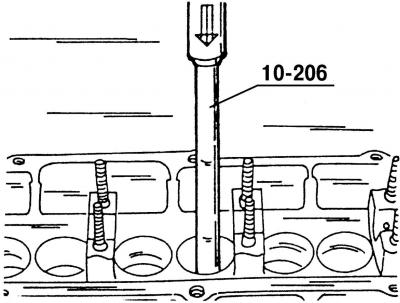
Fig. 115. Pressing out the valve guide bushing. New bushings are pressed in from the same side
- the guide bushing is pressed out of the cylinder head using a punch. To make pressing out easier, the cylinder head can be heated. A journal that fits the inside of the valve guide bushing must be screwed onto the punch. Pressing out the original guide bushing, which has not yet been replaced, is shown in (Fig. 115);
- when replacing the valve guide bushing, the valve itself is replaced along with it. After that, the valve seats need to be ground.
Press the guide bushings into the cylinder head in the following order:
- before installing, lubricate the new guide bushings with engine oil and press them into the cold cylinder head from the camshaft side so that the flange of the valve guide bushing enters the cylinder head. The pressing pressure should not be more than 1 t, otherwise the flange may be cut off. The cylinder head must lie on a completely flat surface;
- after pressing, the valve guide bushing must be processed with a special 3120 reamer. If such a reamer is not available, then an adjustable 8.0 mm reamer can be used, which must be regularly lubricated with a so-called cutting fluid so that after it there are no small nicks left in the hole - traces of "crushing".
Note: If the guide bushing has been replaced, the valve seat should be lapped so that it is concentrically aligned with the new guide bushing.
Valve seats
Check the valve seats in the following order:
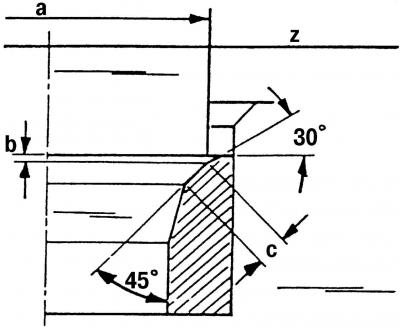
Fig. 116. Valve seats: a - valve seat diameter (see adjustment and control table); b - maximum permissible processing value; c - valve seat width: for intake valve - 2.0 mm, for exhaust valve - 2.4 mm; z - lower edge of the cylinder head; 30° - upper correction angle; 45° - valve seat chamfer angle
- check all valve seats for wear and scratches. On the working chamfers of the seats (valve contact area) there should be no pitting, corrosion or damage. Minor damage can be eliminated by grinding the seats with a cutter at 45°. In this case, remove as little metal as possible. Grinding can be done either manually or with a grinding machine. If the seats are badly worn, they should be milled again. The shape of the valve seat chamfers is shown in (Fig. 116); The angle values are suitable for exhaust and intake valves. The diameter and valve seat values should be taken from the adjustment and control table. This is especially important for intake valves, as they are not the same for some engines;
- to determine the valve seat machining size, take the following measurements:
- insert the valve into its guide bushing and press on the seat (flat head) valves;
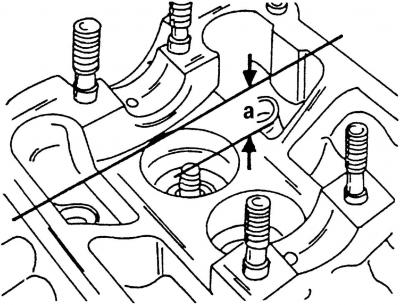
Fig. 117. Measuring the depth when performing additional processing of valve seats. Dimension a is measured between the arrows
- measure the interval a (Fig. 117) between the top of the valve stem and the top edge of the cylinder head. To do this, place a measuring ruler on the plane of the cylinder head;
- calculate the maximum and minimum allowable value of the measured value a after milling. On the intake valves it should be 33.8 mm, on the exhaust valves - 34.1 mm;
- if the minimum distance is subtracted from the measured value, the permissible value b will be obtained (Fig. 116). This is necessary in order not to bore the valve seats in the cylinder head too much. Milling of the valve seats is carried out if new guide bushings have been installed. To do this, you need to:
- lightly mill at an angle of 45°, and then mill at an angle of 30° on the upper edge of the valve seat to reduce the seat width from the valve and bring it to a value of 2.0 mm for intake valves and 2.4 mm for exhaust valves. The machining should be stopped as soon as the valve seat dimensions reach the specified values. The exhaust valve seats have diameter limiters. When machining, be careful not to damage these limiters;
- in order not to bore the valve seats in the cylinder head too much, be sure to calculate the value of b;
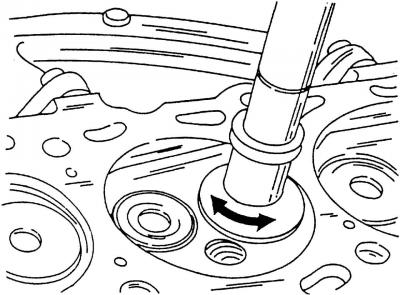
Fig. 118. Grinding the valve using a suction cup. The suction cup should be rotated back and forth in the direction indicated by the arrows
- grind the machined valve seats. To do this, apply a small amount of lapping paste to the valve seat and install the valve in the corresponding seat. Attach a suction cup to the valve and rotate the valve with it back and forth in the direction shown by the arrows (Fig. 118). In order to grind the valve seat well, you need to periodically remove the suction cup, rotate the valves a quarter of a turn, and then continue grinding;
- after lapping, thoroughly clean all parts from dirt and lapping paste;
- check the valve seat where the valve head and sealing ring meet. A continuous, matte ring should be visible on both parts;
- draw a few lines on the ring on the valve head with a pencil. The lines should be drawn around the ring at intervals of approximately 1 mm. After this, carefully insert the valve into the guide sleeve, lower it onto the seat and turn it around 90°, applying a slight force to the valve;
- remove the valve and check if the pencil lines on the sealing ring have disappeared;
- if the valve seat width matches the specified dimensions, the cylinder head can be installed. Otherwise, the valve seats must be re-treated or, as a last resort, a new cylinder head must be installed.
Valves
Everything that is written about the VR6 engine valves (see p. 2.3.3), is also true for the 2.0 L engine. Valve sizes are shown in the adjustment and control table.
Cylinder head
Wash the cylinder head thoroughly and clean the oil passages. Remove carbon deposits from the combustion chambers and the surface of the exhaust passages with a wire brush. Clean the contact surfaces of the cylinder head and cylinder block thoroughly. Inspect the cylinder head. There should be no scoring or damage on the bearings under the camshaft journals and in the holes under the valve tappets. Cracks in any places of the cylinder head are not allowed.
[The original article is available on the website: vwmanual]
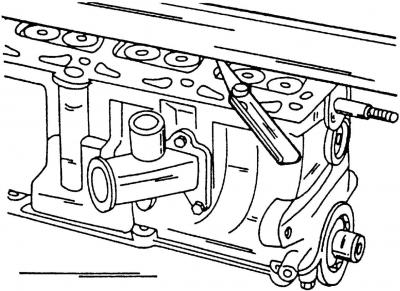
Fig. 119. Checking the cylinder head for deformation using a measuring ruler and feeler gauge
Check the cylinder head surface for deformation (Fig. 119).
To do this, place a measuring ruler on the cylinder head and use a measuring probe to check the gap lengthwise, crosswise and diagonally. If it does not exceed 0.10 mm, the cylinder head can be ground. If the gap is larger in any place, the cylinder head should be replaced, since removing a larger layer of metal can negatively affect engine compression.
The cylinder head can be ground as long as its minimum height a (Fig. 114) is not less than 132.60 mm.
Camshaft
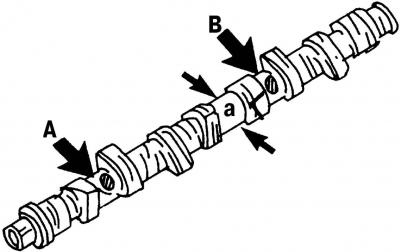
Fig. 120. Marking locations on the camshaft. Letters and numbers are stamped in the locations shown by the arrows
The camshaft of the ADY engine is marked in a specific way. In the place indicated by the arrow A (Fig. 120) the letter (B) is stamped, in place B - the number (037). Since the camshafts for other types of engines have different markings, it is recommended to take the old camshaft with you when buying a new one.
The cam diameter a (Fig. 120) on engines of this design series is reduced to 34.0 mm.
When inspecting the camshafts, pay attention to the surfaces of the bearing journals (bearing locations), cams, which must be well polished and undamaged. If signs of seizure or deep scratches are found, the camshaft must be replaced. Before installing the camshafts, perform the following operations:
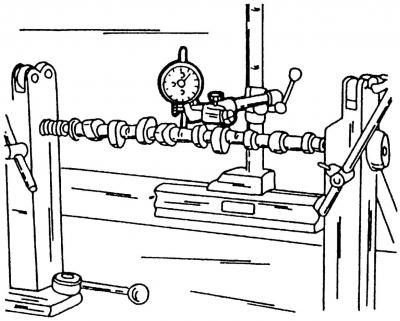
Fig. 47. Measuring the radial runout of the camshaft
- install the camshaft with its outer journals on two prisms, or clamp it between the clamps of a lathe and install a measuring device (Fig. 47) in the place of the middle bearing (journal) of the camshaft;
- slowly rotate the camshaft and monitor the readings of the measuring device. If the radial runout exceeds 0.01 mm, the camshaft must be replaced, as it is deformed;
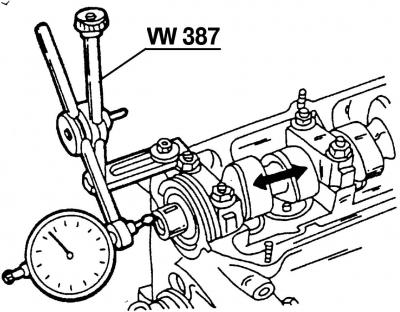
Fig. 121. Measuring the axial clearance of the camshaft
- to measure the axial clearance of the camshaft, insert it into the cylinder head (without pushers), secure with the outer bearings and install the cylinder head on a flat surface. Install the VW387 measuring device (Fig. 121) on the end of the cylinder head and rock the shaft back and forth in the longitudinal direction (in Fig. 121 it is shown by arrows).
The axial clearance should not exceed 0.15 mm. Otherwise, the working surface of the bearing cap is worn out.
Visitor comments