



Before carrying out these works, the following recommendations should be observed:
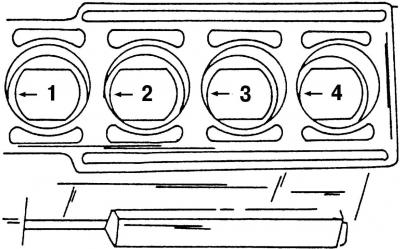
Fig. 130. Marking the piston bottoms before removing them
- apply marking (preferably in color) for each piston and its connecting rod. It is necessary to indicate the number of the cylinder from which the piston and connecting rod were removed. It is best to mark the cylinder number on the piston and an arrow indicating the direction towards the front of the engine on the bottom of the piston (Fig. 130);
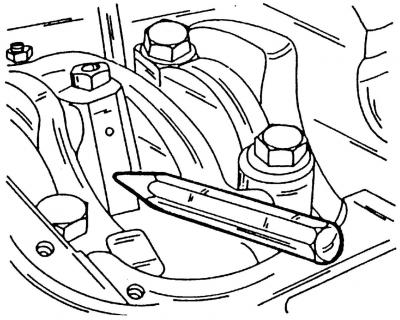
Fig. 55. Marking of the connecting rod and connecting rod bearing cap
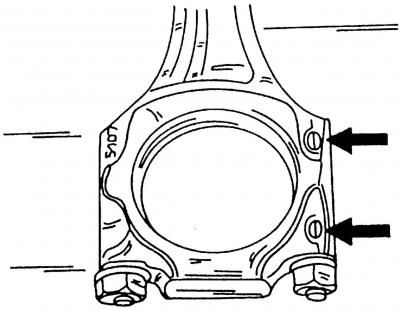
Fig. 56. Connecting rod and connecting rod bearing cap assembly. Arrows indicate protrusions
- immediately after removal, mark the cylinder number on the connecting rod and the connecting rod bearing cap on the side (Fig. 55). It is best to do this with a center punch (for example, for cylinder No.1 - one blow with a center punch, etc.). The connecting rod and connecting rod cap must be assembled in such a way that both cast projections are located opposite each other (Fig. 56);
Caution! Both cast projections after connecting rod installation must always be located on the crankshaft pulley side.
- mark the bearing shells according to the connecting rod and connecting rod cap. Also color code the upper and lower bearing shells on their back side;
- if the pistons need to be replaced, measure the length of the piston pin immediately after disassembly. Experience shows that this dimension may be different on new pistons, so it is essential to select pistons with pins of exactly the same length as the old piston pins;
- when ordering new pistons, please specify the vehicle model and year of manufacture;
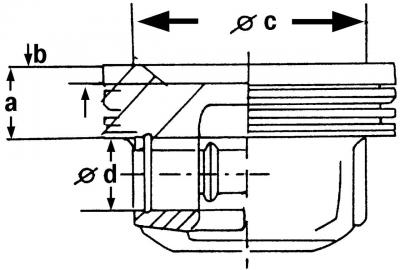
Fig. 131. Sectional view of the piston: a = 21.3 mm; b = 5.0 mm; c = 62.9 mm; d = 21.0 mm
- the geometric dimensions of the pistons differ from each other, so if you install a piston, for example, from an old engine, you should measure the value b (Fig. 131), which differs depending on the engine. The pistons being installed must have the same value b. Different pistons also have differences in the value a;
- the piston diameters are presented in the adjustment and control table.
Remove the pistons in the following order:
- remove the connecting rod caps and liners and knock out the parts. If necessary, scrape off any oil deposits on the top of the cylinder with a scraper. To do this, turn the crankshaft slightly to lower the piston deeper into the cylinder bore. Be careful not to scratch the cylinder with the scraper;
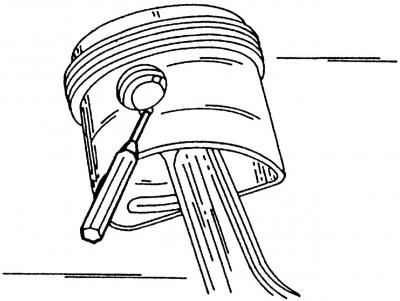
Fig. 57. Removing the piston pin spring retaining ring
- using a sharp object or a small punch (Fig. 57), remove the snap rings located on each side of the piston pin. The notch in the piston pin bore makes it easier to use the punch;
- use a drift to knock out the piston pin. When striking, make sure that the drift does not jump out and hit the piston;
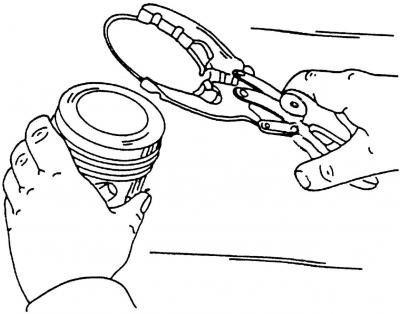
Fig. 58. Removing the piston ring using a puller
- mark the piston rings (if they are installed again) and remove them through the piston bottom using a puller (Fig. 58). First, remove the upper piston ring;
Caution! Never squeeze the piston rings too much.
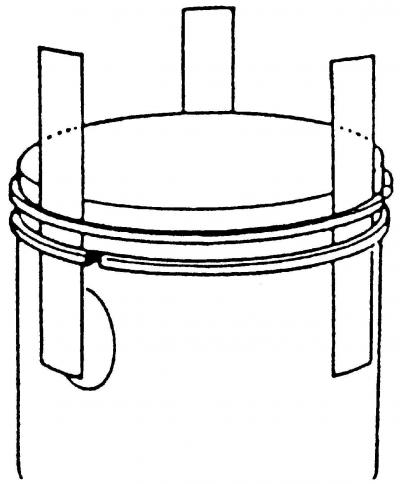
Fig. 59. Removing the piston ring using metal strips
(The original text can be found at: VWMANUAL.ru)
- if you don't have a piston ring puller, you can insert metal strips opposite each other under the piston rings (Fig. 59). Place one of the metal strips under the piston ring lock to avoid scratches on the piston surface;
Note: Use a small screwdriver to carefully pry the piston rings out of the piston grooves as they break very easily.
- remove the piston rings and attach tags with the cylinder number to them. When inspecting the piston rings, make sure that there is an "Oben" or "Top" mark on one side. When installing the piston rings, this inscription should be visible from the piston bottom side.
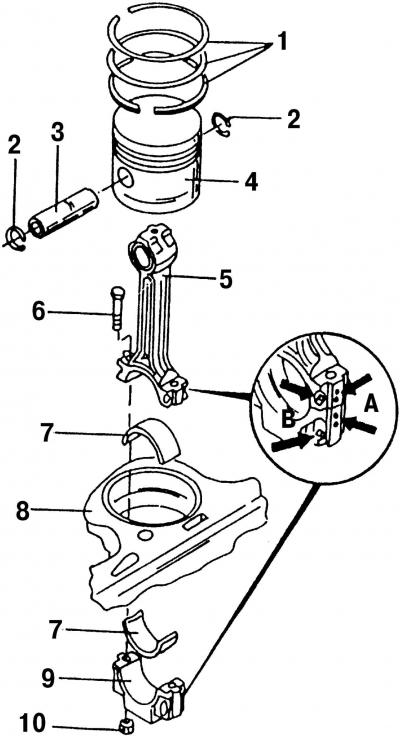
Fig. 132. Parts of the connecting rod and piston group: 1 - piston rings; 2 - retaining ring; 3 - piston pin; 4 - piston; 5 - connecting rod; 6 - connecting rod mounting bolt; 7 - connecting rod bearing shell; 8 - cylinder block; 9 - connecting rod bearing cap; 10 - connecting rod nut; A - marks on the connecting rod and cover; B - position of cast projections
The parts of the engine connecting rod and piston group are shown in Fig. 132. Particular attention should be paid to the places marked with letters A and B, which indicate important points regarding the location and orientation of the parts of the connecting rod and piston group.
Visitor comments