



- generously lubricate the valve stems with engine oil and insert them into the corresponding guide bushings;
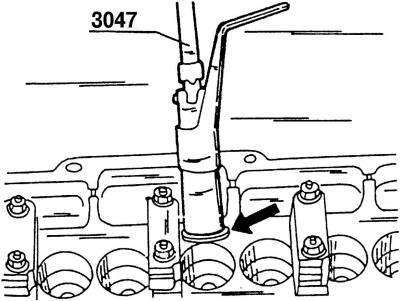
Fig. 112. Removing the lower valve spring plate using special pliers 3047
- using special pliers 3047 (Fig. 112) install the lower valve plates;
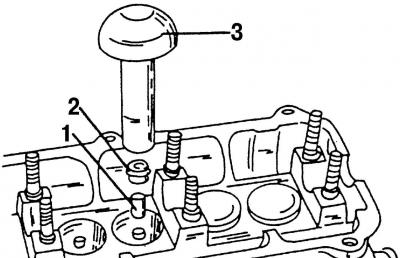
Fig. 122. Installing the oil deflector cap: 1 - plastic sleeve; 2 - oil deflector cap; 3 - special tool 3129
- using special tool 3 (Fig. 122), install oil deflector caps 2, for which:
- place the plastic sleeve 1 using special tool 3129 onto the protruding part of the valve guide sleeve;
- lubricate the oil deflector cap 2 well with engine oil and place it on the plastic sleeve;
- place special tool 3129 on the valve stem seal and carefully push it into the guide sleeve;
Note: Installing the valve stem seals without using special tool 3129 may damage them, resulting in increased oil consumption.
- after lapping the valves, each valve must be installed in the seat to which it was lapped;
- install one inner and one outer spring for the corresponding valve into the cylinder head holes (if old springs are installed);
The original can be seen on the portal: vwmanual
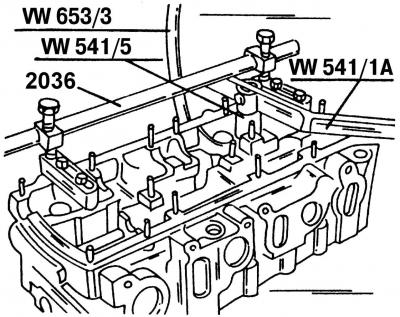
Fig. 36. Removing valves using a special device from the company "Volkswagen"
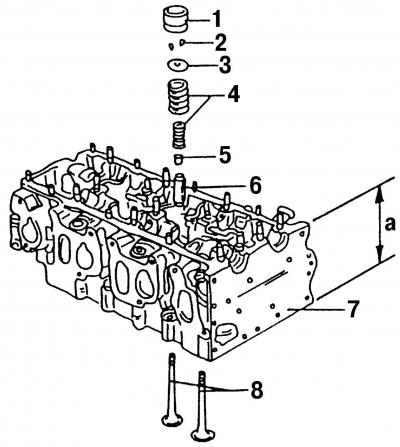
Fig. 37. Valve drive mechanism parts: 1 - hydraulic pusher; 2 - valve stem halves (crackers); 3 - upper valve spring plate; 4 - valve springs; 5 - oil deflector cap; 6 - valve guide bushing; 7 - cylinder head; 8 - valves; a - cylinder head height
- put on the upper valve spring plate. Install the valve puller (Fig. 36) to compress the springs. If the end of the valve stem protrudes from the upper valve spring plate, then you need to install both halves of the valve stem (crackers) 2 (Fig. 37) in the cylindrical grooves of the stem and smoothly press on the valve puller;
- hit the top of the valve stem with a plastic hammer. This will cause the incorrectly installed crackers to fly out of the cylindrical groove;
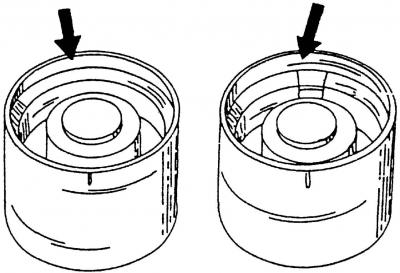
Fig. 109. Marking of hydraulic tappets
- insert the hydraulic tappets into the holes in accordance with the previously applied marks (Fig. 109) (after lubricating them with motor oil);
Note: Before final installation of the tappets, read the instructions regarding hydraulic tappets (see p. 3.3.6), to avoid damage to the engine when it is started for the first time after the work has been carried out.
- generously lubricate the journals with engine oil (bearing locations) camshaft;
- place the camshaft in the cylinder head supports and rotate them several times. Install the camshaft so that both cams of the first cylinder on the shaft are facing upwards;
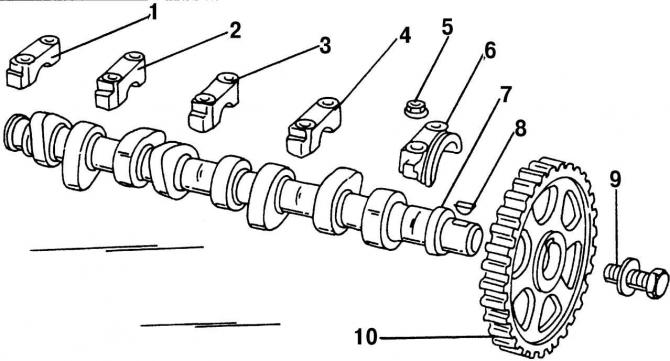
Fig. 108. Camshaft parts: 1 - bearing cover No.5; 2 - bearing cover No.4; 3 - bearing cover No.3; 4 - bearing cover No.2; 5 - nut, 20 Nm; 6 - bearing cover No.1; 7 - camshaft; 8 - segment key; 9 - bolt with washer, 80 Nm; 10 - camshaft gear wheel
- put on bearing caps No.2 and 4 (Fig. 108) and tighten the nuts by hand;
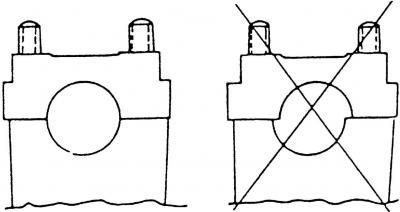
Fig. 123. Installing the camshaft bearing cap on the cylinder head
- check that the bearing caps are correctly installed as shown in Fig. 123, and only then tighten the fastening nuts alternately crosswise in several steps and tighten them to a torque of 20 N·m. Due to the uniform tightening, the valve springs will be slowly compressed, and thus it will be possible to avoid skewing of the camshaft;
- install bearing caps No.5, 1 and 3 in the same manner;
- turn the camshaft several times to make sure it is not jammed anywhere;
- when installing the seal, lubricate the sealing surface with engine oil (the rolling surface of the camshaft should also be lubricated) and make sure that the side of the seal where the spring is located is facing the inside of the cylinder head. To install the seal, you can use a pipe that should completely match the size of the outer part of the seal. Put the seal straight (without distortions) and press it in until its outer surface goes completely in. The seal can be installed in the manner described in paragraph 3.6.4 for the new front crankshaft seal;
- install the intake and exhaust manifolds onto the cylinder head (be sure to use new gaskets when doing this).
Visitor comments