



Gasoline engine 2.8L (AAA) car Volkswagen Sharan 1

VR6 Engine — Design Description
Fig. 15. Schematic representation of three types of six-cylinder engines used in the automotive industry: a — V-shaped 6-cylinder engine; b — VR6 engine; c — in-line engine This...
Fig. 15. Schematic representation of three types of six-cylinder engines used in the automotive industry: a — V-shaped 6-cylinder engine; b — VR6 engine; c — in-line engine This...

Removal and installation the engine
The power unit consists of an engine and a gearbox. It is removed using a hydraulic lift or hoist, lowering it from the engine compartment. Before removing the power unit, do the...
The power unit consists of an engine and a gearbox. It is removed using a hydraulic lift or hoist, lowering it from the engine compartment. Before removing the power unit, do the...

Removal and installation the gearbox from the engine
Removing the gearbox from the engine (with the power unit removed) proceed as follows: unscrew the bolts securing the gearbox to the engine; with the help of an assistant,...
Removing the gearbox from the engine (with the power unit removed) proceed as follows: unscrew the bolts securing the gearbox to the engine; with the help of an assistant,...
Additional operations on a car with air conditioning
Caution! Never open the cooling circuit, as contact with the skin may cause frostbite. This work may only be carried out by specially trained personnel using special devices. Only...
Caution! Never open the cooling circuit, as contact with the skin may cause frostbite. This work may only be carried out by specially trained personnel using special devices. Only...

Engine mount
When replacing the engine mount, use Fig. 23-25. The engine should be jacked up to relieve the individual suspension elements. Always observe the tightening torques of the engine...
When replacing the engine mount, use Fig. 23-25. The engine should be jacked up to relieve the individual suspension elements. Always observe the tightening torques of the engine...
General recommendations for engine disassembly and assembly
Before starting disassembly, thoroughly wash the engine outside. When disassembling, mark the location of removable parts and components so that when reassembling, they can be...
Before starting disassembly, thoroughly wash the engine outside. When disassembling, mark the location of removable parts and components so that when reassembling, they can be...

Removal the cylinder head
Fig. 26. Details of the upper part of the cylinder head: 1 - bolts (5 Nm); 2 - central cover (above the top of the intake manifold); 3 - bolts (25 Nm); 4 - Spark plug wire...
Fig. 26. Details of the upper part of the cylinder head: 1 - bolts (5 Nm); 2 - central cover (above the top of the intake manifold); 3 - bolts (25 Nm); 4 - Spark plug wire...

Disassembling the cylinder head
Disassemble the cylinder head in the following order: Fig. 28. Partially disassembled cylinder head (the parts located on the top of the head were removed): 1 - bolt, 25 Nm; 2 -...
Disassemble the cylinder head in the following order: Fig. 28. Partially disassembled cylinder head (the parts located on the top of the head were removed): 1 - bolt, 25 Nm; 2 -...

Cylinder head repair
Valve springs and valve guides To fully check the valve springs, you should use a special spring testing tool. If you don't have one, then install the springs in a row on a smooth...
Valve springs and valve guides To fully check the valve springs, you should use a special spring testing tool. If you don't have one, then install the springs in a row on a smooth...

Cylinder head assembly
Assemble the cylinder head in the reverse order of disassembly, observing the following recommendations: generously lubricate the valve stems with engine oil and insert them into...
Assemble the cylinder head in the reverse order of disassembly, observing the following recommendations: generously lubricate the valve stems with engine oil and insert them into...

Installing the cylinder head
Place the cylinder head gasket so that the "Oben" or "Top" lettering is visible on top. Always install a new gasket; to ensure the correct positioning of the gasket, two guides...
Place the cylinder head gasket so that the "Oben" or "Top" lettering is visible on top. Always install a new gasket; to ensure the correct positioning of the gasket, two guides...

Hydraulic tappet — removal and installation
Please follow these guidelines: after removal, hydraulic tappets should be installed with the contact surface facing down on a clean surface; always replace the tappets...
Please follow these guidelines: after removal, hydraulic tappets should be installed with the contact surface facing down on a clean surface; always replace the tappets...

Removal pistons and connecting rods
The pistons and connecting rods are knocked out of the cylinder block in an upward direction using a hammer handle, after removing the caps and connecting rod bearing liners....
The pistons and connecting rods are knocked out of the cylinder block in an upward direction using a hammer handle, after removing the caps and connecting rod bearing liners....
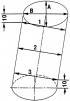
Measuring the inner diameter of a cylinder
Fig. 60. Diagram of measuring the inner diameter of the cylinder: 1, 2 and 3 - upper, middle and lower belts of the cylinder; A, B - transverse and longitudinal directions of...
Fig. 60. Diagram of measuring the inner diameter of the cylinder: 1, 2 and 3 - upper, middle and lower belts of the cylinder; A, B - transverse and longitudinal directions of...

Checking pistons and connecting rods
Clean the piston from carbon deposits and remove all deposits from the piston and connecting rod lubrication channels. Carefully inspect all parts. Cracks of any kind on the...
Clean the piston from carbon deposits and remove all deposits from the piston and connecting rod lubrication channels. Carefully inspect all parts. Cracks of any kind on the...

Assembly of pistons and connecting rods
To correctly assemble the connecting rod with the piston and install it in the engine in the proper position, use the previously applied markings. If the pistons were replaced,...
To correctly assemble the connecting rod with the piston and install it in the engine in the proper position, use the previously applied markings. If the pistons were replaced,...
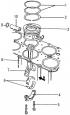
Installing pistons and connecting rods
Install the pistons and connecting rods in the following order: generously lubricate the inner surfaces of the cylinders with engine oil; Fig. 63. Piston group parts: 1 -...
Install the pistons and connecting rods in the following order: generously lubricate the inner surfaces of the cylinders with engine oil; Fig. 63. Piston group parts: 1 -...

Cylinder Block — Check
Fig. 69. Cylinder block with parts installed on it: 1 - bolt, 25 Nm; 2 - cooling pump pulley; 3 - bolt, 20 Nm; 4 - cooling system pump; 5 - O-ring, always replace with a new one;...
Fig. 69. Cylinder block with parts installed on it: 1 - bolt, 25 Nm; 2 - cooling pump pulley; 3 - bolt, 20 Nm; 4 - cooling system pump; 5 - O-ring, always replace with a new one;...

Removal the crankshaft
To remove the crankshaft, the engine must be removed from the vehicle. Since the engine must be completely disassembled, follow these guidelines for complete engine disassembly:...
To remove the crankshaft, the engine must be removed from the vehicle. Since the engine must be completely disassembled, follow these guidelines for complete engine disassembly:...

Checking the crankshaft
Check the crankshaft by performing the following operations: inspect the crankshaft. Cracks in any place of the crankshaft are not allowed. Scratches, nicks and marks are not...
Check the crankshaft by performing the following operations: inspect the crankshaft. Cracks in any place of the crankshaft are not allowed. Scratches, nicks and marks are not...

Installing the crankshaft
The crankshaft installation should be carried out in the following order: Fig. 82. Elements of the crankshaft and main bearings: 1 - bearing cap bolt; 2 - main bearing caps (main...
The crankshaft installation should be carried out in the following order: Fig. 82. Elements of the crankshaft and main bearings: 1 - bearing cap bolt; 2 - main bearing caps (main...

Crankshaft seals
Fig. 85. Elements of the rear side of the engine: 1 - oil seal cover; 2 - bolt, 25 Nm; 3 - bolt, 10 Nm; 4 - oil seal; 5 - flywheel; 6 - flywheel mounting bolt; 7 - driven clutch...
Fig. 85. Elements of the rear side of the engine: 1 - oil seal cover; 2 - bolt, 25 Nm; 3 - bolt, 10 Nm; 4 - oil seal; 5 - flywheel; 6 - flywheel mounting bolt; 7 - driven clutch...
Flywheel — removal and installation
To remove the flywheel from the crankshaft, lock it with a locking device in a stationary position and unscrew the flywheel mounting bolts, which can be immediately discarded,...
To remove the flywheel from the crankshaft, lock it with a locking device in a stationary position and unscrew the flywheel mounting bolts, which can be immediately discarded,...

Timing drive mechanism — design description
Fig. 91. Elements of the valve timing drive: 1 - intermediate shaft; 2 - leading ring; 3 - bolt, 10 Nm; 4 - sensor drive; 5 - bolt, 10 Nm; 6 - bolt, 25 Nm; 7 - elastic element of...
Fig. 91. Elements of the valve timing drive: 1 - intermediate shaft; 2 - leading ring; 3 - bolt, 10 Nm; 4 - sensor drive; 5 - bolt, 10 Nm; 6 - bolt, 25 Nm; 7 - elastic element of...

Removal the timing drive components
Fig. 16. VR6 engine camshaft drive Fig. 91. Elements of the valve timing drive: 1 - intermediate shaft; 2 - leading ring; 3 - bolt, 10 Nm; 4 - sensor drive; 5 - bolt, 10 Nm; 6 -...
Fig. 16. VR6 engine camshaft drive Fig. 91. Elements of the valve timing drive: 1 - intermediate shaft; 2 - leading ring; 3 - bolt, 10 Nm; 4 - sensor drive; 5 - bolt, 10 Nm; 6 -...

Installing the timing drive
Fig. 92. Marking locations of camshaft drive chains (shown by arrows) If the cylinder head has not been removed, the timing chains are marked (Fig. 92) and none of the camshafts...
Fig. 92. Marking locations of camshaft drive chains (shown by arrows) If the cylinder head has not been removed, the timing chains are marked (Fig. 92) and none of the camshafts...

Intermediate shaft — removal and installation
Fig. 69. Cylinder block with parts installed on it: 1 - bolt, 25 Nm; 2 - cooling pump pulley; 3 - bolt, 20 Nm; 4 - cooling system pump; 5 - O-ring, always replace with a new one;...
Fig. 69. Cylinder block with parts installed on it: 1 - bolt, 25 Nm; 2 - cooling pump pulley; 3 - bolt, 20 Nm; 4 - cooling system pump; 5 - O-ring, always replace with a new one;...
Checking the compression in the engine cylinders
To check if the valves are tightly fitted, if the piston rings are worn out, if there are no other malfunctions in the cylinders, measure the compression in the engine cylinders....
To check if the valves are tightly fitted, if the piston rings are worn out, if there are no other malfunctions in the cylinders, measure the compression in the engine cylinders....

Additional air supply system
This system forces air behind the exhaust valves for 65 seconds at an engine coolant temperature between 15° and 35°C. As a result, oxygen-rich exhaust gases leave the engine,...
This system forces air behind the exhaust valves for 65 seconds at an engine coolant temperature between 15° and 35°C. As a result, oxygen-rich exhaust gases leave the engine,...

Removal and installation the exhaust manifold
Fig. 100. Elements of the front part of the exhaust system: 1 - Engine thermal protection screen; 2 - two-piece exhaust manifold; 3 - lifting eye; 4 - nut, 40 Nm; 5 - Engine...
Fig. 100. Elements of the front part of the exhaust system: 1 - Engine thermal protection screen; 2 - two-piece exhaust manifold; 3 - lifting eye; 4 - nut, 40 Nm; 5 - Engine...

Removal and installation of the exhaust system
The service life of the exhaust system generally depends on the conditions in which the vehicle is operated. Frequent short-distance trips result in a significant amount of...
The service life of the exhaust system generally depends on the conditions in which the vehicle is operated. Frequent short-distance trips result in a significant amount of...
This section is available on russian, bulgarian, belarusian, ukrainian, serbian, croatian, romanian, polish, slovak, hungarian
Sharan 1
- General information
- Introduction to guide
- Maintenance
- Petrol engines
- Engine repair 2.8 l (AAA)
- Engine repair 2.0 l (ADY)
- Lubrication system
- Cooling system
- Fuel injection system
- Ignition system
- Diesel engines
- Engine repair
- Lubrication system
- Cooling system
- Supply system
- Transmission
- Clutch
- Manual gearbox and shafts
- Chassis
- Steering
- Car suspension
- Brake system
- Electrical equipment
- Equipment and devices
- Power devices
- Electrical circuits