



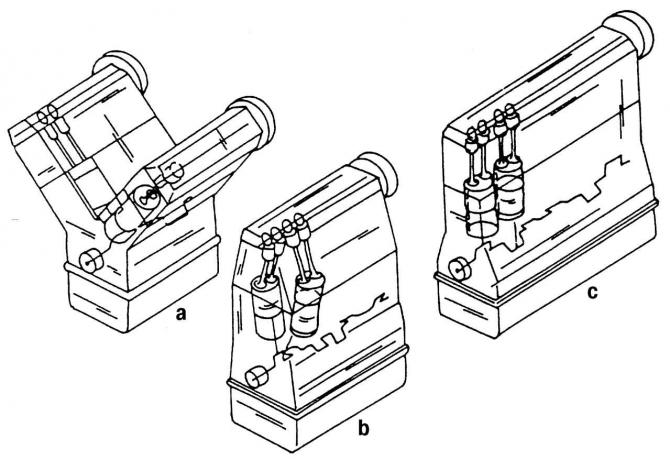
Pic. 15. Schematic representation of three types of six-cylinder engines used in the automotive industry: a - V-shaped 6-cylinder engine; b - VR6 engine; c - in-line engine
This section discusses the 6-cylinder engine, first installed in the Volkswagen Passat in 1991 under the name VR6, which differs significantly from the usual engine design concept «Volkswagen» or «Audi». The company's engine «Volkswagen» received the name «AAA», but it is better known as VR6. Its six cylinders are arranged in a 15°V-shape as opposed to traditional 60°or 90°V-engines. The VR6 engine became so compact that it allowed both banks of cylinders to be covered by one common head, unlike a conventional V-twin engine. The result is a VR6 engine that is shorter in length than an in-line engine and narrower in width than a conventional V-6 engine. On (pic. 15) three types of 6-cylinder engines are shown schematically, and it is clear from which the VR6 engine was developed.
With such an acute angle of the cylinders (15°) problems with uneven rotation of the crankshaft of the VR6 engine do not arise, it runs as smoothly as in-line. The engine has two camshafts that operate twelve vertically arranged valves (2 per cylinder). Both overhead camshafts are housed in an aluminum cylinder head. The camshaft for cylinders 1, 3 and 5 is mounted on four bearings, and the camshaft for cylinders 2, 4 and 6 is mounted on three bearings. The surface of the cylinder head at the place of installation of the sealing gasket is ground. The combustion chambers are angled to fit the V-shaped design of the engine.
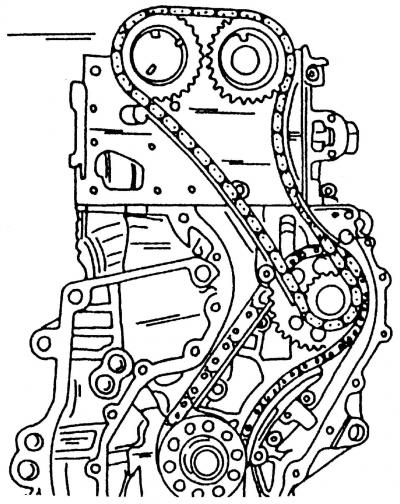
Pic. 16. Camshaft drive of the VR6 engine
Forged crankshaft rotates on seven main bearings and is equipped with twelve counterweights and one torsional vibration damper, which allows it to rotate without radial runout. The connecting rod journals of the crankshaft for each row of cylinders are offset by 22°. Relatively long cranks (164 mm) connect the crankshaft to light weight pistons having two compression piston rings and one oil flinger ring. Most developed in recent years by the company «Volkswagen» engines, the camshaft is driven by a toothed belt. However, in the VR6 engine, the two camshafts are driven by one common two-row chain (pic. 16), which is driven from the intermediate shaft sprocket connected by a single-row chain to the crankshaft gear.
Two tensioners with shoes (unattended) provide the required tension of the chains, and poppet-shaped self-adjusting hydraulic tappets actuate the valves. The design of the drive mechanism made it possible to make the cylinder head more compact.
During the design, special attention was paid to the supply of the air-fuel mixture, since two rows of cylinders had to be provided with a combustible mixture in one cylinder head. The engine was designed with cross scavenging - the intake ports are located on one side and the exhaust ports on the other side, and the combustible mixture in it had to enter 3 cylinders on each side of the engine simultaneously, and the intake pipes had to be of equal length.
To solve this problem, the air intake housing was installed on top of the cylinder head, from which a separate intake pipe goes to each cylinder. Three pipes go directly to the cylinders at the front of the engine, while the other three pipes run above the engine and connect to the cylinders at the rear of the engine. Each intake pipe is equipped with a nozzle, and the spark plugs are located on the outside of the cylinders.
Despite the fact that the designers have tried to make the intake pipes as equal in length as possible, there is still a difference in the speed of compression between the two banks of cylinders. However, this difference is reduced to nothing, thanks to the company's «Bosch» fuel injection system «Motronic», which regulates the mode of operation of injection and ignition, depending on the load on the engine and its operating conditions. Electronic control unit (ECU) determines the amount of fuel injected into the cylinders and the exact ignition timing, thanks to the information received in the form of electrical signals from sensors, namely: data on temperature, position and speed of the crankshaft, air flow entering the engine, compression ratio, advance angle. injection system «Motronic» equipped with a knock sensor in each bank of cylinders, which allows the ECU to precisely match the injection and ignition control for the cylinders in each bank and synchronize the compression timings accordingly.
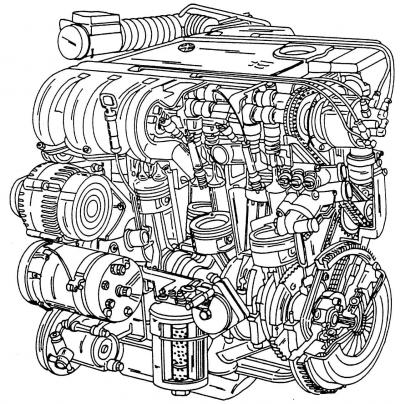
Pic. 17. General view of the VR6 engine assembly
Today for «Volkswagen» it is almost common to install a catalytic converter and an oxygen sensor in your cars that provide feedback. The sensor monitors the oxygen concentration in the exhaust gases, and the ECU, using its signals, maintains the air / fuel ratio that ensures the most efficient operation of the converter. A general view of the VR6 engine assembly is shown on (pic. 17).
Attention! Unleaded gasoline with an octane rating of at least 95 must be used to provide the engine with a good air-fuel mixture under other normal conditions.
Visitor comments