



Since the engine must be completely disassembled, follow these guidelines for complete engine disassembly:
- remove the gearbox from the engine;
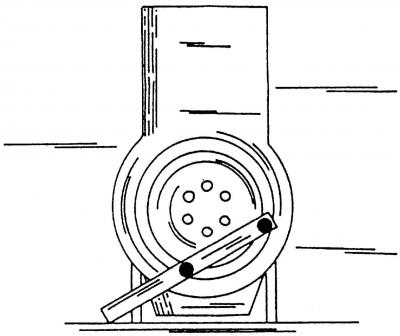
Fig. 70. Locking the flywheel with a locking device
- on a car with a manual transmission, use a screwdriver inserted into the flywheel ring gear to fix the flywheel in a stationary position and unscrew the flywheel mounting bolts. To securely lock the flywheel, you can use a lock (Fig. 70), then unscrew the flywheel bolts;
- before removing the flywheel, use a center punch to mark the relative positions of the pressure plate and flywheel to avoid errors during installation;
- unscrew the crankshaft pulley bolt from the front of the engine;
- on a vehicle with an automatic transmission, remove the drive pulley.
- remove the cylinder head (see p. 3.3.1) together with the intake and exhaust manifolds;
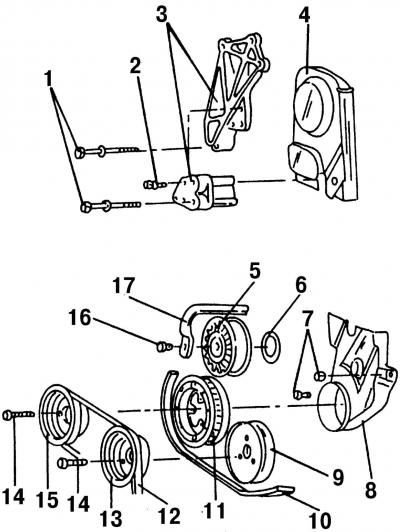
Fig. 106. Timing mechanism drive parts: 1 - bolts, 55 Nm; 2 - bolt, 20 Nm; 3 - engine mount clamp; 4 - upper part of the protective cover; 5 - tensioner roller; 6 - dust cap; 7 - bolts, 10 Nm; 8 - lower part of the protective cover; 9 - Cooling system pump drive pulley; 10 - poly V-belt; 11 - flywheel; 12 - V-belt; 13 - Cooling system pump pulley; 14 - bolt, 25 Nm; 15 - crankshaft pulley; 16 - bolt, 25 Nm; 17 - V-belt tensioner lever
- unscrew the mounting bolt 14 (Fig. 106) and remove the pulley 13 of the coolant pump and the lower protective cover 8 of the toothed drive belt;
- mark (preferably in color) on the outside of the toothed drive belt its direction of rotation;
- loosen the belt tensioner nuts and remove the toothed drive belt from the pulleys and from the tensioner;
(The original text is available on the website: VWmanual)
Caution! After removing the toothed drive belt, the camshaft must not be turned.
- unscrew the mounting bolts and remove the oil pan (see subsection 4.1);
- remove the oil pump (see p. 4.2.1);
- if you only need to remove the crankshaft, the pistons and connecting rods may remain inside the cylinder block. In this case, mark and remove the connecting rod bearing caps one by one and leave them assembled with the liners. Otherwise, remove the pistons and connecting rods (see p. 2.4.1). Remember that used "flexible screws" should always be replaced;
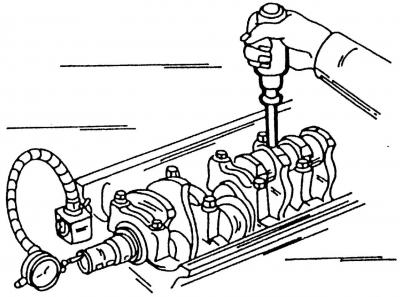
Fig. 80. Checking the axial free play of the crankshaft using a measuring device
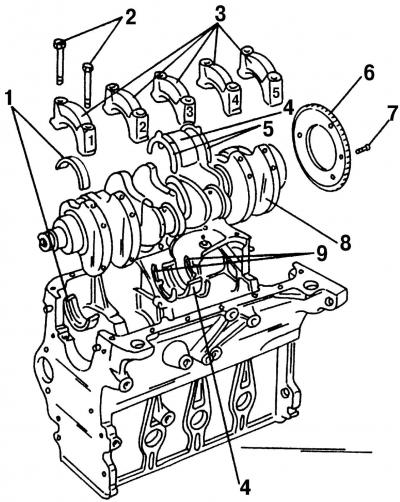
Fig. 104. Cylinder block in disassembled state: 1 - bearing shell No.1, 2, 4 and 5; 2 - cover bolts; 3 - bearing caps; 4 - bearing shell No.3; 5 - thrust half ring on the bearing cover; 6 - toothed rim of the crankshaft speed sensor; 7 - bolt, 10 Nm (tighten another 90°); 8 - crankshaft; 9 - cylinder block thrust half rings
- measure the axial free play of the crankshaft. To do this, install a stand with an indicator on the front part of the cylinder block so that the indicator leg rests against the flange of the front end of the crankshaft (Fig. 80). Use a screwdriver to move the crankshaft to the side and set the device to zero, then move the shaft to the other side. The device arrow will show the axial free play of the shaft, which should be no more than 0.25 mm. If the play is greater, this should be taken into account during assembly and brought to normal by replacing the old half rings with new ones or installing half rings of increased thickness. Liners 4 (Fig. 104) of bearing No.3 have two upper 5 and two lower 9 thrust half rings, which regulate the axial free play of the crankshaft;
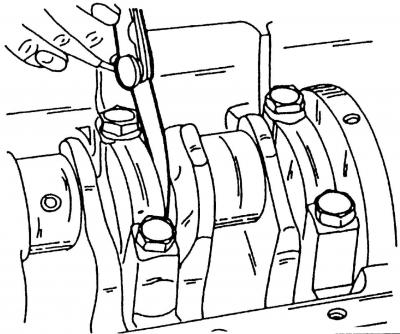
Fig. 81. Measuring the axial free play of the crankshaft with a feeler gauge
- if there is no measuring device, the axial free play can be measured using a feeler gauge (Fig. 81), on the middle bearing, between the connecting rod bearing flange, where the thrust half rings are located, and the surface of the crankshaft;
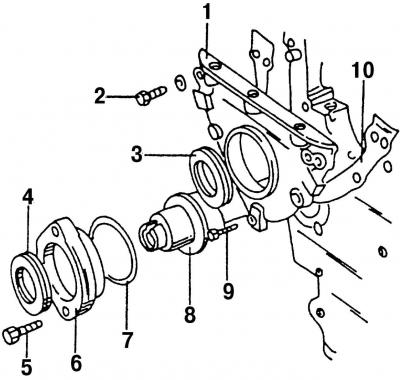
Fig. 136. Individual elements of the front part of the cylinder block: 1 - oil seal cover; 2 - bolt, 20 Nm; 3 - front crankshaft oil seal; 4 - intermediate shaft seal; 5 - bolt, 25 Nm; 6 - intermediate shaft oil seal cover; 7 - O-ring; 8 - intermediate shaft; 9 - bolt, 10 Nm; 10 - gasket
- unscrew the bolts 2 (Fig. 136) of the fastening and remove the cover 1 at the front of the engine. There is a sealing ring in the flange, which should be knocked out immediately, as it needs to be replaced;
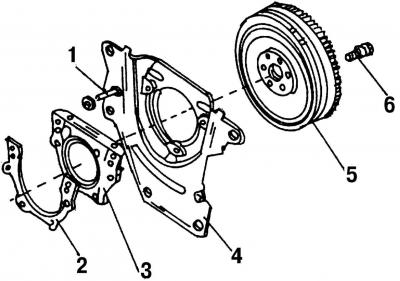
Fig. 137. Individual elements of the rear part of the cylinder block: 1 - mounting pin; 2 - gasket; 3 - lid; 4 - engine intermediate plate; 5 - flywheel; 6 - bolt, 60 Nm (tighten another 90°), always replaceable
- remove the intermediate plate 4 (Fig. 137) of the engine. The plate is guided by the mounting pins;
- unscrew the flange cover bolts and remove the flange with the sealing ring. The sealing ring can be knocked out immediately, as it should always be changed;
- gradually unscrew bolts 2 (Fig. 104) of the covers 3 of the crankshaft 8 bearings crosswise and remove them one by one. Check that the covers are marked with the corresponding numbers. Number the bearing covers from the side of the engine accessory drive pulley;
- remove the main journal bearing shells and place them together with the corresponding bearing caps. The lower crankshaft bearing shells do not have a groove on the inner surface. No adjustment operations should be performed on them. If there are any scoring, scratches or delamination, replace the shells with new ones;
- mark it (preferably in color) the back sides of each insert;
- remove the two upper thrust half rings 5 from the middle bearing of the crankshaft (Fig. 104). They should also be marked so that they are installed correctly during assembly;
- remove the crankshaft from the bearing seats;
- remove the remaining liners from the engine crankcase and place them with the other liners and covers;
- remove the lower thrust half rings 9 from the middle bearing.
Visitor comments