



- Clean the ring grooves and rings from carbon deposits.
- Measure the gap between the piston rings and the ring grooves as shown in Figure 73. If the gap measured with a feeler gauge exceeds 0.15 mm, the ring or piston is considered worn. The normal gap value is 0.02-0.05 mm.
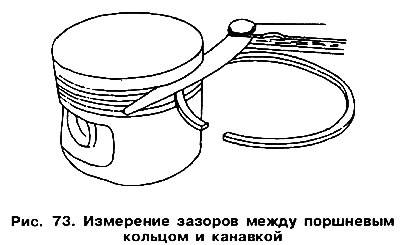
Take a set of new piston rings and measure the gap in the groove again. If the gap exceeds 0.05 mm, replace the pistons. If the gap does not exceed 0.02-0.05 mm, use new rings. In addition to this gap, it is necessary to measure the gap in the piston ring lock using the method described below:
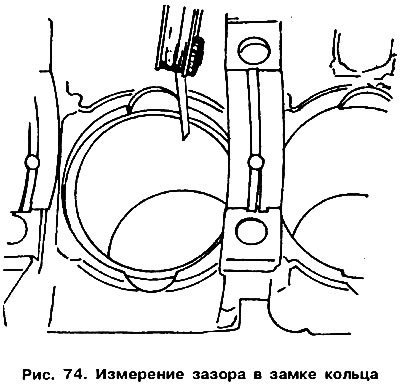
- Insert all rings one by one into the cylinders from the crankcase side and push them 15 mm deep with the piston bottom. This will ensure correct installation of the ring.
- Insert a feeler gauge into the gap between the ends of the ring, thus determining the gap in the lock (figure 74). For compression rings, the gap in the lock should be 0.3-0.5 mm, and for oil scraper rings 0.25-0.4 mm. The maximum permissible gap in the lock is 1 mm for all rings.
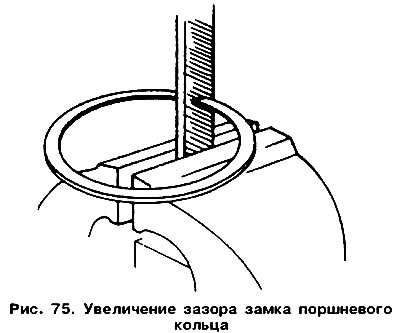
- If the gap is too small (this happens in new rings, which must be checked), then it can be increased by filing both ends with a file, clamping the ring in a vice, as shown in Figure 75. If the gap is large, this ring must be replaced.
 |
 |
Check the degree of wear of the piston pin and connecting rod head bushing.
The maximum permissible gap between the pin and the bushing is 0.1 mm. If the gap is larger, replace the pin. If this does not help, then it is necessary to drill out the bushing from the upper head of the connecting rod, press a new one in there and unfold it to the size of the piston pin.
[The original information is posted on the website: VWMANUAL]
Check the connecting rods for deformations on a special stand.
If at least one connecting rod requires replacement, then replace the entire set.
Always replace connecting rod bolts and nuts. How to measure connecting rod bearing clearance described here.
Visitor comments