



The description applies to a carburettor engine. In the case of a fuel-injected engine, the following additional steps must be performed.
Caution! Do not remove the cylinder head if the engine temperature exceeds 40°C.
Disconnect the battery.
Drain the coolant.
Remove the air filter, disconnect the upper coolant hose.
Disconnect all electrical wires from the cylinder head.
Disconnect the fuel lines, fuel control cable and vacuum booster hose. In the case of a fuel-injected engine, disconnect the fuel lines and all low-pressure hoses running from the cylinder head to the body.
All hoses that go to the carburetor must be marked and then disconnected. Remove the timing belt cover (figure 40). Remove the timing belt. Lock the timing gear (by inserting a rod of a suitable diameter or a large screwdriver-rod into one of the holes of the wheel and resting it against the cylinder head), unscrew the toothed pulley mounting bolts. The pulley is equipped with an installation mark, which must take a certain position during installation.
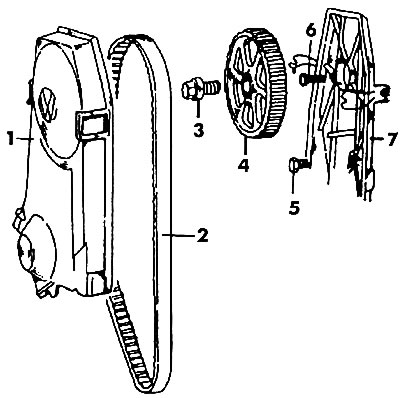
Figure 40. Parts installed on the front of the engine: 1 - front toothed belt cover, 2 - toothed belt, 3 - bolt (80 Nm), 4 - camshaft toothed pulley, 5 - bolt (2 Nm), 6 - bolt (10 Nm), 7 - rear toothed belt cover
Remove the rear cover located behind the toothed pulley.
Remove the valve cover and the oil deflector below.
Using a socket wrench (12 mm), unscrew the cylinder head mounting bolts and remove the head together with the gasket (figure 41).
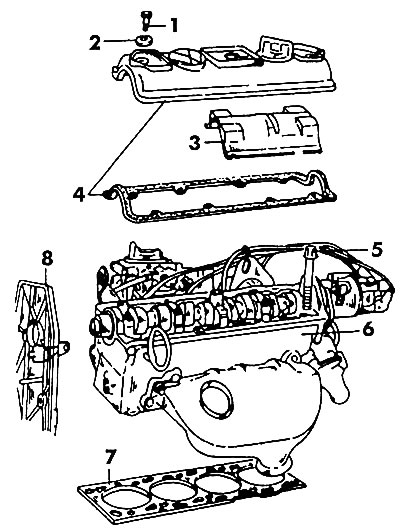
Figure 41. Cylinder head of a carburetor engine: 1 - bolt. (10 Nm). 2 - gasket, 3 - oil deflector, 4 - gasket and valve mechanism cover, 5 - head bolt, 6 - head, 7 - gasket, 8 - casing
Attention! If warping of the mating surface of the cylinder head is detected, it can be milled to a repair size, but you should remember the depth of the valve seats in the cylinder head. Otherwise, the valves may break when they collide with the pistons. The maximum permissible dimensions are given in Table 3.
Visitor comments