



Contents: Regrinding of valve seats ↓ Calculation of the maximum thickness…↓ Control dimensions for regrinding…↓ Replacing the cylinder head guide…↓ Removal and installation oil seals ↓
The valve dimensions are shown in Fig. 2 and Table 1.
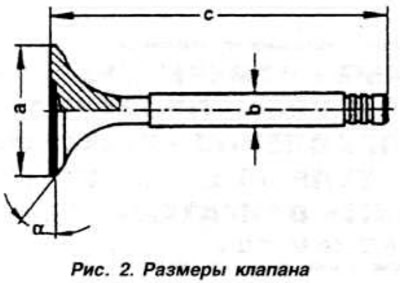
Valves cannot be reground; only lapping is permitted.
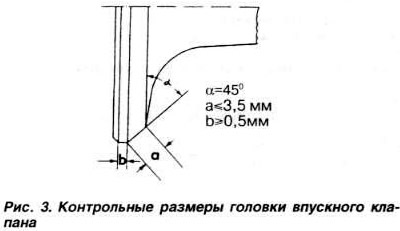
The control dimensions of the inlet valve head are given in Fig. 3.
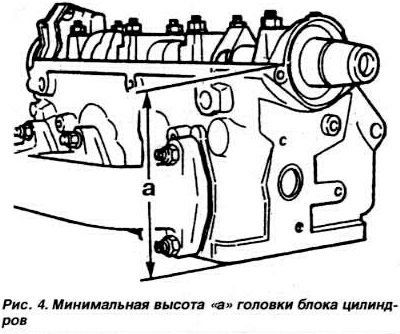
WARNING: Before performing repair work on the cylinder head, ensure that dimension "a" (Fig. 4) is not less than 139.5 mm.
Regrinding of valve seats
When repairing engines with loose valves, it is not enough to regrind the valve seats, grind them in, or replace the valves themselves. It is also necessary to check the wear of the guide bushings, especially if the engine has been removed from the vehicle after a significant mileage.
Valve seats are reground only to the extent necessary to restore the normal appearance of the bearing surface. Before performing the operation, it is necessary to calculate the maximum thickness of the metal layer to be removed when reground the seat. If the actual removal is greater than the calculated one, the function of hydraulic compensation of the clearance in the valves will be disrupted, and the cylinder head will have to be replaced.
Calculation of the maximum thickness of the metal layer removed during regrinding of valve seats
NOTE: If the valve is replaced during repair, a new one is taken for measurement.
After inserting the valve, press it firmly against the seat.
Measure the distance "a" (Fig. 5) between the end of the valve stem and the upper plane of the cylinder head.
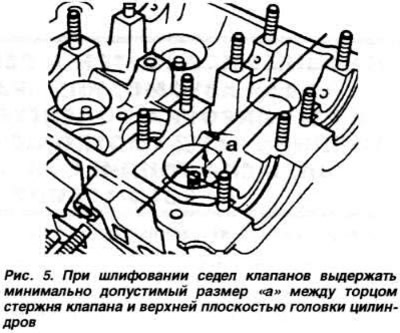
Calculate the size "b" the maximum thickness of the metal layer to be removed as the difference between the measured distance "a" and the minimum allowable control size "c" using the formula
b = a - c
Minimum permissible control dimensions: for intake valves - 33.9 mm; for exhaust valves - 34.1 mm.
Example:
Measured distance a=34.8 mm.
Minimum permissible control size c=34.1 mm. Maximum thickness of the removed metal layer b=0.7 mm.
Control dimensions for regrinding valve seats
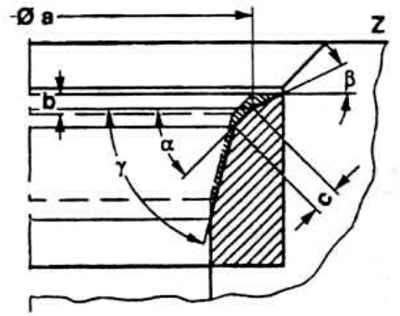
Fig. 6. Dimensions for regrinding the intake valve seat: a — seat diameter, a=38.3 mm; b — maximum permissible metal removal during regrinding; c — size, which should not exceed 1.4 mm (if necessary, the seat insert ring is repaired using a cutter that provides a specified correction angle of 75°); Z — lower plane of the cylinder head; α — valve seat chamfer angle, ∠ α=45°; β — upper correction angle, ∠ β=30°; γ — lower correction angle. ∠ γ=75°
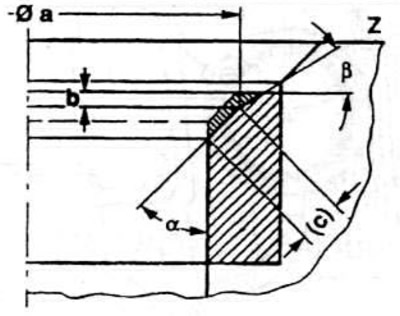
Fig. 7. Dimensions for regrinding the exhaust valve seat: a — saddle diameter, a = 33.5 mm; b — maximum permissible metal removal during regrinding; c — size, which should not exceed 2.0 mm (if necessary, the seat insert ring is repaired using a cutter that provides a specified correction angle of 75°); Z — lower plane of the cylinder head; α — valve seat chamfer angle, ∠ α=45°; β is the upper correction angle, ∠ β=30°.
Replacing the cylinder head guide bushings
The worn guide bushings are pressed out using the 10-206 tool (Fig. 8), installed from the camshaft side. Lubricate the new bushing with engine oil and press it in using the same tool, also from the camshaft side. The cylinder head must be cold. Pressing is carried out up to the sealing belt.
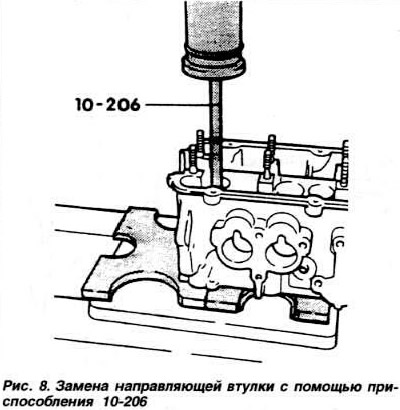
WARNING: Once the guide bushing has been seated against the flange, do not increase the pressing force above 1 tf, otherwise the bushing may be damaged.
After replacing the guide bushings, be sure to grind the valve seats, paying attention to the minimum permissible control dimension.
Insert the new valve into the guide bushing so that the end of the valve stem is level with the edge of the guide bushing, and determine the clearance between the stem and the guide bushing using the VW387 device with an indicator, resting the indicator rod against the valve head (Fig. 9).
(The original can be found at: «vwmanual»)
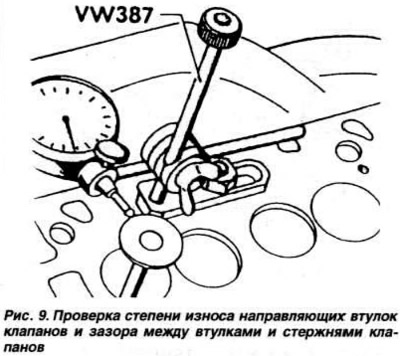
Replace the guide bushings if the indicator reading exceeds 1.0 mm for intake valve guide bushings and 1.3 mm for exhaust valve guide bushings.
Removal and installation oil seals
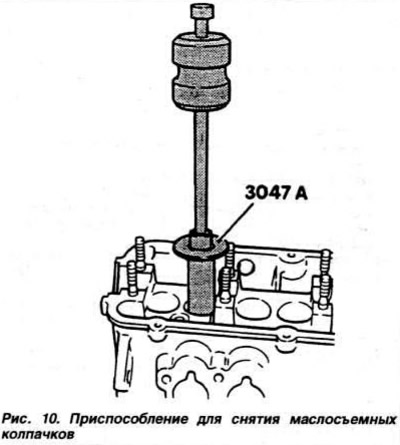
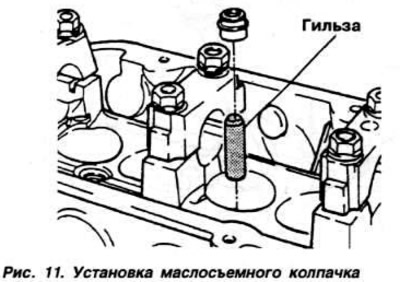
The removal of the oil seals is performed using the 3047A device, the operation of which is clearly shown in Fig. 10. The installation of the oil seals is performed using a special plastic sleeve, which is put on the valve stem. The cap is lubricated with engine oil and carefully pushed first onto the sleeve, and then onto the valve guide bushing (Fig. 11).
Visitor comments