



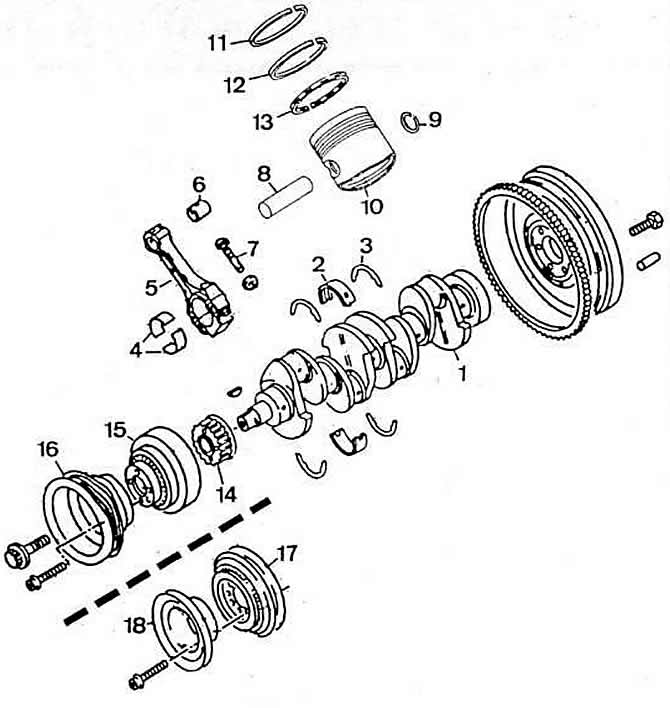
Fig. 2-139. Crank mechanism parts:
1 — crankshaft;
2 — crankshaft main bearing shell;
3 - thrust half ring;
4 — connecting rod bearing shells;
5 — connecting rod;
6 — connecting rod upper head bushing;
7 — connecting rod cap bolt;
8 - piston pin;
9 — piston pin retaining ring;
10 — piston;
11 - Upper compression ring;
12 - lower compression ring;
13 — oil scraper ring;
14 — toothed pulley of the crankshaft;
15 — torsional vibration damper;
16 — crankshaft pulley;
17 — crankshaft pulley with torsional vibration damper on vehicles with air conditioning or power steering;
18 — crankshaft pulley on vehicles with air conditioning and power steering.
The crankshaft is steel, forged, five-bearing, with four counterweights.
Main journal diameter, mm:
- nominal: 54.00-0,022-0,042
- 1st repair size: 53.75-0,022-0,042
- 2nd repair size: 53.50-0,022-0,042
- 3rd repair size: 53.25-0,022-0,042
Maximum permissible ovality of necks, no more than, mm: 0.003.
Diameter of connecting rod journals, mm:
- nominal: 47.80-0,022-0,042
- 1st repair size: 47.55-0,022-0,042
- 2nd repair size: 47.30-0,022-0,042
- 3rd repair size: 47.05-0,022-0,042
Axial clearance of the crankshaft when measured on the middle support, mm:
- nominal: 0.07-0.17;
- maximum permissible: 0.25.
Clearance between liners and main journals of the crankshaft, mm:
- nominal: 0.03-0.08 (0.02-0.06);
- maximum permissible (in operation): 0,17.
The flywheel is attached to the crankshaft flange with six bolts.
Permissible axial runout of the flywheel when measured along the circumference of the contact surface with the driven clutch disc, no more than, mm: 0.08.
The pistons are cast from aluminum alloy and have a flat bottom. On the bottom of each piston there are four recesses, which prevent the valve plates from touching (hitting) the piston bottom in case of a gas distribution problem. To reduce the temperature of the piston head and the upper compression ring area, the inner surface of the bottom is cooled by a stream of oil directed through a special fixed nozzle installed in the crankcase.
The outside diameters of the pistons are shown in Table 2-22.
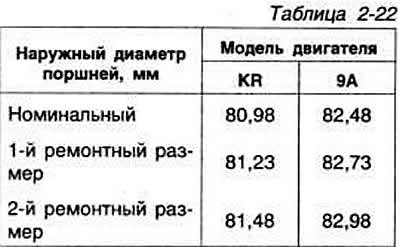
The piston diameter is measured at a distance of 10 mm from the lower edge of the piston skirt at an angle of 90° to the axis of the piston pin. The deviation of the piston diameter from the nominal or repair size should not exceed 0.04 mm.
The piston pins are floating. They are held from axial displacement by two retaining rings.
Each piston has three rings: two compression rings and one oil scraper ring.
The gap in the lock is 0.20-0.40 mm for the upper and lower compression rings; oil scraper ring 0.25-0.50 mm. Maximum permissible clearance during wear is 1.0 mm.
The gap between the ring and the piston groove is 0.02-0.07 mm for the upper compression ring; lower compression ring 0.02-0.06 mm. Maximum permissible clearance during wear 0.15 mm.
The clearance in the lock is measured on the ring installed in the cylinder at a distance of 15 mm from the lower edge of the cylinder. Connecting rods are steel, forged, with an I-section rod, with thin-walled liners. A bushing is pressed into the upper head of the connecting rod. The cover of the lower head of the connecting rod is of straight section.
When installing the connecting rod and piston group, the side of the connecting rod marked "B" must face the camshaft drive.
Axial clearance of the connecting rod on the crankshaft journal:
- nominal 0.05-0.31 mm;
- maximum 0.37 mm.
Operating clearance between the bearing shells and the crankshaft journals:
- nominal 0.01-0.06 mm;
- maximum permissible 0.12 mm.
The clearance between the piston pin and the connecting rod upper head bushing is 0.003-0.007 mm.
Visitor comments