



Fuel injection «K-Jetronic» car Volkswagen Passat B4

Fuel injection system «K-Jetronic»
The engine of the "KR" model is equipped with a mechanical system of constant fuel injection "K-Jetronic" by Bosch. The engine operation in idle and forced idle modes is...
The engine of the "KR" model is equipped with a mechanical system of constant fuel injection "K-Jetronic" by Bosch. The engine operation in idle and forced idle modes is...

Design of some injection system devices
Below is the structure of some elements of the fuel injection system of the "KR" engine. Fig. 2-159. Components of the K-Jetronlc fuel injection system of the KR engine: 1 -...
Below is the structure of some elements of the fuel injection system of the "KR" engine. Fig. 2-159. Components of the K-Jetronlc fuel injection system of the KR engine: 1 -...

Work in different modes
Operation under load conditions The fuel electric pump takes fuel from the fuel tank and pumps it under a pressure of about 5 kgf/cm² into the dispenser-distributor through the...
Operation under load conditions The fuel electric pump takes fuel from the fuel tank and pumps it under a pressure of about 5 kgf/cm² into the dispenser-distributor through the...

Location of the K-Jetronic fuel injection system and ignition system components
Fig. 2-175. Location of fuel injection system components "K-Jetronic" and ignition systems in the engine compartment: 1 - throttle position sensor; 2 — ignition system switch; 3 —...
Fig. 2-175. Location of fuel injection system components "K-Jetronic" and ignition systems in the engine compartment: 1 - throttle position sensor; 2 — ignition system switch; 3 —...

Adjusting engine idle speed
Before adjusting the engine idle speed, perform the following operations: warm up the engine (oil temperature not less than 80X); check and, if necessary, adjust the gaps between...
Before adjusting the engine idle speed, perform the following operations: warm up the engine (oil temperature not less than 80X); check and, if necessary, adjust the gaps between...

Adjusting the throttle opening
Note: The throttle opening is adjusted at the factory and cannot be changed during operation. However, if the stop screw is accidentally turned, the adjustment is restored as...
Note: The throttle opening is adjusted at the factory and cannot be changed during operation. However, if the stop screw is accidentally turned, the adjustment is restored as...
Adjusting the throttle cable
Carefully check the cable for any bent or twisted sections. Press the accelerator pedal all the way down and measure the gap between the throttle control lever and the stop, which...
Carefully check the cable for any bent or twisted sections. Press the accelerator pedal all the way down and measure the gap between the throttle control lever and the stop, which...
Checking the performance of the fuel pump
Relieve the pressure in the fuel injection system by disconnecting the control pressure supply hose from the fuel pressure regulator fitting. Disconnect the fuel drain hose from...
Relieve the pressure in the fuel injection system by disconnecting the control pressure supply hose from the fuel pressure regulator fitting. Disconnect the fuel drain hose from...

Checking the air flow meter
Remove the air intake cap from the air flow meter. Turn the engine crankshaft with the starter for 10 s. Move the air flow meter pressure disk upwards until it stops using a...
Remove the air intake cap from the air flow meter. Turn the engine crankshaft with the starter for 10 s. Move the air flow meter pressure disk upwards until it stops using a...

Adjusting the position of the air flow meter pressure disc
Remove the air intake cap from the air flow meter. Make sure that with the engine not running, the pressure disc is level with or no more than 0.5 mm below the beginning of the...
Remove the air intake cap from the air flow meter. Make sure that with the engine not running, the pressure disc is level with or no more than 0.5 mm below the beginning of the...
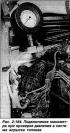
Pressure check
The pressure is checked using a pressure gauge with a nozzle and a tap, which provides measurement of both the flow pressure and the inlet pressure. Connect the pressure gauge...
The pressure is checked using a pressure gauge with a nozzle and a tap, which provides measurement of both the flow pressure and the inlet pressure. Connect the pressure gauge...

Checking the fuel pressure in the system
Check the fuel pump performance and the condition of the air filter element. Set the pressure gauge valve to the "open" position (to measure fuel pressure before the pressure...
Check the fuel pump performance and the condition of the air filter element. Set the pressure gauge valve to the "open" position (to measure fuel pressure before the pressure...

Adjusting the fuel pressure in the system
Remove the fuel pressure regulator from the fuel dispenser-distributor. Check the condition of the sealing rings 1 (fig. 2-185) and replace them if necessary. The fuel pressure in...
Remove the fuel pressure regulator from the fuel dispenser-distributor. Check the condition of the sealing rings 1 (fig. 2-185) and replace them if necessary. The fuel pressure in...

Checking the control pressure on a cold engine
This check is performed on a cold engine with a coolant temperature of 20-30°C. Disconnect the control pressure regulator connector. Open the pressure gauge valve. Start the...
This check is performed on a cold engine with a coolant temperature of 20-30°C. Disconnect the control pressure regulator connector. Open the pressure gauge valve. Start the...

Checking the control pressure on a warm engine
Warm up the engine to normal operating temperature. Disconnect the control pressure regulator connector. Start the engine at idle speed and connect the control pressure regulator...
Warm up the engine to normal operating temperature. Disconnect the control pressure regulator connector. Start the engine at idle speed and connect the control pressure regulator...

Checking residual fuel pressure
Warm up the engine to operating temperature and stop it. Connect the pressure gauge as described above. Start the engine at idle speed and let it run until the required fuel...
Warm up the engine to operating temperature and stop it. Connect the pressure gauge as described above. Start the engine at idle speed and let it run until the required fuel...

Checking the fuel pressure in the system when the engine is stopped
Warm up and stop the engine. Connect the pressure gauge as described above. Start the engine and set the pressure gauge valve to the "Closed" position. Measure the fuel pressure,...
Warm up and stop the engine. Connect the pressure gauge as described above. Start the engine and set the pressure gauge valve to the "Closed" position. Measure the fuel pressure,...

Checking and adjusting the throttle position sensor
Examination Disconnect the throttle position sensor connector and check the resistance between the terminals of the sensor connector (fig. 2-186) in accordance with the given...
Examination Disconnect the throttle position sensor connector and check the resistance between the terminals of the sensor connector (fig. 2-186) in accordance with the given...

Checking the tightness of the injectors and the uniformity of fuel injection
Disconnect the wire from the negative terminal of the battery. Remove the injectors and place each of them in a measuring cup. Remove the fuel pump relay and connect the "+"...
Disconnect the wire from the negative terminal of the battery. Remove the injectors and place each of them in a measuring cup. Remove the fuel pump relay and connect the "+"...

Checking the starting injector
The starting injector is checked on a cold engine. To check the injection duration: disconnect the connectors of the control pressure regulator and the idle speed stabilization...
The starting injector is checked on a cold engine. To check the injection duration: disconnect the connectors of the control pressure regulator and the idle speed stabilization...

Checking the thermal time relay
Disconnect the high-voltage wire from the ignition distributor and connect it to the body ground via an extension cord. Remove the thermal time relay from the engine and immerse...
Disconnect the high-voltage wire from the ignition distributor and connect it to the body ground via an extension cord. Remove the thermal time relay from the engine and immerse...
Checking the control pressure regulator
Warm up the engine to operating temperature Disconnect the connector of the control pressure regulator and connect a voltmeter to the regulator block. Turn on the ignition and...
Warm up the engine to operating temperature Disconnect the connector of the control pressure regulator and connect a voltmeter to the regulator block. Turn on the ignition and...

Checking the idle speed control valve
Turn on the ignition. The idle speed control valve should make a vibrating sound. Disconnect the valve connector and connect an ohmmeter to the terminals of the valve block (fig....
Turn on the ignition. The idle speed control valve should make a vibrating sound. Disconnect the valve connector and connect an ohmmeter to the terminals of the valve block (fig....

Checking the coolant temperature sensor
Disconnect the sensor connector. Check the coolant temperature. Connect an ohmmeter to the terminal and the sensor body (fig. 2-193) and check the compliance of its readings with...
Disconnect the sensor connector. Check the coolant temperature. Connect an ohmmeter to the terminal and the sensor body (fig. 2-193) and check the compliance of its readings with...

Checking the mixture enrichment during acceleration with a cold engine
Make sure the starting injector is working properly. Disconnect the connector from the starting injector and connect the test lamp to the terminals of the injector block....
Make sure the starting injector is working properly. Disconnect the connector from the starting injector and connect the test lamp to the terminals of the injector block....

Checking for fuel cut-off during engine braking
Make sure the vacuum hose to the idle speed control valve is in good condition. Warm up the engine to normal operating temperature. Then increase the crankshaft speed to 2500 rpm....
Make sure the vacuum hose to the idle speed control valve is in good condition. Warm up the engine to normal operating temperature. Then increase the crankshaft speed to 2500 rpm....
Removal and installation the metering unit with air flow meter
To remove, relieve the pressure in the fuel injection line by disconnecting the hose from the control pressure fitting on the fuel pressure regulator. Disconnect the injector fuel...
To remove, relieve the pressure in the fuel injection line by disconnecting the hose from the control pressure fitting on the fuel pressure regulator. Disconnect the injector fuel...

Removal and installation injectors
Release the fuel lines of the injectors from the holders. Remove the flange securing the injectors to the engine. Remove the injectors with the fuel lines. Unscrew the pipeline...
Release the fuel lines of the injectors from the holders. Remove the flange securing the injectors to the engine. Remove the injectors with the fuel lines. Unscrew the pipeline...

Ignition system of the engine «KR»
The ignition system is fully electronic (fig. 2-196). Fig. 2-196. Details of the ignition system of the "KR" engine: 1 - electronic ignition timing control unit; 2 - block...
The ignition system is fully electronic (fig. 2-196). Fig. 2-196. Details of the ignition system of the "KR" engine: 1 - electronic ignition timing control unit; 2 - block...

Removal and installation the ignition distributor
To remove, disconnect the wire from the negative terminal of the battery. Disconnect the spark plug wires and the high-voltage wire of the ignition coil from the ignition...
To remove, disconnect the wire from the negative terminal of the battery. Disconnect the spark plug wires and the high-voltage wire of the ignition coil from the ignition...
Setting the initial ignition timing angle
Warm up the engine (oil temperature not less than 80°C). Make sure that the throttle position sensor is adjusted correctly (see above), and that the idle speed and carbon monoxide...
Warm up the engine (oil temperature not less than 80°C). Make sure that the throttle position sensor is adjusted correctly (see above), and that the idle speed and carbon monoxide...
Checking the automatic ignition advance
To check the ignition timing depending on the crankshaft speed: warm up the engine to operating temperature and stop it; connect the control tachometer and stroboscope in...
To check the ignition timing depending on the crankshaft speed: warm up the engine to operating temperature and stop it; connect the control tachometer and stroboscope in...

Checking and adjusting the fuel injection system «KE-Jetronic» of the engine «PL»
Fig. 21. Electrical diagram of the fuel injection control subsystem KSUD "Motronic" of the "AAA" engine of the vehicle "Passat 2,8 VR6": 1 — controller; 2/1-6 — injectors: 3 —...
Fig. 21. Electrical diagram of the fuel injection control subsystem KSUD "Motronic" of the "AAA" engine of the vehicle "Passat 2,8 VR6": 1 — controller; 2/1-6 — injectors: 3 —...

Possible malfunctions of the KE-Jetronic fuel injection system of the PL engine
Possible malfunctions of the KE-Jetronic fuel injection system of the PL engine, their causes and methods of elimination.
Possible malfunctions of the KE-Jetronic fuel injection system of the PL engine, their causes and methods of elimination.
This section is available on russian, bulgarian, belarusian, ukrainian, serbian, croatian, romanian, polish, slovak, hungarian
Passat B6
Passat B5
Passat B4
Passat B3
Passat B2
- General information
- User manual
- Maintenance
- Petrol engine 1.6L
- Engine repair
- Cooling and lubrication system
- Fuel injection system
- Petrol engine 2.0L
- Engine repair
- Lubrication system
- Cooling system
- Fuel and exhaust systems
- Diesel engine 2.0L
- Engine repair
- Cooling and lubrication system
- Fuel and exhaust systems
- Transmission
- Clutch
- Mechanical gearbox
- Automatic gearbox
- Drive shafts
- Chassis
- Wheels and tires
- Car suspension
- Steering
- Brake system
- Body
- Exterior (external elements)
- Electrical equipment
- Power devices
- Lighting and appliances
- Electrical circuits
- General information
- User manual
- Weekly checks
- Maintenance
- Power unit
- Engine repair
- Cooling system
- Fuel system (petrol)
- Fuel system (diesel)
- Engine management
- Exhaust system
- Transmission
- Clutch
- Car gearbox
- Drive shafts
- Chassis
- Car suspension
- Wheels and tires
- Steering
- Brake system
- Body
- Exterior (external elements)
- Interior (internal elements)
- Doors and covers
- Ventilation and heating
- Electrical equipment
- Power devices
- Lighting and appliances
- Electrical circuits
- General information
- User manual
- Maintenance
- Technical data
- 8-valve engine
- Engine repair
- Cooling and lubrication system
- Supply system
- Ignition system
- Fuel injection «Mono-Jetronic»
- Control system «Mono-Motronic»
- Control system «Digifant»
- Control system «Simos»
- 16-valve engine
- Engine repair
- Cooling and lubrication system
- Fuel injection «K-Jetronic»
- Control system «KE-Motronic»
- Control system «Digifant»
- Diesel engine
- Engine repair
- Cooling and lubrication system
- Power and control system
- Turbocharging system
- Digital control system
- Transmission
- Clutch
- Manual gearbox
- Hydromechanical gearbox
- Front wheel drive
- Chassis
- Car suspension
- Steering
- Brake system
- Body
- Body elements
- Electrical equipment
- Power devices
- Lighting and appliances
- Electrical circuits
- General information
- User manual
- Driving Tips
- Maintenance instructions
- Technical data
- Power unit
- Engine repair
- Ignition system
- Lubrication system
- Cooling system
- Supply system
- Petrol injection system
- Diesel engine
- Exhaust system
- Transmission
- Clutch
- Car gearbox
- Chassis
- Suspension
- Steering
- Brake system
- Wheels and tires
- Body
- Exterior
- Interior
- Heating system
- Electrical equipment
- Power devices
- Lighting system
- Equipment and devices
- Wiper system
- Electrical circuits
- General information
- Introduction to instructions
- User manual
- Power unit
- Engines 4-cylinder FZ
- Engines 4-cylinder
- Engines 5-cylinder
- Transmission
- Clutch
- Four-speed gearbox
- Five-speed gearbox
- Hydromechanical gearbox
- Front wheel drive
- Chassis
- Front suspension
- Rear suspension
- Steering
- Brake system
- Body
- Body elements
- Electrical equipment
- Equipment and devices
- Electrical circuits