



Contents: Checking and adjusting engine idle…↓ Adjusting the idle switch ↓ Adjusting the full load switch ↓ Checking the supply voltage of…↓ Checking fuel pressure ↓ Checking the control pressure ↓ Checking and adjusting the position…↓ Checking the oxygen sensor in the…↓ Checking the mixture enrichment…↓ Checking the mixture enrichment when…↓ Checking the mixture enrichment at…↓ Checking the electrical circuits of…↓
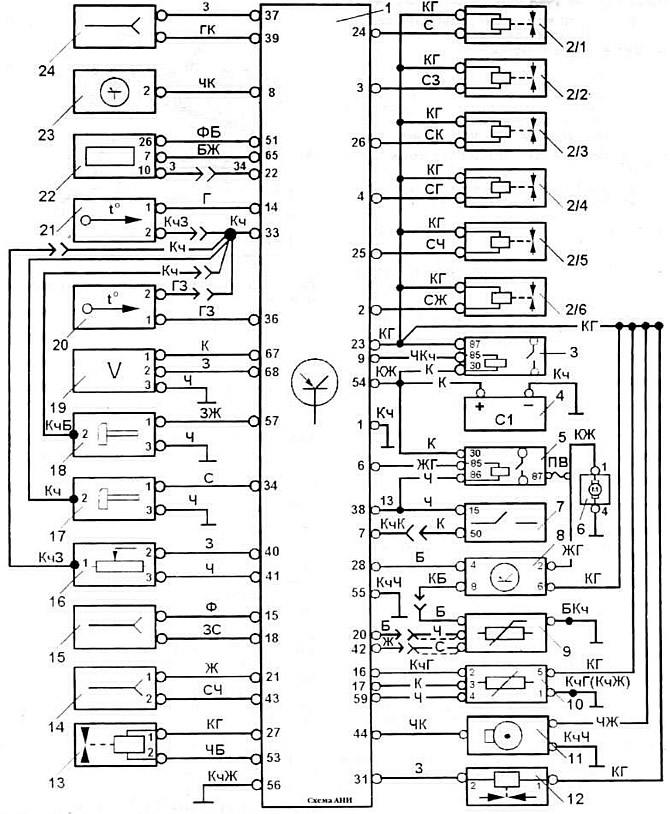
Fig. 21. Electrical diagram of the fuel injection control subsystem KSUD "Motronic" of the "AAA" engine of the vehicle "Passat 2,8 VR6": 1 — controller; 2/1-6 — injectors: 3 — power relay; 4 - battery; 5 — fuel pump relay; 6 - fuel pump; 7 — ignition switch; 8 — EB of the exhaust gas oxygen control system; 9 — exhaust gas oxygen sensor; 10 — mass air flow meter; 11 — spark timing sensor: 12 — purge solenoid valve of the adsorber: 13 — idle speed controller; 14 — diagnostic connector: 15 — engine compartment wiring harness connector; 16 - Potentiometric throttle position sensor; 17 — knock sensor I; 18 — knock sensor II; 19 — crankshaft speed sensor; 20—intake air temperature sensor: 21—coolant temperature sensor; 22 — on-board computer; 23 — switch: 24 — air conditioner connector; PV - fuse link.
Wire color designation: B - white: G - blue; W - yellow: 3 - green: K - red; Kch - brown; C - gray: F - violet; Ch - black.
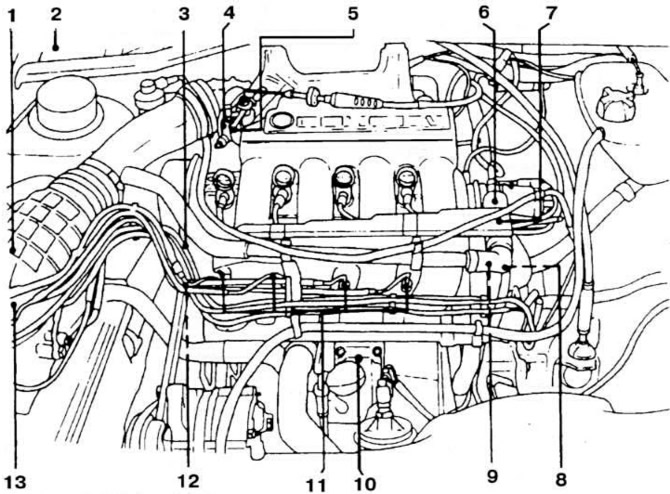
Fig. 23. Placement of the KE-Jetronic fuel injection system elements of the PL engine on the vehicle: 1 — Air flow meter: 2 — ECU: 3 — Idle control valve: 4 — Throttle body; 5 - Idle and full load switches; 6 — idle speed regulator: 7 — fuel pressure regulator; 8 - coolant temperature sensor; 9 - thermal time relay: 10 - control pressure regulator; 11 — injection nozzles; 12 — starting injector: 13 — fuel dispenser-distributor.
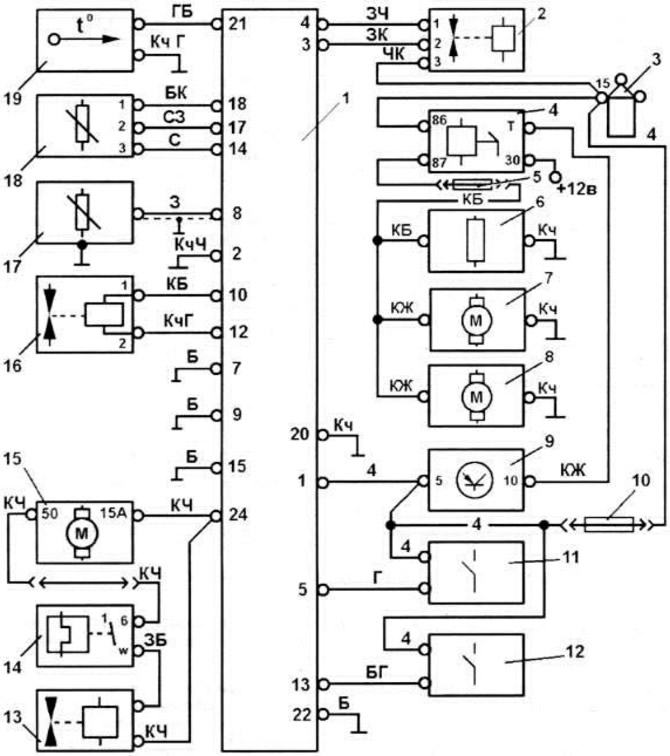
Fig. 28. Electrical diagram of the KE-Jetronic fuel injection system of the PL engine of the vehicle "Passat 16V Cat": 1 — Fuel injection ECU; 2 - idle speed controller; 3 - ignition coil; 4 — fuel pump relay; 5 - fuse #5; 6 — oxygen sensor heater; 7 — fuel pump: 8 — fuel priming pump; 9 — ECU ignition delay; 10 - fuse no. 17; 11 - Full load switch; 12 - idle switch; 13 — control pressure regulator; 14 - thermal time relay: 15 - starter; 16 — fuel pressure regulator; 17 - Exhaust gas oxygen sensor; 18 - air flow meter; 19 — coolant temperature sensor.
The color designation of the wires is shown in Fig. 21, the absence of a color designation indicates an internal connection (for example, connection to the housing or connection through a printed circuit board).
NOTE: The following describes only those checks and adjustments whose performance methods differ from those described for the K-Jetronic fuel injection system of the KR engine (see section "16-valve engines").
Checking and adjusting engine idle speed
These operations are performed in the same way as on the KR engine with the K-Jetronic injection system (see section "16-valve engines"), except for the following.
Before checking, make sure that the exhaust gas oxygen sensor is working properly. Checking the crankshaft speed at idle (800-900 rpm) is performed after the engine switches from fast idle mode to normal idle speed. The CO content in the exhaust gases should be within 0.3-1.2%.
Adjusting the idle switch
Connect the VAG 1501 test lead to the switch wires and to the multi-pin connector.
Connect one voltmeter lead to wire No.1 of the test cord, and connect the other voltmeter lead to ground (Fig. 20).
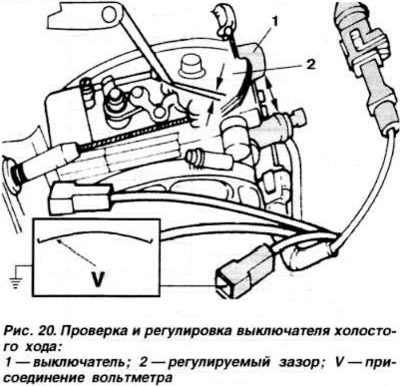
Turn on the ignition. The voltmeter should show the battery voltage.
Open and close the throttle valve until the throttle lever touches the stop screw.
Insert a 0.15-0.5 mm thick feeler gauge between the lever and the stop and make sure that the switch is triggered when the throttle valve is moved.
If the switch does not operate, loosen the switch mounting screws and achieve operation by shifting the switch housing, then tighten the mounting screws.
Adjusting the full load switch
Connect the VAG 1501 test lead to the throttle switch wires and to the multi-pin connector. Connect one lead of the voltmeter to wire No.3 of the test lead, and connect the other lead of the voltmeter to ground (Fig. 22).
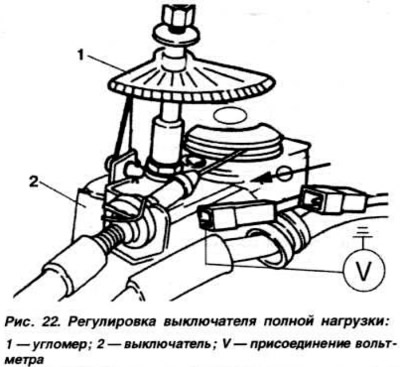
Open the throttle valve completely. The voltmeter should show the battery voltage. Attach the protractor 1 to the throttle valve axis and, with the throttle valve completely open, set the protractor pointer to zero.
Close the throttle valve approximately 20° on the angle gauge, then open it again until the switch operates. The switch should operate 10±2° before the fully open throttle position.
If there is a deviation from the specified norm, loosen the screws securing the switch housing and adjust the tripping moment within the specified limits by moving it, then tighten the screws securing it.
Checking the supply voltage of switches
Connect the VAG 1501 test lead to the switch wires and to the multi-pin connector.
Connect one lead of the voltmeter to the #2 test lead, and connect the other lead of the voltmeter to ground. The voltmeter should show the battery voltage.
Checking fuel pressure
Connect the pressure gauge to the measuring pipe 3 of the fuel dispenser-distributor (Fig. 24) and to the fuel line 4 of the starting injector.
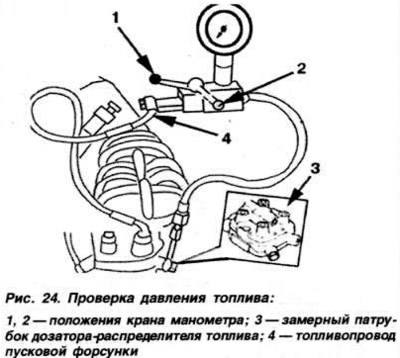
Connect the VAG 1348/ZA remote control unit to the previously disconnected connector of the oxygen sensor in the exhaust gases and to the "+" of the battery.
Open valve 2 of the pressure gauge, turn on the remote control unit and check the pressure gauge readings, which should be within 5.2-5.6 kgf/cm².
Checking the control pressure
Connect the pressure gauge and remote control unit as described above.
Connect the VAG 1251 A/1 test cord to the differential pressure regulator. Connect a voltmeter to the test cord.
Close valve 1 of the pressure gauge.
Disconnect the control pressure regulator connector and turn on the remote control unit. In this case, the control pressure should be set at 0.2-0.5 kgf/cm² below the fuel pressure in the system.
Disconnect the thin hose from the pressure regulator and lower the end of the hose into the measuring cup.
Connect the control pressure regulator connector. Turn on the remote control unit for 1 min and measure the amount of fuel poured into the measuring cup, which should be within 130-150 cm³.
Connect a thin hose to the pressure regulator. Disconnect the coolant temperature sensor connector. Connect the paired adapter to the disconnected multi-pin connector with the side with a resistance of 15 kOhm. Connect the connector of the control pressure regulator and turn on the ignition. In this case, the pressure gauge should show a steady-state pressure, which should be 0.7-1.2 kgf/cm² higher than the fuel pressure in the system. In this case, the control current should be within 50-70 mA.
Checking and adjusting the position of the air flow meter pressure disc
Warm up the engine (oil temperature above 50°C). Turn the crankshaft with the starter for 10 s. Check the position of the air flow meter pressure disk. In the initial position of the pressure disk, the upper edge of its edge should be 1.9+1.1 mm below the beginning of the expanding cone of the air flow meter housing (dimension A in Fig. 25).
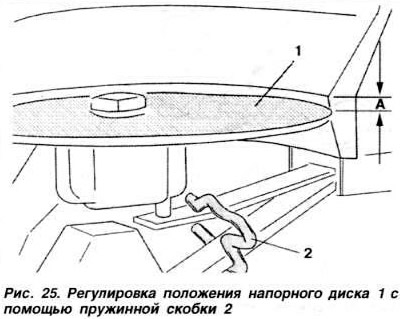
If there is a deviation from the norm, lift the pressure disk and adjust its position within the specified limits by straightening or bending the spring bracket 2. In this case, it is prohibited to bend the plate spring of the disk stop.
After completing the adjustment, check and, if necessary, adjust the engine idle speed.
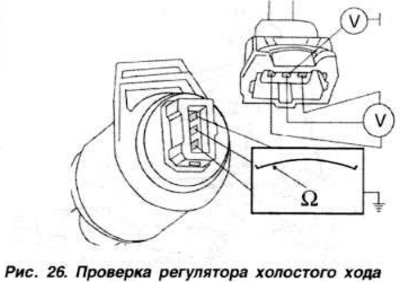
Checking the oxygen sensor in the exhaust gases
Warm up the engine to normal operating temperature and let it idle for at least 2 minutes.
Check the carbon monoxide (CO) content in the exhaust gases. Then pinch the crankcase ventilation hose. The CO content should first increase briefly, then decrease to the original value
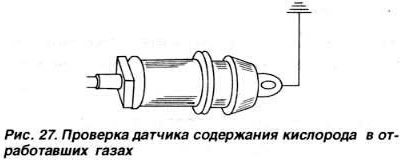
If the CO content does not decrease, disconnect the exhaust gas oxygen sensor connector and connect the connector wire going to the controller to ground (Fig. 27). If the CO content value does not change after about 20 seconds, replace the oxygen sensor.
Checking the mixture enrichment during acceleration
Using the VAG 1315 A/1 test cable, connect the digital multimeter to the control pressure regulator.
Disconnect the coolant temperature sensor connector.
Disconnect the air intake cap from the air flow meter.
Turn on the ignition.
Open the throttle valve approximately 1/3 of its stroke. The ammeter should show a current of 80-100 mA.
Move the air flow meter pressure disk sharply upwards. The current on the ammeter should briefly increase to more than 100 mA.
Checking the mixture enrichment when restarting and warming up the engine
Disconnect the high-voltage wire from the ignition distributor sensor and connect it to ground via an extension cord. Connect a universal digital measuring device to the control pressure regulator using the VAG 1315 A/1 test cord.
Disconnect the coolant temperature sensor connector.
Turn on the starter for about 2 s and leave the ignition on. The ammeter readings should be more than 120 mA for 30-60 s, then decrease to 80-100 mA within 20-50 s.
Checking the mixture enrichment at full load
Using the VAG 1315 A/1 test cable, connect the universal digital measuring instrument to the control pressure regulator.
Disconnect the coolant temperature sensor connector and connect the VAG 1490 dual adapter to the connector. Start the engine and increase the crankshaft speed to 2500 rpm.
When the full load switch is tripped, the ammeter should read about 16 mA.
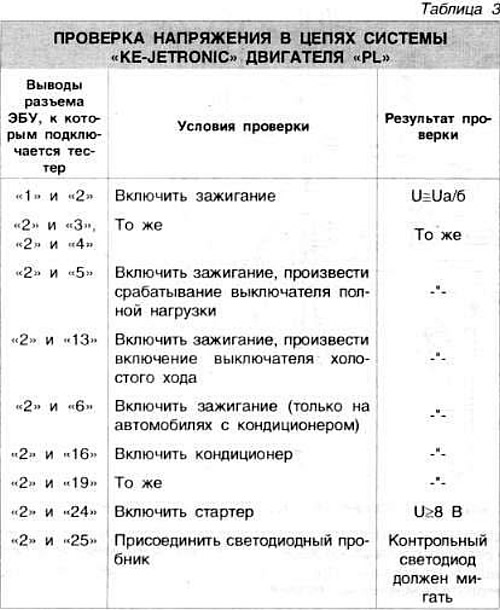
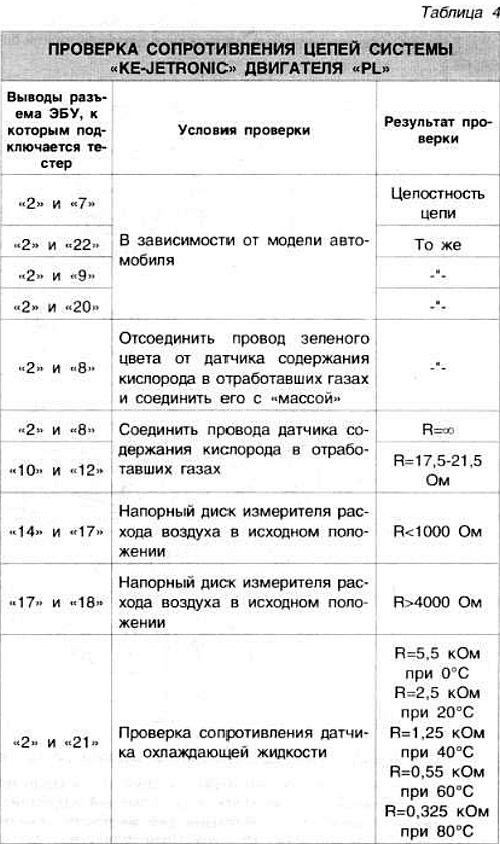
Checking the electrical circuits of the KE-Jetronic system via the ECU connector terminals
Turn off the ignition.
Disconnect the ECU connector.
Disconnect the high voltage wire from the ignition distributor sensor and connect it to ground.
(View the original on the website: www.VWManual.ru)
Use a universal digital measuring device with low impedance for testing purposes.
Visitor comments