
English Русский
Български
Беларускі
Український
Српски
Hrvatski
Română
Polski
Slovenský
Magyar
  |  Articles  |  Sitemap  |  Contacts  |    |
Car maintenance Ford Car maintenance Hyundai Car maintenance Chevrolet Car maintenance BMW Car maintenance Audi Car maintenance Opel Car maintenance AvtoVAZ
VWmanual.ru


Main   Passat   Golf   Polo   Touareg   Tiguan   Sharan   Transporter   Others  
Passat B2 (1981-1988) Passat B3 (1988-1993) Passat B4 (1988-1996) Passat B5 (1996-2005) Passat B6 (2005-2010)

Checking the tightness of the injectors and the uniformity of fuel injection (VW Passat B4)

  • Main
  • Passat
  • Passat B4
  • 16-valve engine
  • Fuel injection «K-Jetronic»
  • Checking the tightness of the injectors and the uniformity of fuel injection
            0


Disconnect the wire from the negative terminal of the battery. Remove the injectors and place each of them in a measuring cup. Remove the fuel pump relay and connect the "+" terminal from the battery of the relay block with a jumper to the switch with the power terminal of the fuel pump.

Connect the wire to the negative terminal of the battery. Turn on the fuel pump with the jumper switch and make sure that there is no fuel leakage through the injector nozzles for at least 2 minutes.

Make sure that the fuel injected by the injector has the correct cone shape (fig. 2-188).
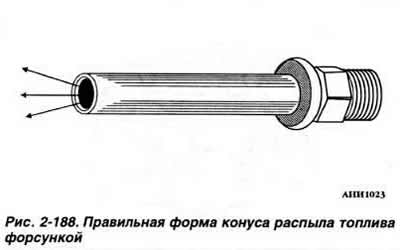
Make sure that the fuel injected by the injector has the correct cone shape (fig. 2-188).


Disconnect the air hose connecting the air flow meter to the throttle body. Move the pressure disk of the air flow meter slightly upward and hold it in this position until a predetermined amount of fuel flows into one of the measuring cups selected as a control.

Check the difference in injector performance. Maximum permissible difference in the amount of fuel injected between injectors, ml:
  • at idle speed with a nominal amount of fuel injected of 20 ml: 2.5;
  • at full load with a nominal fuel injection quantity of 80 ml: 8.0.

If there is any deviation from the norm, replace the corresponding injector.


You can more accurately check the technical condition of the injectors using a stand that includes a hand pump and a pressure gauge.

Connect the tested injector to the test bench according to the operating instructions and check the fuel injection pressure. A properly functioning injector should inject fuel at a pressure of 3.5-4.1 kgf/cm². Check the injector for leaks. To do this, use the bench pump to create a pressure 0.5 kgf/cm² less than the injector fuel injection pressure and maintain it for 15 seconds, during which not a single drop of fuel should flow out of the injector sprayer. Press the bench pump lever at a rate of one stroke per second. In this case, fuel should be sprayed from the injector sprayer with a hum in the form of a cone at an angle of approximately 35°.

If the injector does not meet at least one of the above requirements, it must be replaced.

This article is available at russian, bulgarian, belarusian, ukrainian, serbian, croatian, romanian, polish, slovak, hungarian
The text has been checked: Kolesnikov Artem

Share information:

Previous articles
Checking and adjusting the throttle position sensor
Checking the fuel pressure in the system when the engine is stopped
Checking residual fuel pressure
Checking the control pressure on a warm engine
Checking the control pressure on a cold engine
Adjusting the fuel pressure in the system
Next articles
Checking the starting injector
Checking the thermal time relay
Checking the control pressure regulator
Checking the idle speed control valve
Checking the coolant temperature sensor
Checking the mixture enrichment during acceleration with a cold engine


Similar articles from other manuals for VW cars:
Checking the fuel injection system Golf 4 (1997-2004)
Checking the fuel pump Polo 3 (1995-2003)
Checking injectors (petrol engine) Touareg 1 (2002-2006)
Checking the fuel pressure regulator N276 Tiguan 1 (2007-2015)
Fuel injection system of the VR6 engine Sharan 1 (1995-2000)
Checking the tightness of the cooling system by external… Transporter T4 (1990-2003)
Checking the tightness and quantity of fuel injected (since 2006) Caddy 3 (2003-2010)
Link to this page in different formats


Visitor comments


No comments yet


How much will 19 + 29 =


Passat B6 
  • General information
  • User manual
  • Maintenance
  • Petrol engine 1.6L
  • Engine repair
  • Cooling and lubrication system
  • Fuel injection system
  • Petrol engine 2.0L
  • Engine repair
  • Lubrication system
  • Cooling system
  • Fuel and exhaust systems
  • Diesel engine 2.0L
  • Engine repair
  • Cooling and lubrication system
  • Fuel and exhaust systems
  • Transmission
  • Clutch
  • Mechanical gearbox
  • Automatic gearbox
  • Drive shafts
  • Chassis
  • Wheels and tires
  • Car suspension
  • Steering
  • Brake system
  • Body
  • Exterior (external elements)
  • Electrical equipment
  • Power devices
  • Lighting and appliances
  • Electrical circuits
Passat B5 
  • General information
  • User manual
  • Weekly checks
  • Maintenance
  • Power unit
  • Engine repair
  • Cooling system
  • Fuel system (petrol)
  • Fuel system (diesel)
  • Engine management
  • Exhaust system
  • Transmission
  • Clutch
  • Car gearbox
  • Drive shafts
  • Chassis
  • Car suspension
  • Wheels and tires
  • Steering
  • Brake system
  • Body
  • Exterior (external elements)
  • Interior (internal elements)
  • Doors and covers
  • Ventilation and heating
  • Electrical equipment
  • Power devices
  • Lighting and appliances
  • Electrical circuits
Passat B4 
  • General information
  • User manual
  • Maintenance
  • Technical data
  • 8-valve engine
  • Engine repair
  • Cooling and lubrication system
  • Supply system
  • Ignition system
  • Fuel injection «Mono-Jetronic»
  • Control system «Mono-Motronic»
  • Control system «Digifant»
  • Control system «Simos»
  • 16-valve engine
  • Engine repair
  • Cooling and lubrication system
  • Fuel injection «K-Jetronic»
  • Control system «KE-Motronic»
  • Control system «Digifant»
  • Diesel engine
  • Engine repair
  • Cooling and lubrication system
  • Power and control system
  • Turbocharging system
  • Digital control system
  • Transmission
  • Clutch
  • Manual gearbox
  • Hydromechanical gearbox
  • Front wheel drive
  • Chassis
  • Car suspension
  • Steering
  • Brake system
  • Body
  • Body elements
  • Electrical equipment
  • Power devices
  • Lighting and appliances
  • Electrical circuits
Passat B3 
  • General information
  • User manual
  • Driving Tips
  • Maintenance instructions
  • Technical data
  • Power unit
  • Engine repair
  • Ignition system
  • Lubrication system
  • Cooling system
  • Supply system
  • Petrol injection system
  • Diesel engine
  • Exhaust system
  • Transmission
  • Clutch
  • Car gearbox
  • Chassis
  • Suspension
  • Steering
  • Brake system
  • Wheels and tires
  • Body
  • Exterior
  • Interior
  • Heating system
  • Electrical equipment
  • Power devices
  • Lighting system
  • Equipment and devices
  • Wiper system
  • Electrical circuits
Passat B2 
  • General information
  • Introduction to instructions
  • User manual
  • Power unit
  • Engines 4-cylinder FZ
  • Engines 4-cylinder
  • Engines 5-cylinder
  • Transmission
  • Clutch
  • Four-speed gearbox
  • Five-speed gearbox
  • Hydromechanical gearbox
  • Front wheel drive
  • Chassis
  • Front suspension
  • Rear suspension
  • Steering
  • Brake system
  • Body
  • Body elements
  • Electrical equipment
  • Equipment and devices
  • Electrical circuits
VWmanual.ru © 2016-2026 | Mobile version | News and articles | Sitemap: EN BG BY UA RS HR RO PL SK HU | Write message | Site search
Passat B2 • Passat B3 • Passat B4 • Passat B5 • Passat B6 • Golf 1, diesel • Golf 1, petrol • Golf 2, petrol • Golf 2 • Golf 3 • Golf 4 • Golf 5 • Polo 3 • Polo 4 • Touareg 1 • Tiguan 1 • Sharan 1 • Transporter T3 • Transporter T4 • LT 28 • LT 2D • Beetle • Caddy 3 •
Our website uses cookies to ensure functionality and convenience.