



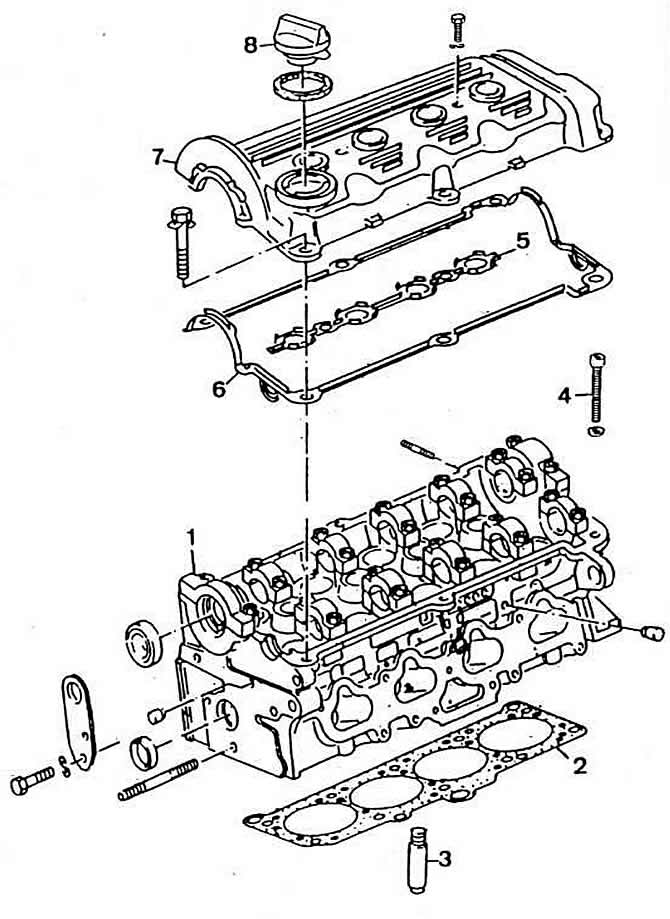
Fig. 2-141. Cylinder head parts:
1 - cylinder head;
2 - cylinder head gasket;
3 — valve guide bushing;
4 — cylinder head mounting bolt;
5, 6 — cylinder head cover gasket;
7 — cylinder head cover;
8 — oil filler plug.
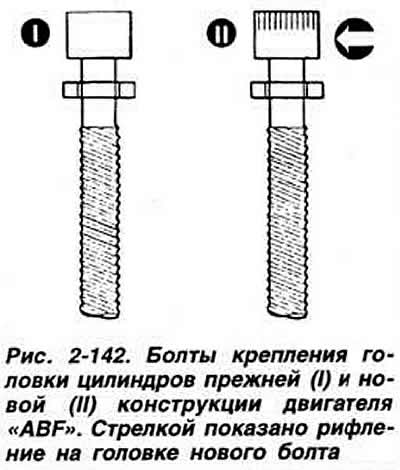
The cylinder head gasket is installed with the "Oben" mark ("Top") facing upwards. Since February 1994, a new metal cylinder head gasket has been installed on the "ABF" engine, which required the use of special cylinder head mounting bolts. When repairing the engine, it is permissible to install a new cylinder head gasket on engines of previous releases, provided that the specified new cylinder head mounting bolts are used.
The bolts used with the previous cylinder head gasket have a smooth head face, while the new bolts have a knurled head (fig. 2-142). The order and tightening torque of the cylinder head bolts remain unchanged.
Valve seats
The valve seats are made of special steel and pressed into the cylinder head. Valve seats should only be replaced at service stations. If traces of burning or wear appear on the valve seats that cannot be removed while maintaining the required angles and widths of the working chamfers, the entire cylinder head must be replaced.
Note: Valve seats are ground only to obtain the required surface quality. Determine the maximum allowable grinding size before grinding (distance from the end of the valve stem to the mating surface of the cylinder head). If the specified size is reduced, automatic compensation of gaps in the valve drive mechanism by hydraulic tappets is not ensured. In this case, the cylinder head must be replaced.
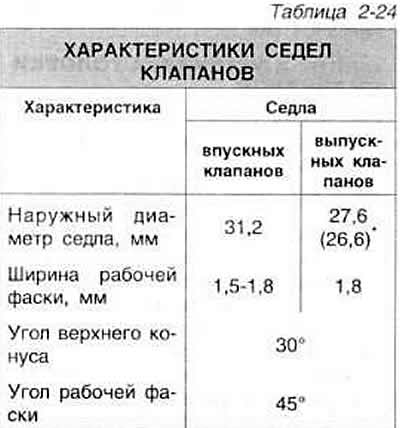
In brackets for the "ABF" engine.
The valve guide bushings are made of special bronze and are pressed into the cylinder head. The maximum permissible clearance (when worn out) between the valve stem and the guide bushing (the measurement method is described in the section "8-valve engines"): for intake valves 1.0 mm; for exhaust valves 1.3 mm.
Length of guide bushings 38 mm.
The valves are made of special steel. To improve heat exchange, the exhaust valves have an internal closed cavity filled with sodium in a certain proportion. The exhaust valves are arranged in a row vertically, the intake valves are inclined at an angle of 25° to the cylinder axis.
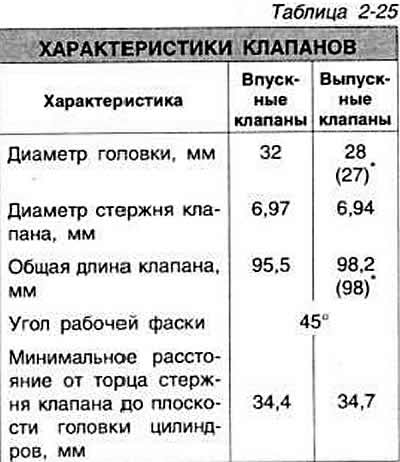
In brackets for the "ABF" engine.
Clearances in the valve drive mechanism are compensated automatically by hydraulic tappets.
Each intake and exhaust valve has two springs. The intake and exhaust valve springs are identical. Hydraulic tappets are installed directly in the cylinder head. The valves are driven by camshaft cams through the plungers of the hydraulic tappets. The free travel of the tappet plungers is no more than 0.1 mm.
Visitor comments