



In case of replacement of the front oil seal it is necessary to remove the V-belt, casing and toothed belt, as well as the pulley and toothed pulley. To unscrew the toothed pulley mounting bolt it is necessary to lock the crankshaft; for example, engage fourth or fifth gear and apply the handbrake.
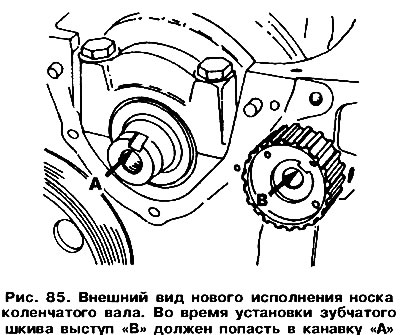
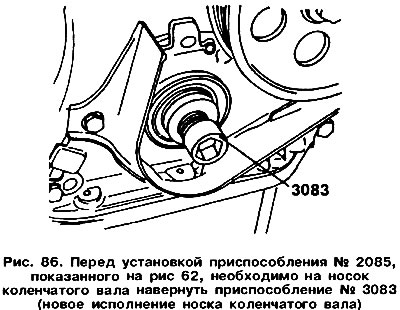
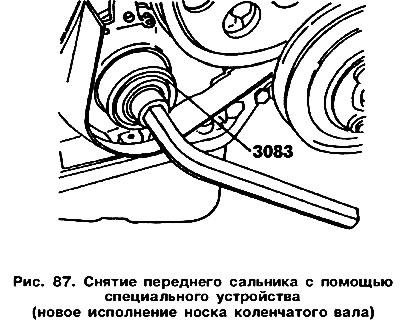
At the end of 1986, changes were made to the design of the front nose of the crankshaft (figure 85). These changes affected only those crankshafts that were supplied as spare parts. In factory assembly of engines, crankshafts of a modified design began to be used somewhat later. The operations for replacing the front oil seal will be described for both design variants below. Usually, to remove the front oil seal, use the device shown in figure 62, but in the case of a modified crankshaft, another device is needed, shown in Figure 86, the bolt of which is screwed into the nose of the crankshaft as deep as possible. And then you can use the puller shown in figure 62. Removal is carried out in the same way as described for the camshaft oil seal (figure 87).
 |
 |
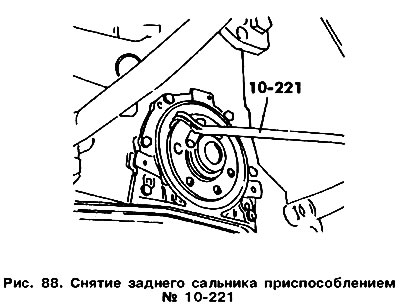
When removing the rear oil seal, you must first remove the gearbox, clutch and flywheel. To remove the oil seal, you must use the special device shown in Figure 88, or try to carefully remove it with a screwdriver, while being careful not to damage the mounting surfaces with the screwdriver. If the engine is removed from the car, you must remove the cover 2 (see figure 82) together with the gland (this cover is shown in Figure 82). Then the seal is knocked out of the cover.
Caution! A flywheel with a worn surface causing clutch slippage or with damaged ring teeth must be replaced.
Visitor comments