



Contents: Removal ↓ Installation ↓
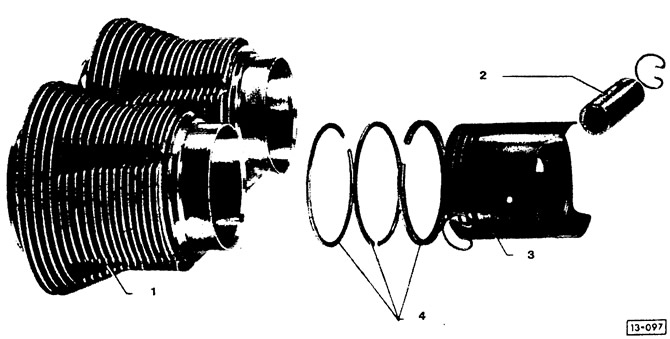
Cylinders, pistons and piston rings: 1 - cylinder (mark before disassembling); 2 - piston pin (when installing, heat the piston to a temperature of approximately 6 (PC); 3 - piston (difference in mass of individual pistons: max. 10 g); 4 - piston rings (shift the locks by 120°, the oil scraper ring lock should be located on top)
Removal
Remove and disassemble the engine (see sections "Removal and installation the engine" and "Disassembling and assembling the engine").
Remove the exhaust system (see section "Replacing the exhaust system").
Remove the cooling system fan (see chapter "Cooling system").
Remove the engine cover (see section "Removal and installation the rear engine cover").
Remove the cylinder head (see section "Removal and installation cylinder heads").
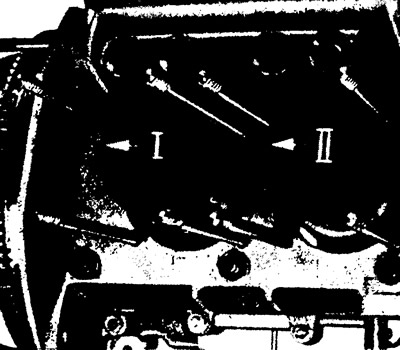
Mark the cylinders on the side and the pistons on the bottom with their serial number and an arrow pointing towards the flywheel so that they can be installed in their places later without getting mixed up.
Remove the guide shields under the cylinders and remove the cylinder. When pulling out the piston, hold it so that it does not fall down and get damaged.
Turn the crankshaft so that the piston being removed extends as far as possible.
Remove the piston pin snap rings using standard snap ring pliers.
Press out the piston pins by hand through a suitable mandrel. If the piston pin is difficult to remove, the piston can be carefully heated with a blowtorch to a temperature of about 60°C.
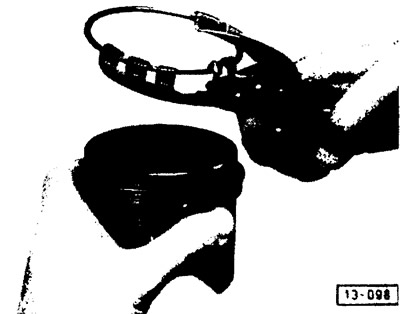
Caution! Piston rings may only be removed using piston ring pliers.
Installation
When installing new cylinders and pistons, the following requirements must be observed.
Three "cylinder-piston" repair kits are available as spare parts (normal size, 1st repair size and 2nd repair size).
Each cylinder-piston assembly of a given diameter is further subdivided into two different size classes. These classes are marked with colored dots (blue or pink) on the piston crown and cylinder fins.
Maximum difference in piston mass in a new set (for all 4 cylinders) should not exceed 10 g, therefore there are two more weight classes for pistons, which are marked with a "-" or "+" sign on the piston bottom and an additional colored dot: brown dot - gray - "+".
Before assembling used pistons, piston rings and cylinders, it is necessary to inspect the pistons, measure the gap in the piston ring joint, and check the quality of the cylinder surface.
Piston rings can only be installed using piston ring pliers. When installing, you need to take into account the type of rings.
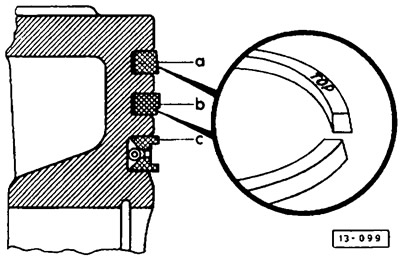
The designation "TOP" faces the piston bottom. Piston ring "a" is the upper compression ring, "b" with a groove is the lower compression ring, "c" is the oil scraper ring.
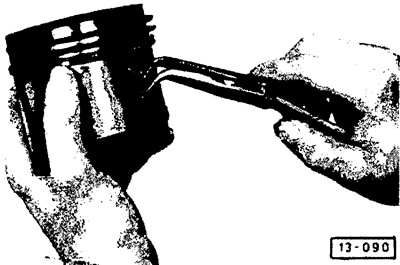
Assemble the piston. Using pliers, install the retaining rings into the pistons of the 1st and 2nd cylinders on the side facing the flywheel, and into the pistons of the 3rd and 4th cylinders on the opposite side. This will allow all piston pins to be inserted from the same side.
Place the pistons on the connecting rods (paying attention to the arrows and previously made marks indicating their belonging to the corresponding cylinders) and insert the piston pins up to the retaining rings. If the pins do not fit, preheat the pistons to approximately 60°C.
Install the second retaining ring using pliers and check that both rings snap into their grooves.
Lubricate the pistons and piston rings with engine oil.
Rotate the three piston rings so that their ring ends are rotated 120° relative to each other. In this case, the oil scraper ring lock should be directed upwards.
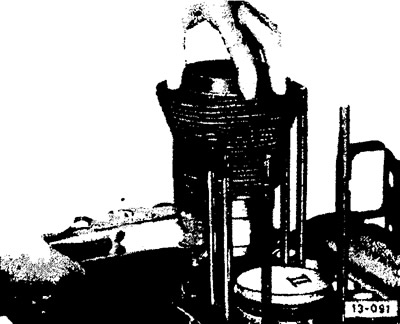
Tighten the piston rings using a clamping band, lubricate the working surface of the cylinder with oil and carefully push the cylinder onto the piston.
Check the cylinder for wear.
If pitting or wear marks occur, the cylinder must be replaced. When replacing a cylinder, the piston must also be replaced. New parts must belong to the same size class.
The cylinder seating surface, as well as the cylinder seats in the crankcase and cylinder head, must be perfectly clean. Foreign bodies can cause the cylinders to lose their seal and become damaged.
Press the cylinder against the seating surface of the crankcase, then turn it to install it so that the 4 studs on the crankcase do not touch the through holes in the cylinder cooling fins.
Install the guide shield onto the underside of the cylinder. If necessary, the shield can be bent slightly to ensure it is securely mounted on the studs.
Install the cylinder head.
Install the engine cover.
Install the cooling system fan.
Install the exhaust system.
Assemble and install the engine.
Visitor comments