



Contents: Removal ↓ Installation ↓
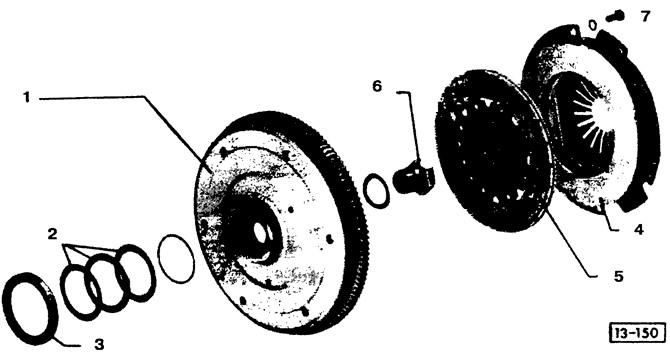
Flywheel: 1 - flywheel; 2 - spacer washers (the thickness of the washers is determined by checking the axial play); 3-cuff (can be removed with a screwdriver); 4 - clutch pressure plate (the installation position is indicated)
Removal
Remove the engine (see section "Removal and installation the engine").
Remove the clutch (see section "Removal, checking and installation the clutch").
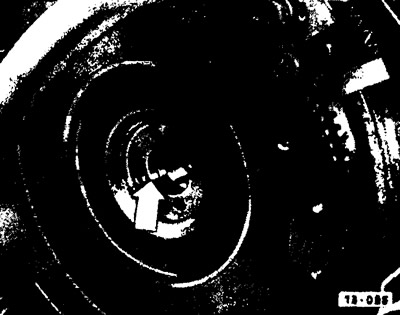
Mark the flywheel mounting position relative to the crankshaft with paint (see arrow).
Unscrew the hollow bolt. At the same time, use a screwdriver to lock the flywheel (an assistant will be needed).
Remove the flywheel.
Installation
Before installation, check the integrity of the flywheel ring gear; repair or replace the flywheel if necessary.
Check that the dowel pins and holes for them in the flywheel and crankshaft are not knocked out.
Check the needle bearing in the hollow bolt. If the bearing was washed with gasoline, lubricate it and the felt ring with oil. Remove excess grease and oil to prevent it from getting into the clutch.
Check the crankshaft axial play and replace old spacer washers if necessary (see section below "Checking and adjusting the crankshaft axial play").
(The original article is available on the website: www.vwmanual.ru)
Replace (if necessary) mounting bolts, install the flywheel in place. In this case, ensure that the marks applied during removal match.
Install the hollow bolt with the lock washer and tighten it to 350 Nm (35 kgfm). Check the flywheel for runout. The maximum end runout should not exceed 0.3 mm.
Attention! If new parts are installed (crankshaft, flywheel, clutch), then it is necessary to ensure that they are installed with their designated imbalances at an angle of approximately 120° in relation to each other. If only two parts are marked, the marks must be located at an angle of 180° to each other.
Install the clutch.
Install the engine.
Visitor comments