
English Русский
Български
Беларускі
Український
Српски
Hrvatski
Română
Polski
Slovenský
Magyar
  |  Articles  |  Sitemap  |  Contacts  |    |
Car maintenance Ford Car maintenance Hyundai Car maintenance Chevrolet Car maintenance BMW Car maintenance Audi Car maintenance Opel Car maintenance AvtoVAZ
VWmanual.ru


Main   Passat   Golf   Polo   Touareg   Tiguan   Sharan   Transporter   Others  
LT 28 (1975-1991) LT 2D (1996-2003) Beetle (1960-1986) Caddy 3 (2003-2010)

Engine malfunctions and how to fix them (VW Beetle)

  • Main
  • Volkswagen
  • Beetle
  • Power unit
  • Engine repair
  • Engine malfunctions and how to fix them
            0


If the engine does not start, the fault must be found. For an engine to start, two basic conditions must be met: the fuel-air mixture must enter the cylinders, and there must be a spark at the spark plugs. Therefore, the first thing to do is to check the fuel supply. How this is done is described in the chapter "Power supply system".

In order to determine whether there is a spark, you need to remove the high-voltage wire from the middle of the ignition distributor cap, bring it approximately 10 mm to the ground (engine) and turn the crankshaft with the starter. If a spark jumps, unscrew the spark plug, insert it into the tip, connect it to ground and turn the crankshaft again with the starter. If there is no spark, find the fault using the table below.

Caution! When connecting high-voltage wires, remember the cylinder firing sequence (1-43-2). Remove the distributor cap; there is a mark on the distributor housing. When the cover is installed, there is a wire to the 1st cylinder above this mark. High voltage wires for cylinders 4, 3 and 2 are arranged clockwise. When measuring the voltage at terminal 15 of the ignition coil using a voltmeter, the following measures must be taken to prevent electrical breakdown:


Connect the voltmeter to terminal 15 of the ignition coil and to ground.

Connect the auxiliary wire to terminal 1 of the ignition coil and to ground.

Turn on the starter and measure the voltage at the moment of starting.

The voltage must be at least 9 V. To check the distributor rotor, which has radio interference protection, an ohmmeter is required.
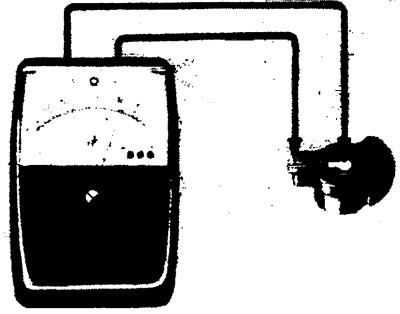


Connect the ohmmeter as shown in the figure and measure the resistance. It should be a maximum of…


Connect the ohmmeter as shown in the figure and measure the resistance. It should be a maximum of 10 kOhm. The resistance of the high-voltage wires, including the spark plug tip, is checked in the same manner. The resistance of each high-voltage wire, including the tip, must be no more than 10 kOhm.

Problem: The engine starts poorly or does not start at all


CauseSolution
The launch is not performed correctlyAt temperatures below 0°C: Slowly depress the accelerator pedal once and release it. Turn on the ignition and immediately engage the starter without pressing the accelerator pedal
At temperatures above 0°C: When starting, slowly press the accelerator pedal
If the engine is hot: press the accelerator pedal all the way down and start the engine. After starting, immediately release the pedal
No spark. Distributor cap is wet or dirtyClean and dry the lid, treat it with a special aerosol
Cracks and burn marks in the distributor capReplace the cover
The carbon contact in the distributor cap is worn outReplace the contact
The gap in the breaker contacts is too large or too smallAdjust the gap
The breaker contacts are burnt outReplace contacts
The ignition distributor rotor is faultyReplace the runner
The resistance of the ignition distributor rotor is too highReplace the runner
The resistance of the high-voltage wire or spark plug tip is too highReplace the wire or tip
The tips are installed in the wrong orderInstall the tips correctly
Spark plugs are flooded with gasoline due to numerous starting attemptsDry the candles
The spark plugs are wet or dirty on the outsideClean and dry the candles, put protective caps on them and their tips
The ignition coil power is too lowCheck the coil wires for tightness of connection and reliable contact
Too little (less than 9 V) voltage at terminal 15 of the ignition coilCharge the battery, restore contact between the battery and the body or the gearbox and the body, eliminate the voltage drop between the battery, the light switch and terminal 15
The ignition coil has cracks and traces of burningReplace the coil
Voltage drop due to electrical connections and wires coming into contact with the engineLay electrical wires correctly
The capacitor in the ignition distributor has poor contact or is faultyFix the capacitor or replace it
The ignition timing is offsetAdjust the ignition timing
The starter turns too slowlyCharge the battery, fill it with all-season oil in the cold season, check the starter
The valve clearance is incorrectly adjustedAdjust the gap
Insufficient compression in the engine cylindersAdjust valve clearances, repair the engine

The original can be seen on the portal: www.VWmanual.ru

This article is available at russian, bulgarian, belarusian, ukrainian, serbian, croatian, romanian, polish, slovak, hungarian
The text has been checked: Kolesnikov Artem

Share information:

Previous articles
Removal, checking and installation connecting rods
Removal, disassembly, assembly and installation of the crankshaft
Removal, checking and installation the camshaft
Disassembly, inspection and assembly of the crank mechanism
Main engine components
Intake manifold and preheating ducts
Next articles


Similar articles from other manuals for VW cars:
Possible malfunctions of the fuel injection control subsystem… Passat B4 (1988-1996)
Possible engine malfunctions Golf 1 (1974-1984, petrol)
Starting the engine from an auxiliary battery Polo 3 (1995-2003)
Car engine number Touareg 1 (2002-2006)
Car engine number Tiguan 1 (2007-2015)
Checking the engine oil level and replacing it Sharan 1 (1995-2000)
Diagnosis of wiper malfunctions Transporter T4 (1990-2003)
Link to this page in different formats


Visitor comments


No comments yet


How much will 32 + 46 =


Caddy 3 
  • General information
  • User manual
  • Daily care
  • Maintenance
  • Petrol engines 1.4 l
  • Engine repair
  • Cooling and lubrication system
  • Power and exhaust system
  • Petrol engines 1.6 l
  • Engine repair
  • Cooling and lubrication system
  • Power and exhaust system
  • Diesel engines
  • Engine repair
  • Cooling and lubrication system
  • Power and exhaust system
  • Transmission
  • Mechanical gearbox 0AH
  • Mechanical gearbox 0A4
  • Drive shafts
  • Chassis
  • Car suspension
  • Steering
  • Brake system
  • Body and wiring diagrams
  • Interior and exterior
  • Electrical circuits
Beetle 
  • General information
  • Maintenance
  • Power unit
  • Engine repair
  • Cooling and lubrication system
  • Supply system
  • Exhaust system
  • Transmission
  • Clutch
  • Car gearbox
  • Chassis
  • Front suspension
  • Rear suspension
  • Steering
  • Brake system
  • Wheels and tires
  • Body
  • Exterior
  • Electrical equipment
  • Equipment and devices
  • Power devices
  • Electrical circuits
LT 2D 
  • General information
  • User manual
  • Maintenance
  • Power unit
  • Petrol engines 2.3 l
  • Diesel engines 2.5 l
  • Diesel engines 2.8 l
  • Injection system (diesel 2.8 l)
  • Transmission
  • Clutch
  • Manual gearbox
  • Differential
  • Chassis
  • Car suspension
  • Steering system
  • Brake system
  • Body
  • Body elements
  • Heating system
  • Electrical equipment
  • Equipment and devices
  • Electrical circuits
LT 28 
  • General information
  • Maintenance
  • Power unit
  • Petrol engines 2.0L
  • Petrol engines 2.4L
  • Diesel engines
  • Cooling and heating
  • Fuel and exhaust system
  • Ignition system
  • Transmission
  • Clutch
  • Car gearbox
  • Cardan shaft
  • Rear axle
  • Chassis
  • Brake system
  • Car suspension
  • Steering system
  • Body
  • Body elements
  • Doors, locks and windows
  • Electrical equipment
  • Power devices
  • Equipment and devices
  • Electrical circuits
VWmanual.ru © 2016-2026 | Mobile version | News and articles | Sitemap: EN BG BY UA RS HR RO PL SK HU | Write message | Site search
Passat B2 • Passat B3 • Passat B4 • Passat B5 • Passat B6 • Golf 1, diesel • Golf 1, petrol • Golf 2, petrol • Golf 2 • Golf 3 • Golf 4 • Golf 5 • Polo 3 • Polo 4 • Touareg 1 • Tiguan 1 • Sharan 1 • Transporter T3 • Transporter T4 • LT 28 • LT 2D • Beetle • Caddy 3 •
Our website uses cookies to ensure functionality and convenience.