



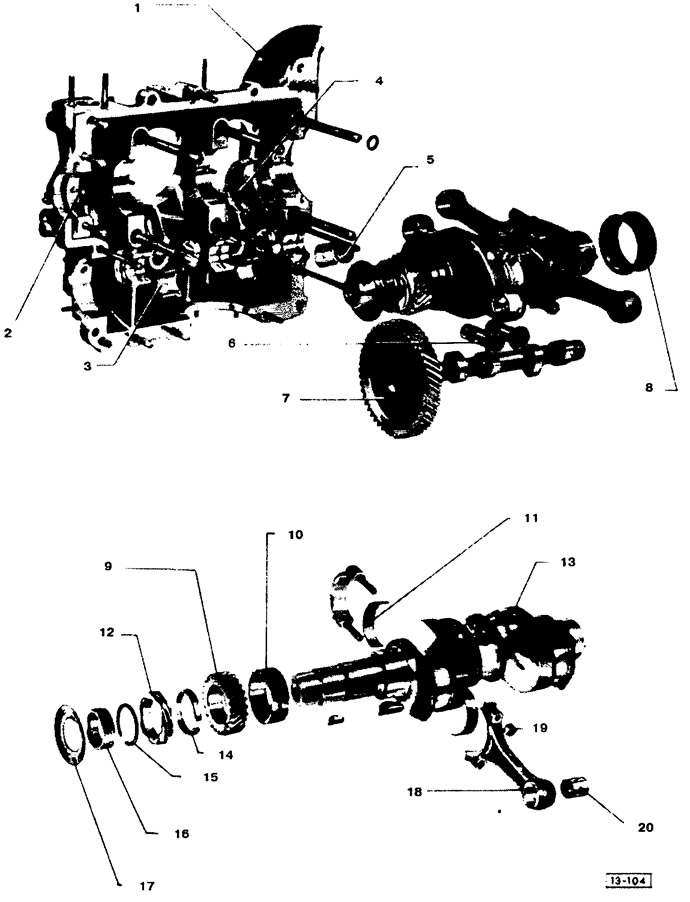
Crank mechanism: 1 - engine crankcase (clean and blow out the oil channels with compressed air, lubricate the adjacent surfaces with sealant);2 - mounting pin (pay attention to the tightness of the installation; 3 - camshaft bearing (lubricate with oil, install the ends in the crankcase recesses); 4 - 2nd main bearing (lubricate with oil, maintain the installation position, do not move); 5 - camshaft locking cover (install with sealant); 6 - pusher (lubricate with oil, secure with spring clamps); 7 - camshaft;8-1st main bearing (lubricate with oil; the hole for the dowel pin is directed towards the flywheel); 9 crankshaft gear;10 - main bearing (3 pcs.) (lubricate with oil; the hole for the dowel pin is directed towards the crankshaft cheek); 11 - bearing shell (maintain the installation position, do not move); 12 - ignition distributor drive gear (removed together with the crankshaft gear); 13 - crankshaft (clean and blow out oil channels with compressed air; do not install without corrosion protection); 14 - mounting ring; 15 - retaining ring;16 - 4th main bearing (lubricate with oil; the groove is directed towards the oil deflector disc); 17 - oil deflector disc (concave side - towards the belt pulley); 18 - connecting rod; 19 - 35 Nm (3.5 kgfm) (lubricate the mating surfaces with oil, connecting rod bolts (in a car with a 1200 engine) replace); 20 - connecting rod bushing
Disassembly
Remove the engine (see section "Removal and installation the engine").
Remove the exhaust system (see section "Replacing the exhaust system").
Remove the intake manifold together with the carburetor (see section "Removal and installation the carburetor").
Remove the cooling system fan (see chapter "Cooling system").
Remove the oil radiator (see the section "Removing and installing the oil radiator").
Remove the ignition distributor and its drive shaft (see subsection "Removal and installation the ignition distributor").
Remove the fuel pump (see section "Removal and installation the fuel pump").
Remove the V-belt pulley (see section "Replacing V-belt pulleys").
Remove the clutch (see section "Removal, checking and installation the clutch").
Caution! When replacing the engine, pay special attention to the installation instructions.
Remove the flywheel (see section "Removal and installation the flywheel").
Remove the oil filter with the generator bracket, oil pressure sensor and mesh oil filter (see chapter "Lubrication system").
Remove the oil pump (see section "Removal, checking and installation the oil pump").
The article is posted on the portal [VWmanual]
Remove the cylinder head (see section "Removal and installation cylinder heads").
Remove the cylinders (see section "Removal and installation cylinders").
Remove the pistons (see section "Removal and installation of cylinders, pistons and piston rings").
Using a socket wrench, unscrew the nuts from the crankcase mounting studs.
Turn the crankcase so that the left half is located at the bottom.
Secure the tappets to the right half of the crankcase with wire or spring clips.
Loosen the top half of the crankcase with light blows of a rubber hammer and lift it up. Never use a screwdriver or other auxiliary tool to force the joint apart, otherwise the sealing surfaces will be damaged and the crankcase will become unusable. When lifting the right half of the crankcase, care must be taken to ensure that the connecting rods do not tip over to the side and damage the sealing surface of the left half of the crankcase.
Remove the crankshaft and camshaft.
Attention! Mark the mounting position of the bearings to be separated. When removing the crankshaft and camshaft, make sure that all camshaft bearings and the 2nd crankshaft bearing are separated. Bearings may stick to the working surfaces of the shafts and be damaged during removal.
The camshaft bearings and the 2nd crankshaft bearing should only be removed after they have all been marked.
Pull 6 sealing rings off the studs of the 3rd bearing support.
Remove the valve lifters.
Remove the lubrication system safety valve (see section "Removal and installation the safety valve").
Examination
Using kerosene, clean the sealing surfaces of both crankcase halves from any remaining sealing gasket, being careful not to damage the metal surface.
Carefully inspect the crankcase halves for damage and scratches.
Check the studs for tightness. Threaded inserts made of wire spiral can be screwed into holes with worn threads.
Fasten both halves of the crankcase together without using sealant. Observe the specified tightening torques: 17 mm wrench - 35 Nm (3.5 kgfm), 13 mm wrench - 20 Nm (2.0 kgfm).
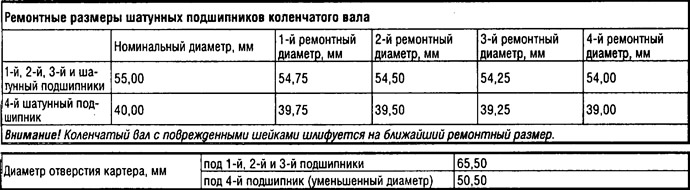
Check the diameters of the holes in the crankcase for the crankshaft bearings using a bore gauge and a micrometer.
| Hole in the crankcase | Diameter, mm |
| under the 1st, 2nd and 3rd bearings | 65,00 |
| under the 4th bearing | 50,00 |
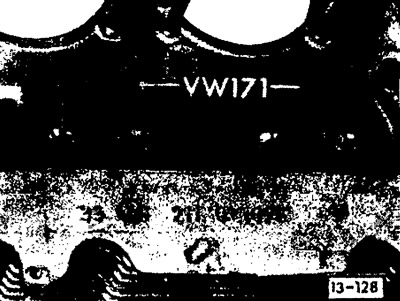
Please note! The engine being installed in place of the one being replaced may differ from the latter due to additional processing of various parts. By means of additional processing it is possible to obtain installation dimensions that are larger or smaller than the nominal ones. A crankcase with an additionally processed, leveled joint surface or with holes for the increased size of the crankshaft bearings is marked on the end side of the right half of the crankcase (near the joint surface) with the letters "P" or "O". Engines designated with the letter "O" have oversized V-belt pulleys. These pulleys are marked with two circular grooves on the front side. In the case of additionally machined cylinder seating surfaces, compensating washers are installed between the crankcase and the cylinder head gasket. The installation of compensating rings cannot be neglected, otherwise the compression in the engine cylinders will change.
Assembly
Please note! Both halves of the crankcase are machined as an assembly during manufacturing. Therefore, they must also be replaced together.
Thoroughly wash both halves of the crankcase in kerosene and blow out the oil channels with compressed air.
Raise the left half of the crankcase.
The crankshaft and camshaft are installed correctly if the mark on the camshaft is located between the marks (see arrow) crankshaft gears.
Lubricate the crankshaft and camshaft bearing shells with oil and install the shells according to the marks.
Install the crankshaft and camshaft, observing the markings.
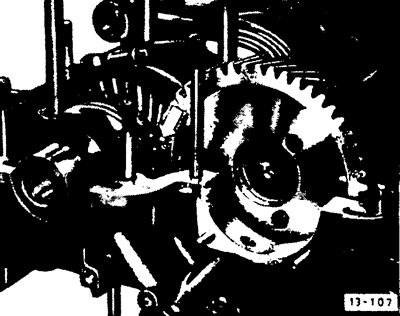
Place 6 new sealing rings on the studs.
Evenly coat the mating surfaces of the crankcase halves with a thin layer of Curil sealant. Avoid getting any sealant in the crankshaft and camshaft bearing oil passages.
Insert the oiled tappets into the right half of the crankcase and secure them with spring clips or wire.
Install the camshaft locking cover with the bottom of the cover facing outward, having lubricated it with sealant.
Connect the crankcase halves.
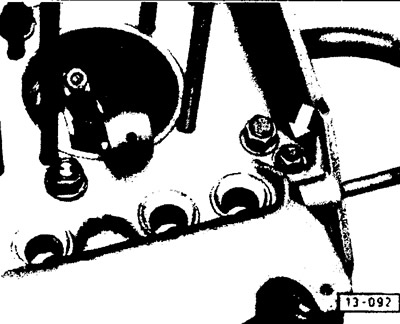
First tighten the M8 nut to 20 Nm (see arrow), located next to the M12 stud of the 1st crankshaft bearing. Then tighten the M12 nuts to a torque of 35 Nm. After this, tighten all remaining M8 nuts to a torque of 20 Nm.
Caution! Follow the specified tightening order for the nuts.
Check the ease of rotation of the crankshaft.
Assemble the engine in the reverse order of disassembly.
Visitor comments