



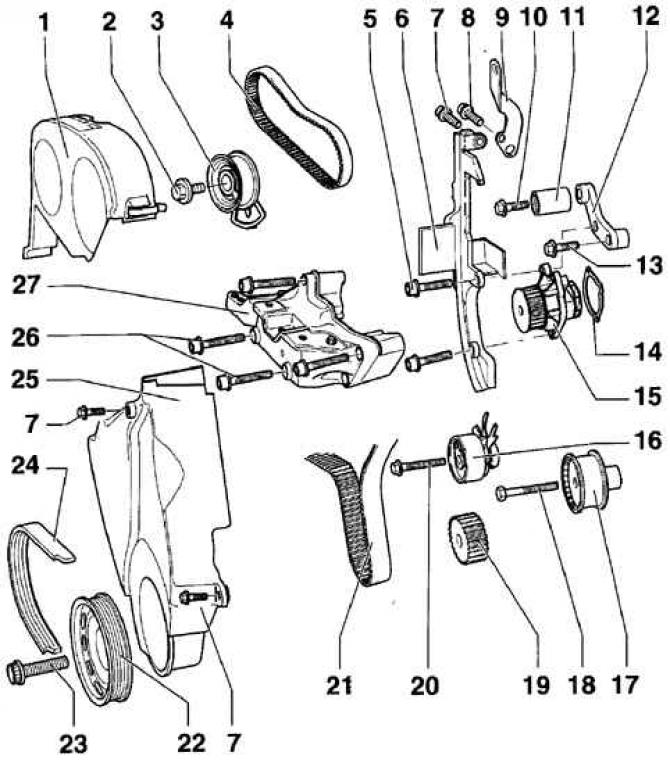
- 1 - Upper timing belt casing;
- 2 - bolt, 20 Nm;
- 3 - tension roller of the connecting belt;
- 4 - toothed connecting belt.
Check the condition of the timing belt. Before removing the timing belt, it is necessary to apply an arrow to it indicating the direction of rotation of the timing belt;
- 5 - bolt, 20 Nm;
- 6 - rear toothed belt cover;
- 7 - bolt 10, Nm;
- 8 - bolt 20, Nm;
- 9 - eye;
- 10 - guide roller mounting bolt, 25 Nm;
- 11 - guide roller;
- 12 - bracket;
- 13 - bolt, 50 Nm;
- 14 - Seal. If damaged, use a new seal;
- 15 - water pump;
- 16 - tension roller of the main toothed belt;
- 17 - guide roller;
- 18 - bolt, 50 Nm;
- 19 - Crankshaft timing belt pulley;
- 20 - bolt, 20 Nm;
- 21 - main toothed belt. Check the condition of the toothed belt. Before removing the toothed belt, it is necessary to apply an arrow to it indicating the direction of rotation of the toothed belt. Do not bend the toothed belt;
- 22 - Belt pulley. There is a lock for correct installation of the belt pulley;
- 23 - bolt, 90 Nm + turn further by 90°. A new bolt must be used during installation. Before screwing in the bolt, lubricate the bearing surface of the bolt head with a thin layer of engine oil. Turning the bolt further by 90° can be done in several steps;
- 24 - V-belt. Before removing the V-belt, it is necessary to apply an arrow to it indicating the direction of rotation of the V-belt;
- 25 - lower toothed belt casing;
- 26 - bolt, 50 Nm;
- 27 - Engine holder
Location of timing belts on the 1.4-I engine
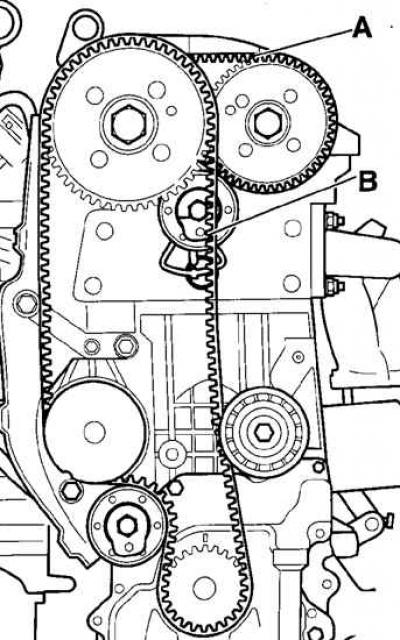
- A - toothed belt connecting the camshaft pulleys;
- B - main toothed belt
The camshaft that controls the intake valves is driven by a toothed belt from the crankshaft pulley. The camshaft that controls the exhaust valves is driven by a toothed belt from the camshaft pulley that controls the intake valves.
Warning: General timing belt replacement procedures applicable to all engines are described in subsection 2.1.3.2this section only covers the differences relating to the 1.4-I engine.
ORDER OF EXECUTION
1. Remove the four screws and remove the upper engine cover.
2. Remove the air filter.
3. Remove the upper timing belt cover.
[The information is available on the website www.VWManual.ru]
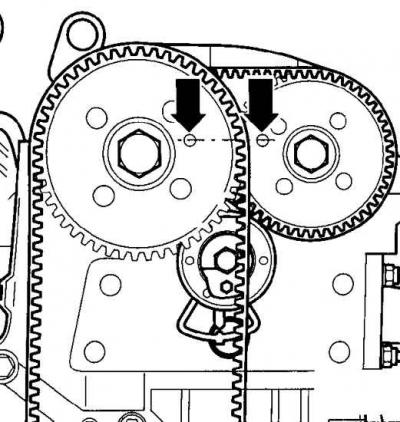
4. Set the piston of the first cylinder to the top dead center in the compression stroke. In this position, the mounting holes (indicated by arrows) on the camshaft pulleys must be directed towards each other and be in line (the location of the mounting holes on the 1.4-I engine is shown). In this position, a mandrel or 8 mm drill shank can be inserted into the mounting holes.
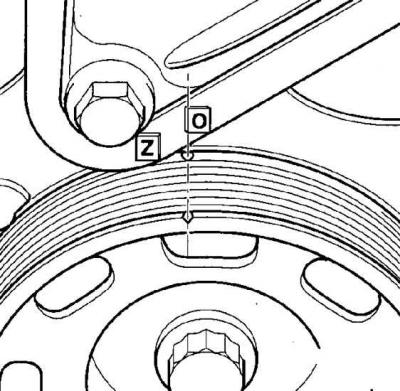
5. When setting the piston of the first cylinder to TDC, the mark on the crankshaft pulley should align with the pointer.
6. Remove the right powertrain support (see subsection 2.1.3).
7. Lower the right side of the engine until the crankshaft pulley mounting bolt is accessible.
8. Remove the auxiliary V-belt.
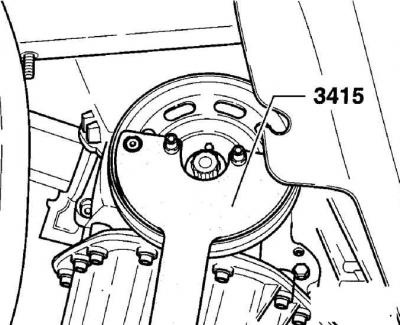
9. Using a special tool to hold the crankshaft from turning, unscrew the central bolt securing the toothed and V-belt pulleys.
10. Remove the V-belt pulley from the crankshaft and then, using two thick washers, hand-tighten the crankshaft pulley mounting bolt.
Cars with air conditioning
11. Unscrew the V-belt guide and tension roller.
12. Unscrew the lower part of the timing belt cover.
13. If the timing belts are to be reused, use chalk or paint to mark the direction of rotation of the timing belts.
14. Loosen the main timing belt tension roller mounting nut, causing the roller to rotate and relieve the belt tension. Remove the main timing belt.
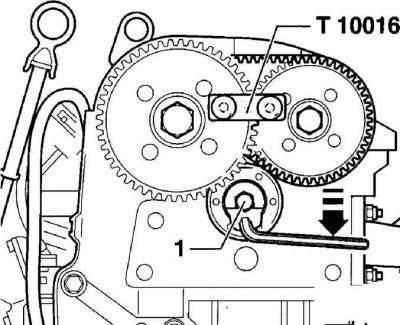
15. Loosen the bolt (1) securing the auxiliary toothed belt tension roller and, by turning the tension roller clockwise, loosen the belt tension. Secure the camshaft pulleys with a special tool and remove the toothed belt.
Warning: After removing the timing belts, do not rotate the camshaft pulleys, otherwise the valves may collide with the pistons.
16. Install the toothed belt in accordance with the previously made markings indicating the direction of rotation of the toothed belt. When viewed from the front of the engine, the engine pulleys rotate clockwise.
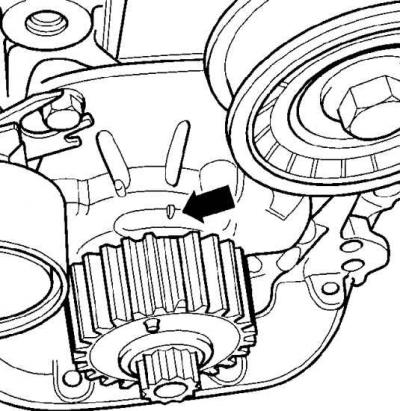
17. Check that the cut tooth (indicated by the arrow) on the crankshaft toothed belt pulley is aligned with the indicator on the front engine cover.
18. Install the connecting toothed belt first on the camshaft toothed belt pulley that controls the exhaust valves, then on the camshaft toothed belt pulley that controls the intake valves. The loose branch of the belt should be at the bottom on the tension roller side.
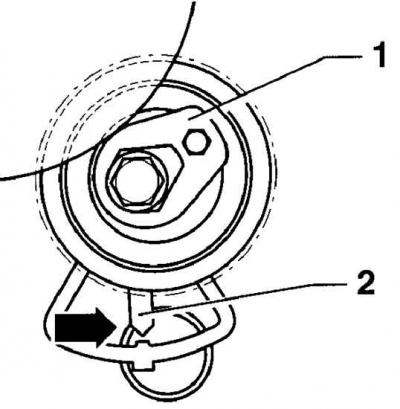
19. Turn the auxiliary timing belt tension roller (1) so that the pointer (2) aligns with the protrusion on the cylinder head.
20. Turn the auxiliary toothed belt tension roller with an internal Allen key. Tighten the tension roller mounting bolt to 20 Nm.
21. Install the main timing belt in sequence on the water pump pulley, tension roller, crankshaft pulley, idler roller and camshaft pulley that controls the intake valves.
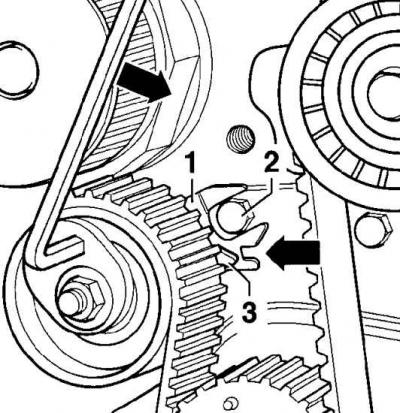
22. Check the installation position of the main toothed belt tension roller. The fastening bolt (2) must pass through the recess of the movable plate (1) of the roller (3 - pointer).
23. Using an Allen key, turn the main timing belt tension roller until the pointer (3) aligns with the recess on the sliding plate. In this position, tighten the tension roller mounting nut to 20 Nm.
24. Check that the crankshaft and camshaft pulleys are in the position where the piston of the first cylinder is installed at top dead center.
25. Install the timing belt cover.
26. Install the crankshaft belt pulley and secure it with a new bolt.
27. Before screwing in the bolt, lubricate the bottom of the bolt head with clean engine oil. Tighten the bolt to 90 Nm and then turn it through an angle of 90°.
28. Secure the support to the cylinder block by tightening the mounting bolts to a torque of 50 Nm.
29. Using new bolts, secure the right powertrain mount.
30. Install the power steering fluid reservoir.
31. Install the V-belt.
Visitor comments