



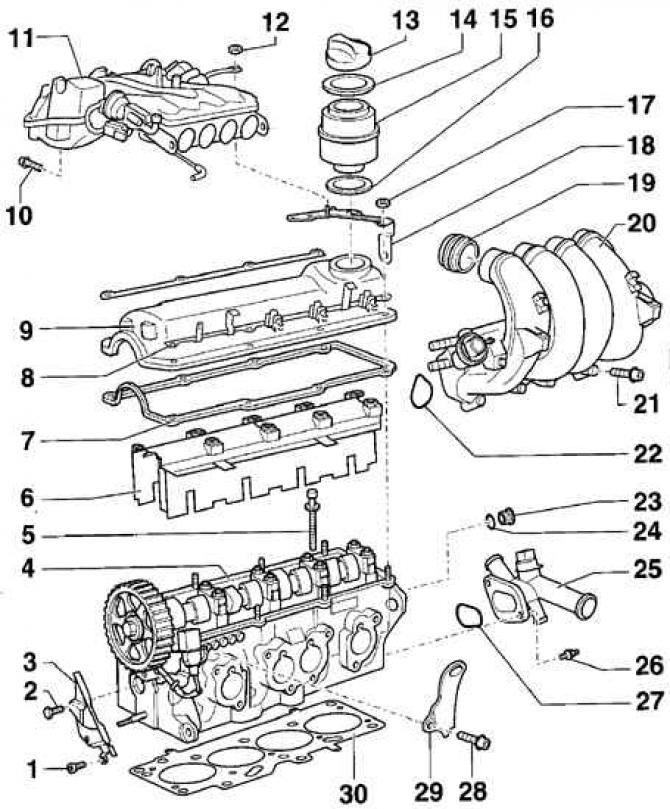
- 1 - bolt, 15 Nm;
- 2 - bolt, 20 Nm;
- 3 - rear toothed belt cover;
- 4 - cylinder head;
- 5 - cylinder head mounting bolt. New bolts must be used during installation;
- 6 - oil deflector;
- 7 - cylinder head cover seal. If damaged, a new seal must be used. When installing the seal, apply a thin layer of D2 sealant to the sealing surface;
- 8 - reinforcing plates;
- 9 - cylinder head cover;
- 10 - bolt, 10 Nm;
- 11 - upper part of the suction pipeline;
- 12 - nut, 10 Nm;
- 13 - oil filler cap;
- 14 - sealing ring;
- 15 - crankcase ventilation housing;
- 16 - Seal. If damaged, a new seal must be used;
- 17 - nut, 10 Nm;
- 18 - bracket;
- 19 - seal;
- 20 - lower part of the suction pipeline;
- 21 - bolt 20 Nm;
- 22 - Intake manifold seal. If damaged, use a new seal;
- 23 - threaded plug 15 Nm;
- 24 - sealing ring. If damaged, a new sealing ring must be used;
- 25 - flange with branches;
- 26 - bolt, 10 Nm;
- 27 - Seal. If damaged, a new seal must be used;
- 28 - bolt 20 Nm;
- 29 - eye;
- 30 - Cylinder head gasket. Use only a new gasket when installing
After installing the cylinder head, it is necessary to add fresh coolant.
The original article is available at: www.VWManual.ru
A burnt or defective cylinder head gasket is determined by the following signs:
- reduction of engine power;
- the coolant level decreases. White steam comes out of the exhaust pipe;
- decrease in engine oil level;
- the presence of coolant in the engine oil. In this case, the oil level increases. If there is coolant in the engine oil, the engine oil turns gray and has foam bubbles;
- presence of motor oil in the coolant;
- intense bubbling of coolant;
- reduction of compression in two adjacent engine cylinders.
Warning: This section describes the operations for removing the cylinder head on the 1.8-I four-cylinder petrol engine. Separate instructions are given for the 1.6-I engine. Before removing the cylinder head, ensure that all hoses, pipes and electrical connectors are disconnected from the cylinder head.
Visitor comments