



These engines have hydraulic tappets which are automatically controlled by the oil pressure to compensate for the clearance between the camshaft lobe and the corresponding valve stem. Therefore, regular checking and adjustment of the valve clearances is not required. However, it is essential that good quality engine oil of the recommended viscosity is used and that the engine oil is changed at the recommended intervals. When starting a cold engine, there is a slight delay until the engine oil pressure equalizes throughout the engine, especially in the hydraulic tappets. Therefore, the valves may "knock" for about 10 seconds, after which the knocking disappears. This is a normal condition, provided that all tappets operate silently thereafter.
After the engine has not been started for several days, the valves may "knock" for a longer period of time, as almost all the oil drains from the top of the engine and the bearing surfaces. During this time, care must be taken not to damage the engine, i.e., avoid sudden changes in engine speed until all the tappets are filled with engine oil. When the engine warms up, the fast idle speed (maximum from 2000 to 2500 rpm) should not be exceeded for 10-15 minutes, or until the valve tappet noise stops. If tappet noise is present, turn off the engine and perform the following steps.
Execution order
1. Disconnect and remove the fuel injection system components.
2. Remove the cylinder head cover. Remove the oil deflector and gasket from the cylinder head.
3. Rotate the crankshaft until the cam lobe above the tappet being tested is straight up.
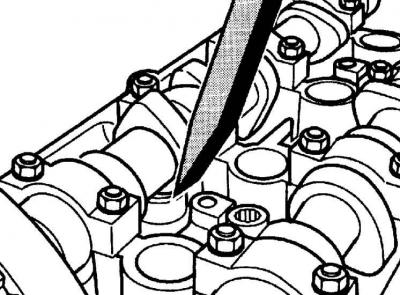
4. Press the plunger with a wooden or plastic wedge.
(The information is posted on this website vwmanual.ru)
5. If the free play of the tappet is more than 0.1 mm, the tappets must be replaced.
Visitor comments