
English Русский
Български
Беларускі
Український
Српски
Hrvatski
Română
Polski
Slovenský
Magyar
  |  Articles  |  Sitemap  |  Contacts  |    |
Car maintenance Ford Car maintenance Hyundai Car maintenance Chevrolet Car maintenance BMW Car maintenance Audi Car maintenance Opel Car maintenance AvtoVAZ
VWmanual.ru


Main   Passat   Golf   Polo   Touareg   Tiguan   Sharan   Transporter   Others  
Passat B2 (1981-1988) Passat B3 (1988-1993) Passat B4 (1988-1996) Passat B5 (1996-2005) Passat B6 (2005-2010)

Checking hydraulic valve lifters (VW Passat B5)

  • Main
  • Passat
  • Passat B5
  • Power unit
  • Engine repair
  • Checking hydraulic valve lifters
            0


Setting the valve clearances correctly is very important because they largely determine the performance of the engine. If the valve clearances are too large, the engine will be noisy and the engine efficiency will be reduced because the valves open too late and close too early. A more serious problem occurs if the valve clearances are too small because the valves cannot close completely when the engine is hot, which can lead to serious engine damage.

These engines have hydraulic tappets which are automatically controlled by the oil pressure to compensate for the clearance between the camshaft lobe and the corresponding valve stem. Therefore, regular checking and adjustment of the valve clearances is not required. However, it is essential that good quality engine oil of the recommended viscosity is used and that the engine oil is changed at the recommended intervals. When starting a cold engine, there is a slight delay until the engine oil pressure equalizes throughout the engine, especially in the hydraulic tappets. Therefore, the valves may "knock" for about 10 seconds, after which the knocking disappears. This is a normal state of affairs, provided that all tappets subsequently operate silently.

After the engine has not been started for several days, the valves may "knock" for a longer period of time, as almost all the oil drains from the top of the engine and the bearing surfaces. During this time, care must be taken not to damage the engine, i.e., avoid sudden changes in engine speed until all the tappets are filled with engine oil. When the engine warms up, the fast idle speed (maximum from 2000 to 2500 rpm) should not be exceeded for 10-15 minutes, or until the valve tappet noise stops. If tappet noise is present, turn off the engine and perform the following steps.


Execution order


1. Disconnect and remove the fuel injection system components.

2. Remove the cylinder head cover. Remove the oil deflector and gasket from the cylinder head.

3. Rotate the crankshaft until the cam lobe above the tappet being tested is straight up.
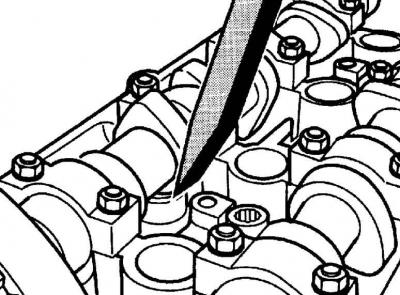
3. Rotate the crankshaft until the cam lobe above the tappet being tested is straight up.


4. Press the plunger with a wooden or plastic wedge.

If the free travel of the tappet is more than 0.1 mm, replace the tappets. To do this, turn the crankshaft and set the piston of the first cylinder to TDC.

This article is available at russian, bulgarian, belarusian, ukrainian, serbian, croatian, romanian, polish, slovak, hungarian
The text has been checked: Tarasov Ivan

Share information:

Previous articles
Removal and installation of cylinder head of 1.6-I and 1.8-I engines
Removal and installation a timing belt for petrol engines
Lower engine compartment splash guard
Engine design
Engine specifications
Next articles
Cylinder head repair
Gas distribution mechanism drive
Removal and installation the cylinder head of the 2.3-I-VR5 engine
Removal and installation a toothed belt of a diesel engine
Removal and installation the cylinder head of a diesel engine
Removal and installation the timing belt of the 2.8-I-V6 engine


Similar articles from other manuals for VW cars:
Checking hydraulic valve lifters of 1.6-/1.8-I engines Golf 4 (1997-2004)
Checking the valve guide bushing Polo 3 (1995-2003)
Checking the valve timing Touareg 1 (2002-2006)
Checking the operation of the intake manifold flap Tiguan 1 (2007-2015)
Checking the hydraulic system for leaks Sharan 1 (1995-2000)
Checking the valve guides Transporter T4 (1990-2003)
Checking the valve guides Caddy 3 (2003-2010)
Link to this page in different formats


Visitor comments


No comments yet


How much will 37 + 40 =


Passat B6 
  • General information
  • User manual
  • Maintenance
  • Petrol engine 1.6L
  • Engine repair
  • Cooling and lubrication system
  • Fuel injection system
  • Petrol engine 2.0L
  • Engine repair
  • Lubrication system
  • Cooling system
  • Fuel and exhaust systems
  • Diesel engine 2.0L
  • Engine repair
  • Cooling and lubrication system
  • Fuel and exhaust systems
  • Transmission
  • Clutch
  • Mechanical gearbox
  • Automatic gearbox
  • Drive shafts
  • Chassis
  • Wheels and tires
  • Car suspension
  • Steering
  • Brake system
  • Body
  • Exterior (external elements)
  • Electrical equipment
  • Power devices
  • Lighting and appliances
  • Electrical circuits
Passat B5 
  • General information
  • User manual
  • Weekly checks
  • Maintenance
  • Power unit
  • Engine repair
  • Cooling system
  • Fuel system (petrol)
  • Fuel system (diesel)
  • Engine management
  • Exhaust system
  • Transmission
  • Clutch
  • Car gearbox
  • Drive shafts
  • Chassis
  • Car suspension
  • Wheels and tires
  • Steering
  • Brake system
  • Body
  • Exterior (external elements)
  • Interior (internal elements)
  • Doors and covers
  • Ventilation and heating
  • Electrical equipment
  • Power devices
  • Lighting and appliances
  • Electrical circuits
Passat B4 
  • General information
  • User manual
  • Maintenance
  • Technical data
  • 8-valve engine
  • Engine repair
  • Cooling and lubrication system
  • Supply system
  • Ignition system
  • Fuel injection «Mono-Jetronic»
  • Control system «Mono-Motronic»
  • Control system «Digifant»
  • Control system «Simos»
  • 16-valve engine
  • Engine repair
  • Cooling and lubrication system
  • Fuel injection «K-Jetronic»
  • Control system «KE-Motronic»
  • Control system «Digifant»
  • Diesel engine
  • Engine repair
  • Cooling and lubrication system
  • Power and control system
  • Turbocharging system
  • Digital control system
  • Transmission
  • Clutch
  • Manual gearbox
  • Hydromechanical gearbox
  • Front wheel drive
  • Chassis
  • Car suspension
  • Steering
  • Brake system
  • Body
  • Body elements
  • Electrical equipment
  • Power devices
  • Lighting and appliances
  • Electrical circuits
Passat B3 
  • General information
  • User manual
  • Driving Tips
  • Maintenance instructions
  • Technical data
  • Power unit
  • Engine repair
  • Ignition system
  • Lubrication system
  • Cooling system
  • Supply system
  • Petrol injection system
  • Diesel engine
  • Exhaust system
  • Transmission
  • Clutch
  • Car gearbox
  • Chassis
  • Suspension
  • Steering
  • Brake system
  • Wheels and tires
  • Body
  • Exterior
  • Interior
  • Heating system
  • Electrical equipment
  • Power devices
  • Lighting system
  • Equipment and devices
  • Wiper system
  • Electrical circuits
Passat B2 
  • General information
  • Introduction to instructions
  • User manual
  • Power unit
  • Engines 4-cylinder FZ
  • Engines 4-cylinder
  • Engines 5-cylinder
  • Transmission
  • Clutch
  • Four-speed gearbox
  • Five-speed gearbox
  • Hydromechanical gearbox
  • Front wheel drive
  • Chassis
  • Front suspension
  • Rear suspension
  • Steering
  • Brake system
  • Body
  • Body elements
  • Electrical equipment
  • Equipment and devices
  • Electrical circuits
VWmanual.ru © 2016-2026 | Mobile version | News and articles | Sitemap: EN BG BY UA RS HR RO PL SK HU | Write message | Site search
Passat B2 • Passat B3 • Passat B4 • Passat B5 • Passat B6 • Golf 1, diesel • Golf 1, petrol • Golf 2, petrol • Golf 2 • Golf 3 • Golf 4 • Golf 5 • Polo 3 • Polo 4 • Touareg 1 • Tiguan 1 • Sharan 1 • Transporter T3 • Transporter T4 • LT 28 • LT 2D • Beetle • Caddy 3 •
Our website uses cookies to ensure functionality and convenience.