



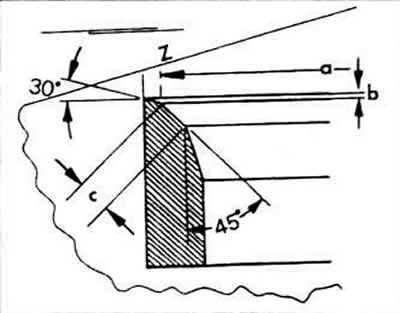
Main parameters of intake valves:
- a - valve seat diameter, see table of dimensions and adjustment parameters;
- b - maximum processing size;
- c - 1.5-1.8 mm - valve seat width;
- Z - lower edge of the cylinder head;
- 30° - upper correction angle;
- 45° - valve seat angle.
Main parameters of exhaust valves:
- a - valve seat diameter, see table of dimensions and adjustment parameters;
- b - maximum processing size;
- c - 1.5 mm - valve seat width;
- Z - lower edge of the cylinder head;
- 30° - upper correction angle;
- 45° - valve seat angle.
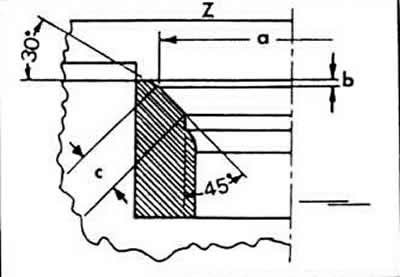
The following measurements must be taken to determine the amount of additional treatment required.
Insert the valve into its guide and press firmly into the seat.
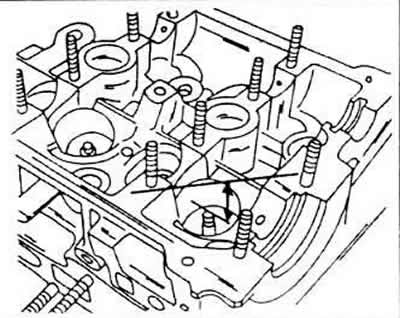
Measure the distance -arrow- (a) between the valve stop and the upper edge of the cylinder head.
Calculate the maximum permissible size of additional milling of the measured value and the permissible minimum size. For a normal head, this size is 34.4 mm (for exhaust valves) and 34.7 (for intake valves). If you subtract the minimum distance from the measured value, you get the permissible maximum size (b).
Valve seats must be additionally milled if new valve guides are being inserted.
In this case, proceed as follows.
Rout a 45° angle and then use a 30° router to lightly rough up the top edge of the seat to reduce the valve seat width to 1.5-1.8mm (for intake valves) or 1.8 mm (for exhaust valves). The milling should be stopped as soon as the seat width reaches the specified value, now the diameter of the exhaust valve seats is smoothly reduced. When additionally milling the seats, pay attention not to disturb the radius of this reduction.
To avoid the seat being cut too deeply into the cylinder head, the above measurement should be taken.
[The original text is available on the portal: www.VWMANUAL.ru]
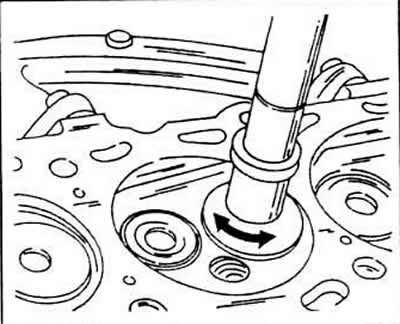
Grind the additionally treated valve seats by lubricating the valve seat surfaces with grinding paste and inserting the valve into the corresponding seat. Bring the air blower to the valve and move the valve from side to side.
After grinding, thoroughly clean all parts from dirt and grinding paste and check the valve seat in the valve plate area, as well as the seat ring. On both parts, a continuous matte ring should be visible, determining the width of the valve seat.
Use a pencil to draw a few lines on the valve plate. The lines should be drawn in a circle at a distance of approximately 1 mm. Then carefully lower the valve into the guide and seat, and then turn it 90°. Press the valve lightly.
Remove the valve and check if the pencil marks have disappeared from the seat ring. If the valve seat widths are within the specified limits, the head can be reinstalled. Otherwise, work on the valve seats or, in the worst case, install a spare head.
Visitor comments