



To measure the working clearance of the pistons, measure their diameter and write it down. Now to determine the working clearance, you need to measure the diameter of the cylinder bore as follows.
Using a cylindrical dial indicator, measure the diameter 10 mm from the top edge of the hole, and then 10 mm from the bottom edge of the hole.
Additionally, take a measurement in the middle.
Take the above measurements in the longitudinal direction of the block, and then again at the same levels in the transverse direction of the block. Record all six results.
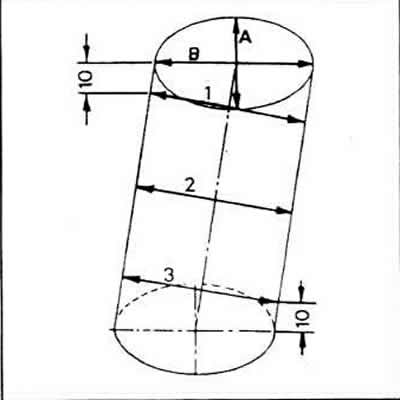
If sketches similar to those shown in the figure are made, then for greater clarity, the measurement parameters can be written down next to each other. The difference between the upper and lower measurements shows compaction. The difference between the longitudinal and transverse measurements shows ovality (non-roundness). Nowhere should the deviation from the nominal size exceed 0.08 mm.
For all engines there are also pistons of two oversized sizes and the block needs to be ground accordingly to the closest size.
Measure the cylinder block in the longitudinal, transverse and diagonal directions.
(The original article is available on the website: «VWManual»)
Do not use a thickness gauge with a thickness greater than 1 mm. Before starting the measurement, check that the cylinder block surface is perfectly clean and that there are no foreign bodies between the thickness gauge and the block surface.
Visitor comments