



Contents: Dismantling ↓ Measuring the internal diameters of…↓ Checking pistons and connecting rods ↓ Assembly of pistons and connecting…↓ Installation of pistons and…↓
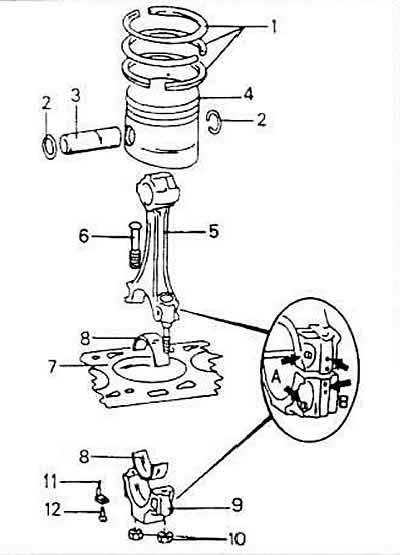
A - marking of connecting rods and caps;
B - position of cast tubercles;
1 - piston rings;
2 - spring retaining ring for piston pin;
3 - piston pin;
4 - piston;
5 - connecting rod:
6 - connecting rod screw;
7 - cylinder block;
8 - connecting rod bearing shells;
9 - connecting rod bearing cap;
10 connecting rod cap nuts;
12 - screw, 10 Nm.
Dismantling
The pistons and connecting rods are pushed upwards from the inside of the cylinder block using a hammer handle and after removing the connecting rod bearing caps and liners. Before carrying out this work, the following instructions regarding markings, installation direction, etc. must be taken into account.
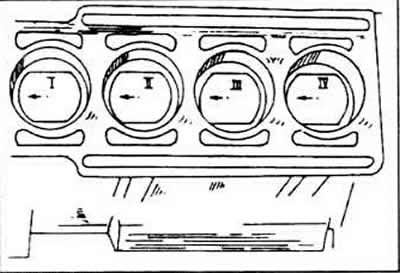
Mark each piston and its connecting rod with the cylinder number from which they were removed. This is best done by marking the cylinder number with paint on the piston crown, and also by drawing an arrow on the piston crown pointing toward the front of the engine.
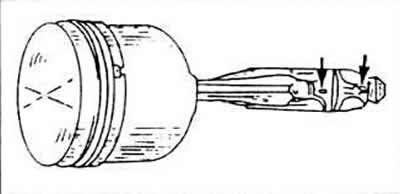
When dismantling the piston together with the connecting rods, pay attention to the correct direction of installation of the connecting rod bearing cap and immediately after dismantling apply the cylinder number to the connecting rod and the bearing cap on one side. It is best to do this with a center punch (cylinder No.1 - one punch, etc.).
The connecting rods and caps must be assembled in such a way that both cast humps are opposite each other. Both humps after installation face the crankshaft belt pulley.
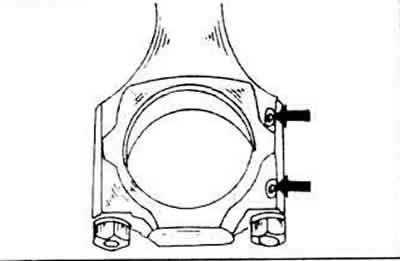
Oil sprayers are installed to cool the pistons.
Mark the bearing shells to match the specific connecting rod and bearing cap. Also mark the upper and lower bearing shells with paint on the back.
When removing the pistons, proceed as follows.
Remove the bearing caps and liners and push the parts out as mentioned above. If necessary, scrape the oil seal ring on the top side of the cylinder bores with a scraper.
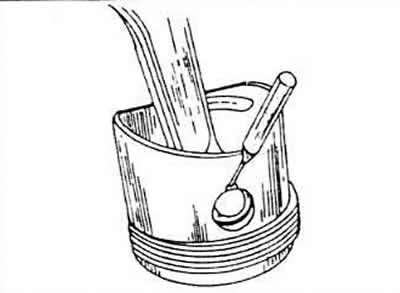
Press out the piston rings after the retaining clips have been removed. Due to the recess in the inspection hole of the piston, a mandrel can be inserted to extract the retaining elements. Using the piston mandrel, press out the piston pin.
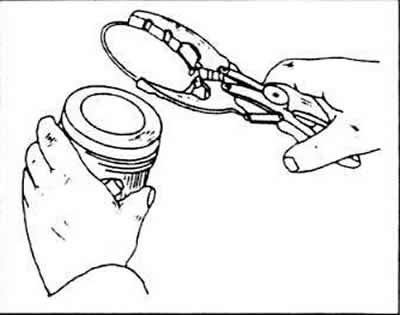
Remove the piston rings one by one using special ring pliers, moving them towards the piston bottom. If the rings are to be reused, they should be marked accordingly.
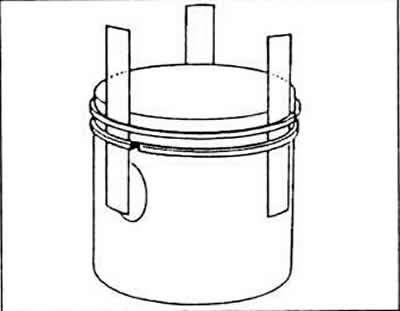
If you do not have suitable piston ring pliers, you can insert metal strips under the ring on opposite sides. To avoid scratches, the strip should be pushed down under the ring.
Measuring the internal diameters of cylinders
To measure the inner diameters of the cylinders, you need a cylindrical dial indicator, which can be used to measure the upper side, middle part and lower side of the hole. If you do not have a dial indicator, you can do the following: - Measure the inner diameters of the cylinders in the longitudinal and transverse directions. In addition, take measurements 10 mm from the upper edge, 10 mm from the lower edge and again in the middle. Thus, you need to take a total of six measurements of each cylindrical hole. Write down all the data obtained and compare them with those given in the table of dimensions and adjustment parameters.
Please note that all cylinders must be bored additionally if the size of at least one of the cylinders does not fit into the table parameters. A deviation of 0.08 mm from the specified dimensions is permissible. Oversized pistons, the dimensions of which are indicated in the table of dimensions and adjustment parameters, are available for sale. The final size of the inner cylinder bore is determined by measuring the piston 10 mm from the lower edge of the trunk part of the piston and at a right angle to the piston pin hole; then to this value you need to add the working clearance of the piston, equal to 0.03 mm. In addition, you need to take into account the final honing, adding 0.02 mm.
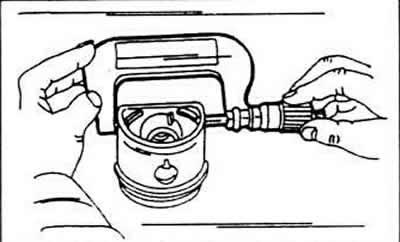
To control the working clearance of the piston, it is necessary to measure the piston and the inner diameter of the cylinder in the described manner and calculate the difference between the dimensions by the diameter of the cylinder. If the result is greater than the required by 0.08 mm, the cylinders must be ground.
Checking pistons and connecting rods
Check all parts carefully. If there are any signs of scoring, scratches or wear on the parts, they must be replaced. Perform the following tests on the pistons.
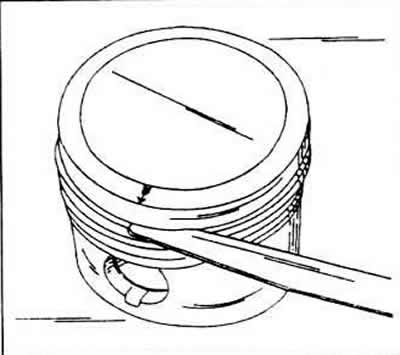
Measure the height of the piston ring gap in the piston grooves by inserting the piston rings one by one into the corresponding groove. Using a thickness gauge, determine the size of the gap between the planes of the ring and the piston groove. If the gap of any ring exceeds 0.15 mm, either it or the piston is worn. The nominal value of the gap is within 0.02-0.05 mm.
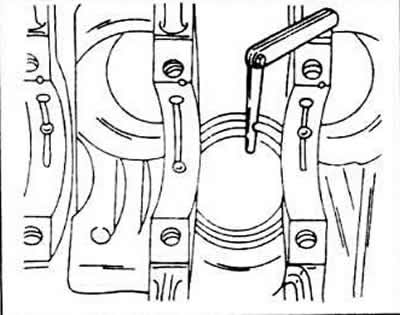
Insert all piston rings into the cylinder bores one by one from the bottom of the crankcase. Turn the piston over and press on the rings, moving them down by 15 mm. This will ensure that they sit in the bore without skewing.
Insert a thickness gauge into the gap between both ends of the rings to measure the piston ring joint clearance. For sealing rings, the gap is 0.3-0.45 mm; for oil scraper rings - 0.25-0.64 mm. The wear limit of all rings is 1 mm.
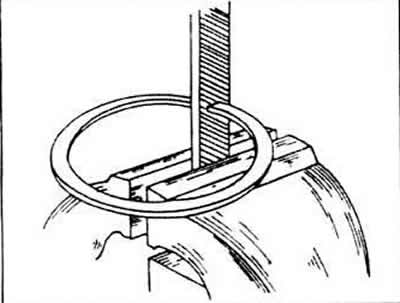
If the gap is too small (for example, for new rings, which also need to be measured), the ends of the rings can be filed. To do this, clamp a personal file in a vice; if the butt gap is too large, the corresponding ring should be replaced.
Check the degree of wear of the piston pin and connecting rod bushing, as well as the presence of scoring on them. Even if only one connecting rod has lost its functional qualities, the entire set must be replaced.
Connecting rod bearing nuts should always be replaced.
Using a rod straightener, check the connecting rods for twist or bending.
Check the connecting rod bearing bolts for damage and replace them if necessary.
Assembly of pistons and connecting rods
If the piston cooling nozzles have been removed, lubricate the screws with thread protector AMV 188 100.02; reinstall the nozzles and tighten the screws to a torque of 10 Nm.
Heat the piston to 60°C (putting in hot water). Use a suitable drift that can be inserted into the inside of the piston pin.
Press the piston pin by hand into the heated piston and connecting rod.
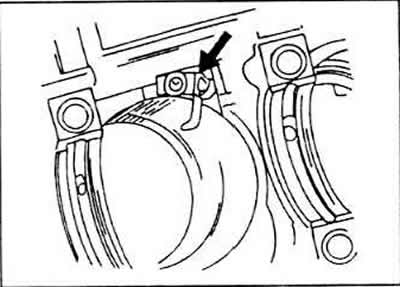
When assembling pistons and connecting rods, the following must be taken into account.
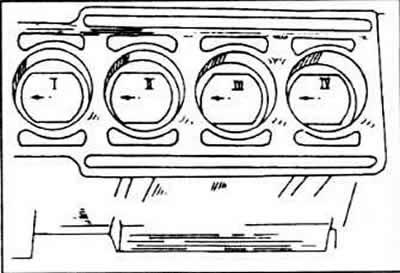
Arrow on the piston bottom (painted or stamped in new pistons) must face the front of the engine.
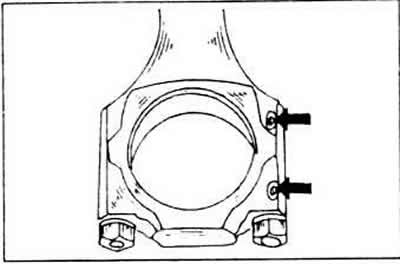
The cast bosses on the connecting rod and bearing cap must face the engine belt pulley.
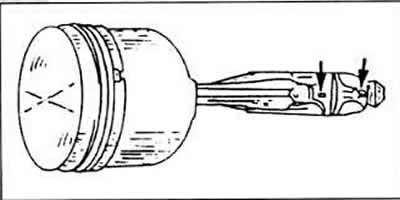
The cylinder number markings on the connecting rod and bearing cap must match.
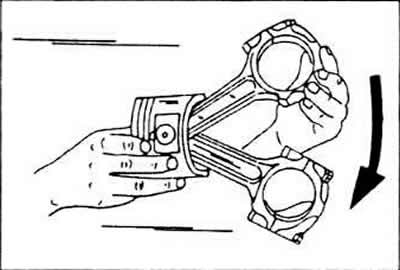
Check that after assembly the piston operates flawlessly on the connecting rod, performing a reciprocating motion - arrow.
Using piston ring pliers, insert the piston rings into the grooves one by one. It is possible to mix up both sealing rings, so look at the cross-sections before installing them. In addition, both sealing rings are marked on one side with the words "Top" ("Bottom") or "Oben" ("Up"); after putting on the ring, this inscription should be visible from the piston bottom side.
Installation of pistons and connecting rods
Lubricate the cylinder bores well with oil.
All connecting rods are designed for the corresponding cylinder numbers. The cast knobs on the connecting rod and bearing cap must be directed towards the crankshaft pulley.
The arrows on the piston crown must point towards the front of the engine.
Distribute the piston ring joints evenly around the piston perimeter at an angle of 120° from each other.
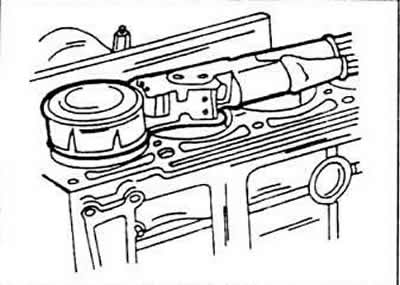
Wrap the piston rings with a piston ring retaining band and press the rings into the grooves. Check that they are optimally pressed into the grooves.
To avoid scratching the hole, place short rubber or plastic sleeves over the connecting rod studs.
Turn the crankshaft until the two crankpins are at dead center.
Insert the connecting rod into the hole from above. To do this, lay the engine on its side so that you can guide the connecting rod onto the bearing journal without scratching the hole or the connecting rod pin. The connecting rod bearing shell should already be on the connecting rod, with the protrusion in the recess.
The original text can be found on the portal www.VWManual.ru
Move the piston until the rings slide into the hole one by one and the connecting rod leg sits on the crank pin.
Insert the second bearing shell into the bearing cap, lubricate the shell well with oil, press the cap against the connecting rod studs and tap lightly. Of course, you must first remove the rubber sleeves again. Be sure to make sure that both cast installation marks match, since you can still make a mistake at the last moment.
Lubricate the mating surfaces of the nuts on the connecting rod bearing cap with oil.
Tighten the connecting rod bearing cap nuts alternately to a tightening torque of 30 Nm and from this final position turn them a further 90°, i.e. a quarter of a turn.
After installing the connecting rod, rotate the crankshaft several times to immediately identify the pinched areas.
Recheck the markings on all connecting rods and also check that the pistons are facing the correct direction.
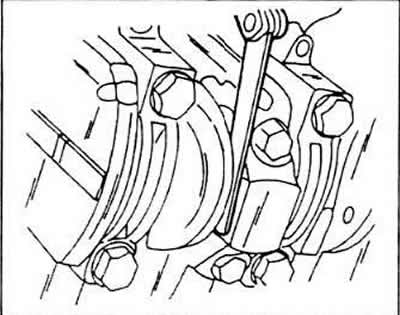
Using a thickness gauge, measure the clearance between the side surface of the connecting rod and the thrust surface of the crankshaft. This is the axial clearance of the connecting rod bearings; its value should not exceed 0.37 mm.
Install the oil bath.
Visitor comments