



Compare the used spring with the new one. To do this, clamp both springs in a vice and slowly close the vice. If the compression ratio of both springs is the same, this is a sure sign that they have approximately the same elasticity, but if the old spring after compression has become significantly shorter than the new one, this is a sign of spring fatigue, so the old springs must be replaced as a set.
Place the springs one by one on a smooth surface (glass plate) so that the closing winding is at the bottom.
Place a steel square next to the spring. Measure the gap between the top edge of the spring and the square; it should not exceed 2 mm. Otherwise, the spring is bent.
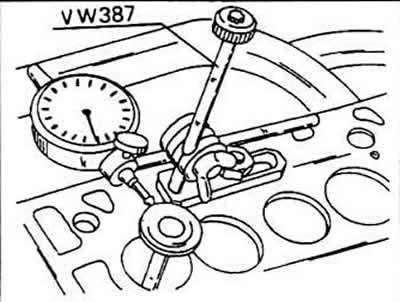
Move the spring plate from side to side; watch the dial indicator readings. If they are more than 1 mm for the exhaust valves, then in most cases the valve guide should be replaced.
Check the overall condition of the cylinder head before replacing the valve guide. Can be reused (polishing) cylinder heads that have small cracks if their width does not exceed 0.5 mm. If the cylinder head is ground, its height in zone (a) must be measured. To do this, place the cylinder head on a smooth surface and measure through the specified screw hole using a depth gauge. The distance between the top side of the head and the measurement plane must be 118.1 mm.
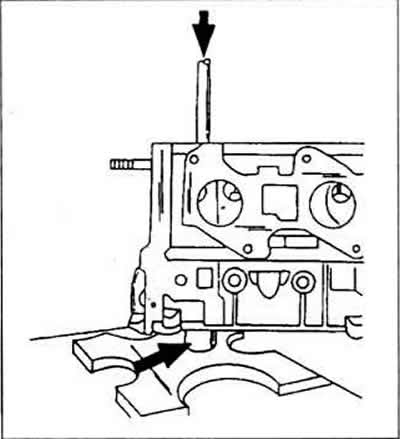
To replace the valve guide, press the old guide out of the cylinder head from the combustion chamber side using a suitable mandrel. To make the job easier, the cylinder head can be heated. A journal that fits the size of the inner part of the guide must be screwed onto the mandrel used for dismantling. Support the cylinder head with a piece of pipe in the place indicated by the arrow so that the guide can be pressed out.
When replacing the guides, the valves are also replaced. In this case, the seats can be ground.
Coat the new guides well with oil and press them into the cold cylinder head from the camshaft side until the guide flange is pressed against the cylinder head. After this, the pressing force should not exceed 1 ton, otherwise the flange can be cut off. Since the guides sit at an angle in the cylinder head, the head must be supported accordingly so that the guide can be pressed in vertically.
After pressing, process the valve guides with a special 3120 reamer. If you don't have such a screwdriver, you can use an adjustable reamer. Process the inlet and outlet valve guides with a reamer to a size of 7 mm. This will automatically create the valve guide clearance required by the instructions.
Visitor comments