



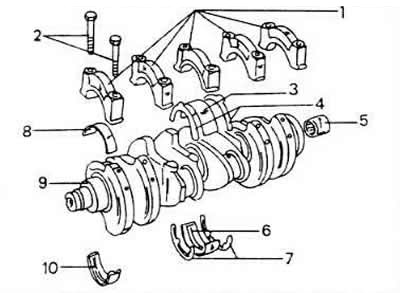
1 - main bearing caps
2 - cover screws, 65 Nm
3 - main bearing shell No.3
4 - thrust washer for main bearing cap
5 - needle roller bearing
7 - thrust washer for cylinder block
8 - main bearing shells in bearing caps
9 - crankshaft
10 - main bearing shells in bearing caps
Removal the crankshaft
To remove the crankshaft, you need to remove the engine.
Unfasten the gearbox from the engine. When removing the gearbox, do not bend the clutch shaft.
While holding the clutch ring gear with a screwdriver, loosen the clutch screws. Most often, the screws can also be loosened with a socket wrench, so you don't have to hold the clutch. To do this, place the ring wrench at a right angle and tap the end of the wrench with your hand. In most cases, the screws loosen by tapping.
Before removing the clutch, hit the pressure plate and flywheel with a center punch to mark both parts together, from the front of the engine, loosen the crankshaft belt pulley bolt until the flywheel can be held.
Disconnect the cylinder head together with the intake duct.
Unscrew the belt pulley from the water pump and the lower cover that protects the timing belt.
Mark the direction of rotation of the timing belt with paint on the outside.
After loosening the clamping nut, remove the timing belt from the flywheels and belt tensioner. Do not turn the camshaft now.
Unscrew the oil bath.
Remove the oil pump.
If only the crankshaft needs to be removed, the pistons and connecting rods may remain in the cylinder block. Otherwise, remove. Otherwise, remove the pistons and connecting rods. If the pistons remain in the block, mark and remove the connecting rod bearing caps one by one and keep them together with the liners. Remember that the used flexible screws must be replaced if they are damaged.
Place the pointer indicator with the stand on the front side of the cylinder block so that the measuring tab is put on the end journal of the crankshaft. Use a screwdriver to press the crankshaft to the side, set the indicator to zero and press the shaft to the other side. The indicator shows the axial clearance of the crankshaft. This reading should be recorded for subsequent assembly; if it exceeds 0.25 mm, this should be taken into account during installation. The middle bearing shells are equipped with thrust half washers. The thrust half washers take the axial pressure of the crankshaft.
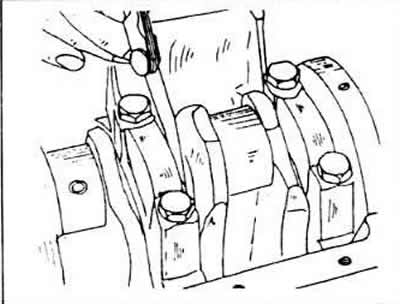
If there is no dial indicator, you can use a thickness gauge to measure the gap on the middle bearing between the bearing flange and the crankshaft surface.
Loosen the sealing flange mounting screws on the front of the engine and remove the flange together with the seal.
Remove the engine intermediate plate, unscrew the sealing ring flange screws and remove the flange together with the sealing ring. The engine intermediate plate guides are fitted bushings.
Evenly, crosswise, disconnect the screws of the crankshaft bearing caps and remove them one by one. Check that the numbers on the cap are clearly visible. Cap No.1 is on the belt pulley side.
Remove the bearing shells from the support journals and place them together with the corresponding bearing caps.
Remove the remaining liners from the crankcase and stack them with the other liners and covers. These bearing liners are provided with lubrication grooves; when reassembling, they must be reinserted into the crankcase. Remove the lower thrust washers located on the middle bearing. If the same thrust washers are installed again, they must be stored securely. so as not to damage the working surfaces. Otherwise, discard the washers.
Checking the crankshaft parts
Carefully check the crankshaft for damage: measure the main and connecting rod bearing journals accurately. The crankshaft main bearing journals and connecting rod pins can be additionally ground up to three times. Therefore, the shaft can be mounted together with oversized bearing shells.
Clamp the crankshaft between the lathe stop centers (or insert both outer support pins into the prisms) and using a dial indicator mounted on the middle support journal, check for runout. The runout should not exceed 0.06 mm. Otherwise, replace the shaft.
Measure the operating clearance in the main and connecting rod bearings.
Clean the bearing shells thoroughly and insert them into the bearing holes in the cylinder block or into the connecting rods.
Wrap all main bearing journals with a plastic strip "Plastigage" and fit all main bearing caps with inserted bearing shells. Tighten the screws to a tightening torque of 65 Nm. Do not turn the shaft any further.
To check the connecting rod clearance, install the connecting rod against the crankpin and place "Plastigage" on the upper side of the crankpin. Mount the bearing cap together with the liner and tighten the nuts to a tightening torque of 30 Nm. Since the shaft cannot be turned any further, check the two connecting rod bearings respectively. located at the bottom dead center.
For the main bearings, unscrew the cover; for the connecting rod bearings, unscrew both covers one by one.
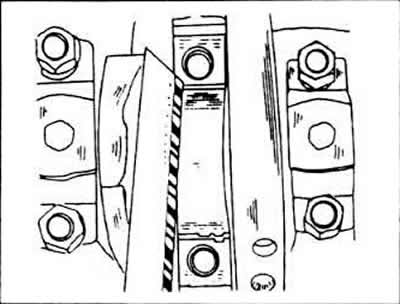
Using the gauge supplied with the PlastiGage kit, measure the widest part of the flattened PlastiGage strip. If the measurement is more than 0.17 mm for main bearings or 0.12 mm for connecting rod bearings, new bearing shells should be used; in this case, it is necessary to take into account whether the support pins had already been ground before.
If the connecting rod bearing running clearance checks, rotate the crankshaft and inspect the other two connecting rod bearing journals by measuring them as described above.
Crankshaft installation
Wipe the blind holes and insert the bearing shells, equipped with lubrication grooves, so that the guide projections of the shells enter the recesses of the blind holes. Lubricate the shells well.
On the center bearing, place both thrust washers used in the block if the bearing shells have not been replaced.
Carefully insert the crankshaft into the bearing shells. If the connecting rods are still in the cylinder block, the connecting rod bearings must be installed on the connecting rod journals.
Insert the lower crankshaft bearing shells (protrusions into grooves) and lubricate the surfaces well, if they are mounted, put both other thrust washers to the cover. The lubrication grooves fit the crankshaft.
Place the covers on the crankcase and tap with a rubber or plastic hammer.
Tighten the cover screws in several stages (moving from the center to the outside) to a torque of 65 Nm. After tightening the caps, turn the crankshaft several times to determine the pinched areas.
Check the axial clearance again.
Install the pistons and connecting rods.
Install both oil seal rings.
Using a key, install the crankshaft flywheel.
Install the control belt.
In vehicles with a gearbox, mount the flywheel. The screws should always be replaced. Lubricate the screw threads with D6 thread protector. The tightening torque is 100 Nm. Secure the crankshaft by inserting a wooden block between the crankshaft cheek and the crankcase wall.
Install the flywheel and clutch.
Install the oil pump.
Stick the new oil pan seal with grease and install the oil pan. Tighten the hexagon head screws to a torque of 20 Nm.
Visitor comments