



Contents: First stage ↓ Second stage ↓
First stage
a) Remove the automatic starter equipment cover.
b) Rotate the diaphragm control lever clockwise and hold it in this position using a rubber band.
c) Remove the elastic low-pressure hose from the carburetor 1 (figure 3.27).
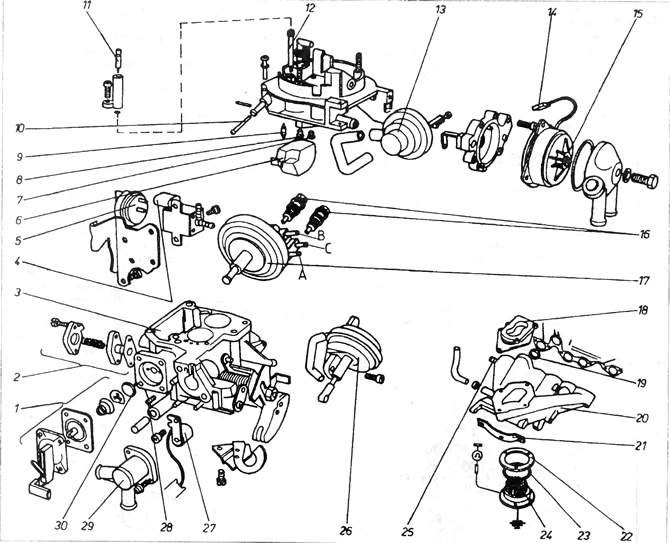
Figure 3.27. Carburetor 2E2 1 - accelerator pump unit; 2 - mixture enrichment valve when the throttle is partially opened (once the valve is removed, it must be replaced with a new one); 3 - float chamber; 4 - valve that controls the disconnection of the idle system and at speeds higher than idle speed; 5 - thermo-time valve; 6 - float; 7 - first pass main jet; 8 - main jet of the second pass; 9 - needle valve; 10 - filter; 11 - exhaust gas composition adjusting bolt; 12 - idle jet; 13 - servomotor; 14 - plug; 15 - Automatic start equipment cover; 16 - valves for adjusting idle speed (the lower one is only available with a four-output servomotor); 17 - servo motor with three outputs; 18 - A, B, C - servomotor connection nipples (four outputs have servomotors in cars with automatic transmission); 18 - shock-absorbing cuff; 19-additional gasket type o-ring (ring) between the collector and the head, 20-drive manifold; 21 - holder; 22 - washer; 23 - gasket; 24 - mixture heater; 25 - nipple for connecting servo; 26 - servomotor controlling the opening of the second passage; 27 - partial throttle opening channel heater; 28 - adjusting bolt; 29 - valve cover with coolant fittings; 30 - mushroom valve.
Connect a hand vacuum pump to port A (figure 3.27).
d) Remove the low pressure connection from the low pressure flexible hose 4 (figure 3.33). Do not pinch the nipple.
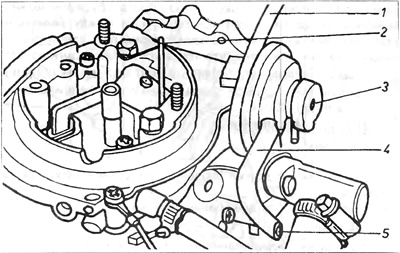
Figure 3.33. Adjusting the diaphragm gap of the 2E2 launcher 1 - low pressure branch pipe; 2 - drill; 3 - adjusting bolt; 4 - low pressure branch pipe; 5 - end of low pressure pipe
d) Create reduced pressure within 200-300 mbar.
e) Check the clearance of the starting diaphragm by using a drill of a certain diameter (figure 3.33).
e) If the clearance does not correspond to the technical data, adjust it by turning the hexagon head bolt 3 (figure 3.33). After completing the adjustment, protect the adjusting bolt with paint.
Second stage
a) Seal the end of pipe 5 with a suitable plug (figure 3.33).
b) Reduce the pressure to 200 mbar.
c) Recheck the diaphragm clearance using drill 2 (figure 3.34).
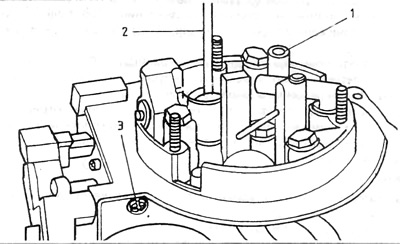
Figure 3.34. Adjusting the launch diaphragm gap - second stage 2 - drill, 3 - adjusting bolt
d) If the carburetor characteristics do not correspond to the technical data, adjust it by turning bolt 3 (figure 3.34).
d) After completing the adjustment, protect the bolt with paint.
e) The signs on the launch equipment cover must match - one continues the other.
d) Servo motor with three or four outputs. The servo motor with four outputs is used in cars with automatic transmission or air conditioning.
To test the operation of this servo motor, a vacuum pump will be needed.
a) Disconnect the elastic low-pressure pipes from the servomotor and connect the vacuum pump to the nipple A (figure 3.27).
Reduce the pressure to tighten the servo motor pusher to the "off" position and then measure the length of the protruding part of the pusher, which should be 8.5 mm.
b) To check the overshoot-cutoff point (only in models with automatic transmission), it is necessary to remove the plug from the end of the low-pressure pipe C, then increase the vacuum using a vacuum pump. This should cause the pusher, servomotor to move to the "excess-cutoff" point. Measure the length of the protruding part of the pusher. The pusher should now protrude 1 mm from the servomotor and this value should not change for 1 minute.
c) If the protruding length of the lever is abnormal or does not hold for the required period of time, this indicates that the three- or four-output servo motor is leaky and needs to be replaced.
10. Low pressure servomotor unit 2nd pass This equipment is installed on models of cars with a 1.6 engine and a manual transmission, as well as with a 1.8 engine and an automatic transmission since August 1984. The task of this equipment is to slightly delay the opening of the second pass of the carburetor when the coolant temperature is less than 18°C. The delay is carried out by connecting the control servomotor to the atmosphere, opening the second pass by the thermopneumatic valve 5, and the flange in the branch pipe connecting valve 5 and the low pressure servomotor of the 2nd pass. In 1.6 engines, the flange is marked in blue, and in 1.8 engines - in yellow. Check if the second branch pipe on the valve nipple 5 is clogged; blow through the valve. At a temperature of + 18°C, the valve should be open, and when the temperature exceeds + 28°C, the valve should close (figure 3.27).
11. Adjusting the idle speed.
To check and adjust the idle speed, you need to read the contents of paragraph 23 16 and proceed according to the description of this paragraph, taking into account the following differences:
a) Before checking the idle speed, first make sure that tappet 5 is in the "off" position and that the engine speed adjusting bolt on the intake is aligned with tappet 5. Otherwise, it is necessary to warm up the engine well (figure 3.28).
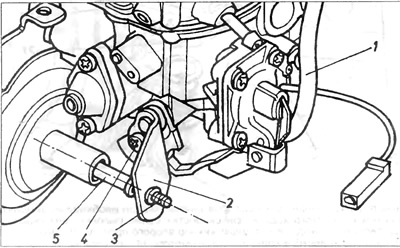
Figure 3.28. Carburetor 2E2 1 - low pressure branch pipe; 2 - cam plate; 3 - engine speed adjustment bolt on the suction side; 4 - fixing screw; 5 - three-output servomotor pusher.
b) If adjustment is necessary, rotate the idle speed adjusting valve 3 and the exhaust gas composition adjusting screw 11 (figure 3.35 and 3.27).
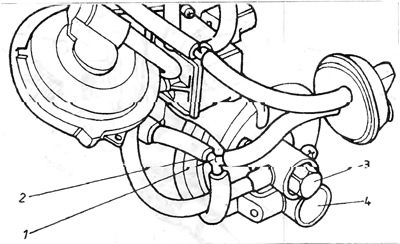
Figure 3.35. Carburetor - 2E2 1 - tee; 2 - low pressure branch pipe; 3 - idle speed adjusting bolt; 4 - adjusting bolt of rotation speed xonocforo stroke under load.
If it is difficult to reduce the carbon monoxide content in the exhaust gas to a certain level, it is necessary to unscrew the carbon monoxide content adjusting screw and clean its tip, then screw in the screw and make adjustment.
12. Adjusting the engine speed at suction:
a) Connect a speed meter to the engine
b) Seal the elastic low-pressure hose from the carburetor to the temperature regulator 3 (figure 3.3).
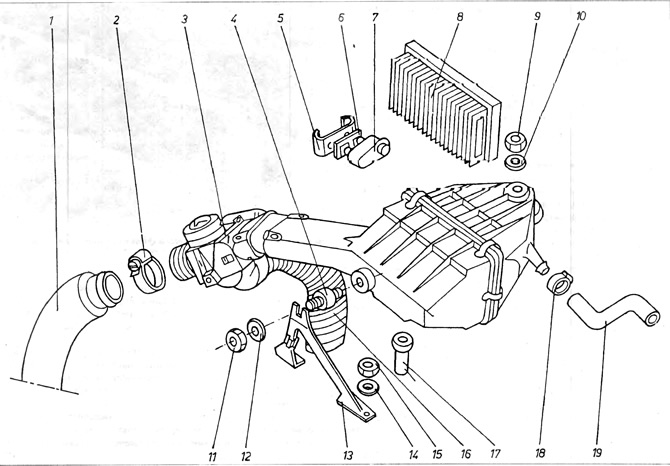
Figure 3.3. Air filter assembly - 1.6 and 1.8 L engines 1 - suction pipe; 2 - clamping belt. 5 - temperature regulator; 4 - rubber shock absorber; 5 - temperature sensor bracket; 6 - temperature sensor; 7 - filter insert; 8 - nut securing the body; 9 - washer; 10 - nut; 11 - washer; 12 - bracket; 13 - washer; 14 - nut; 15 - warm air suction pipe; 16 - spacer sleeve; 17 - clamping belt; 18 - crankcase air outlet pipe.
If the air filter has been removed:
c) Remove tee 1 from elastic low-pressure pipe 2 and seal the pipe with a plug (Fig. 3.35)
d) Start the engine and check the engine speed at the intake.
d) If the rotation speed does not correspond to the technical data, make adjustments by turning the adjusting bolt 3 (figure 3.28).
e) Reconnect the low pressure flexible hose and (if necessary) adjust the idle speed.
13. The engine idle speed under load in automatic transmission models can be checked as follows. First of all, in addition to the preliminary requirements required when checking the idle speed setting, the handbrake must be fully applied and the wheels must be blocked with wedges.
a) Start the engine, turn on the air fan at full speed, turn off the high beam and rear window heating.
The person sitting in the car should press the brake pedal, and then select position D in the gearbox control b) Check whether the adjusting bolt 3 is on the pushrod 5, and the engine speed is not lower than 800 rpm. If necessary, adjust the speed, change the setting of valve 4 (figure 3.36). This valve is only available in vehicles with automatic transmission or air conditioning.
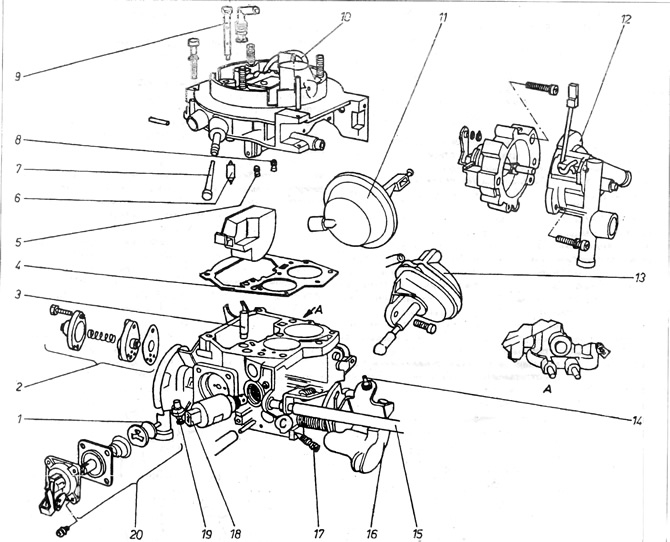
Figure 3.36. Carburetor 2EZ 1 - mushroom valve; 2 - mixture enrichment valve with partially open throttle; 3 - the injection pump injector must supply fuel in the direction selected in the carburetor throat; 4 - cover gasket; 5 - main jet - passage 1; 6 - needle valve 7 - strainer; 8 - main jet - passage 2; 9 - idle jet; 10 - economizer tube; 11 - servomotor of starting equipment; 12 - Launch equipment cover; 13 - servomotor controlling the opening of the second passage; 14 - adjusting bolt; 15 - idle speed adjustment; 16 - lever, 17 - mixture composition adjusting bolt; 18 - idle cut-off valve; 19 - limiting screw 20 - accelerator pump unit.
c) Disconnect tee 1 from elastic low-pressure hose 2 and plug the hose. Connect the speed meter to the engine. Start the engine and check whether the engine speed at the intake corresponds to the value specified in the technical data.
(The original text is available on the portal: «vwmanual.ru»)
If the speed value does not correspond to the specified one, it is necessary to adjust it by turning the adjusting bolt 3 (figure 3.29).
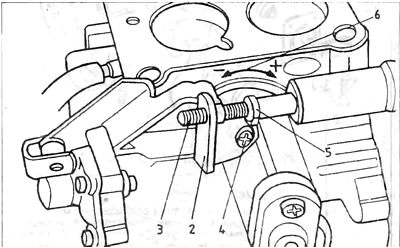
Figure 3.29. Carburetor 2E2 1 - low pressure branch pipe; 2 - cam plate; 3 - engine speed adjustment bolt on the suction side; 4 - fastening screw; 5 - servomotor pusher with three outputs; 6 - designation of the direction of rotation of the plate: (+) - increase in portion, (-) - decrease in portion.
After finishing the adjustment, protect the screw with paint. Remove the plug from the flexible pipe and reconnect the tee and check whether the idle speed corresponds to 900-1000 rpm.
Visitor comments