



b) Start the engine and set the throttle adjusting screw to the third tooth of the choke speed cam 1 (figure 3.16)
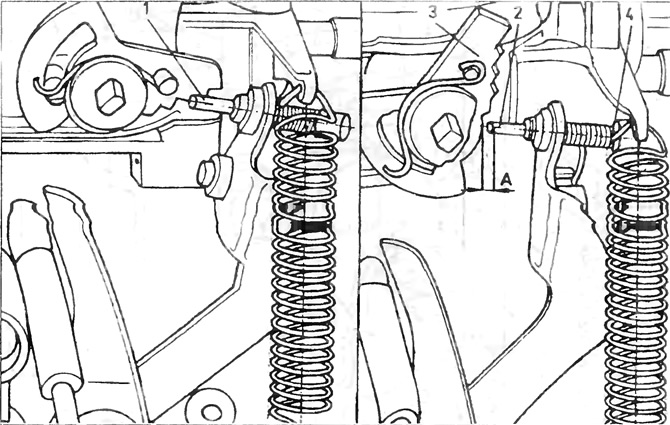 Figure 3.16. Idle speed adjustment bolt on the choke
1 - adjusting bolt; 2 - cam; 3 - clearance between the cam and the bolt.
c) Record the rotation speed value from the rpm meter.
d) If the rotation speed exceeds the limits specified in the technical data, remove the safety plug and adjust by screwing and unscrewing bolt 1.
d) After adjusting the speed to the normal value, check whether there is a gap of 0.2 mm between the edge of the adjusting screw 2 and the choke speed cam 3 when the diaphragm is fully open (figure 3.16).
e) On the right side, install a new safety plug 4 and disconnect the speed meter
14. The flow rate of the accelerator pump can be checked with the carburetor installed on the engine or with it removed. However, the air filter must be removed and the float chamber filled with fuel. Open the diaphragm of the starting equipment and hold it in this position with a piece of wire, then press a piece of suitable plastic tubing onto the pump nozzle, engine and throttle. Hold until fuel appears in the tube. Then place the tube in a measuring cylinder with a scale of 0.2 cm³.
Perform five full throttle movements (for at least two seconds) per stroke of the throttle. Divide the amount of fuel collected in the cylinder by 5 to determine the amount per stroke and compare the result with the value specified in the technical data. In case of very low pump performance, change the position of the adjusting screw on the accelerator pump lever (on the right in Figure 3.17) or turn nut 1 (on the left in the same picture), to increase the lever stroke.
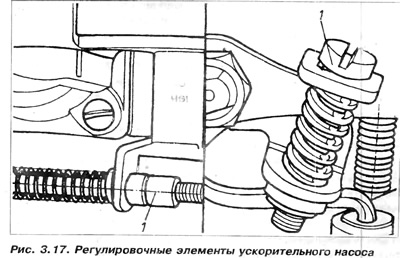
Note: Please note that the fuel must be injected into the throttle gap. If necessary, bend the nozzle tube. Very low performance of the accelerator pump may cause engine failure during sudden throttle opening.
15. The throttle clearance is adjusted as follows:
a) Remove the carburetor.
b) Turn the carburetor, close the diaphragm and throttle.
c) Using drill 2 (Fig. 3.18) of the appropriate diameter, check the gap between the throttle plate and the neck wall.
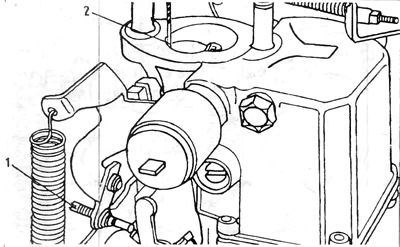
Figure 3.18. Adjusting the throttle clearance
1 - adjusting screw; 2 - drill.
d) If the gap size does not correspond to that specified in the technical data, remove the safety plug and adjust the throttle position by turning the adjusting screw 1 (figure 3.18).
d) After completing the adjustment, install a new safety plug and install the carburetor as described earlier.
e) After installing the carburetor on the engine, it is necessary to check the idle speed and the mixture composition.
16. Idle Speed Adjustment - 31 PIC-7. Fine adjustment of the carburetor is only possible after the ignition, breaker closing angle and spark plug gaps have been adjusted. Incorrect valve clearances may also affect carburetor adjustment. It is important to remember that the engine idle speed adjusting screws may have safety plugs on them.
a) Start the engine and warm it up to normal operating temperature, then turn it off. Connect a speed meter and exhaust gas localizer to the engine.
b) It is necessary to remember that idle speed adjustment is performed with the radiator fan running.
c) Disconnect the elastic ventilation hose of the main engine crankcase from the air filter and plug the filter inlet.
d) Start the engine and let it idle. Check whether the engine speed and CO content in the exhaust gases correspond to the data in the technical specifications. If these values are incorrect, it is necessary to rotate the two adjusting screws located above the electromagnetic shut-off valve within a certain range (figure 3.13).
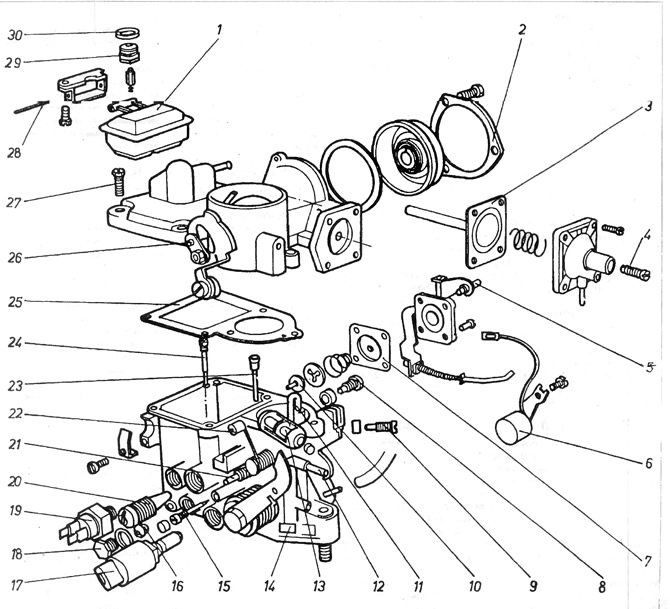
Figure 3.13. Carburetor 31 PIC-7
1 - float; 2 - fastening ring; 3 - servomotor diaphragm; 4 - diaphragm clearance adjusting screw; 5 - accelerator pump flow adjusting bolt; 6 - partial throttle opening channel heater; 7 - pump diaphragm; 8 - additional fuel jet; 9 - idle jet; 10 - mushroom valve; 11 - accelerator pump nozzle; 12 - nipple for connection to the air filter temperature regulator; 13 - diaphragm clearance adjusting bolt; 14 - designation of the carburetor type; 15 - mixture composition adjusting bolt, 16 - main fuel jet; 17 - side air valve; 18 - cork; 19 - Thermal switch of the partial throttle opening channel heater; 20 - idle speed adjusting bolt; 21 - nipple for connecting the low pressure pipe of the ignition timing regulator; 22 - roller of the engine uniform operation lever; 23 - Air brake jet with emulsion tube; 24 - additional air jet; 25 - gasket; 26 - eccentric kingpin; 27 - carburetor cover bolt; 28 - float axis; 29 - needle valve; 30 - adjusting washer for needle valve.
d) If an exhaust gas analyzer is not available, the mixture ratio can be roughly adjusted by turning mixture ratio screw 15 to obtain the highest engine speed at a given position of screw 20.
e) Connect the elastic ventilation hose of the main crankcase.
If the carbon monoxide content in the exhaust gases increases, this indicates that the oil is diluted with fuel and requires an oil change. Another way, if an oil change seems unreasonable, is to drive the car fast for a long time, which should reduce the amount of fuel in the oil. The cause of an increased CO content in the exhaust gases after connecting the main crankcase ventilation pipe may be wear of the piston-cylinder pair and the associated increased scavenging of the exhaust gases.
e) Turn off the engine and disconnect the speedometer and exhaust gas analyzer.
17. Adjusting the fuel level in the float chamber:
a) Before checking the fuel level in the float chamber, run the engine for a minute until the fuel level reaches the normal value.
b) Turn off the engine and remove the air filter assembly.
c) Remove the carburetor cover and gasket and measure the distance from the top of the carburetor body to the fuel surface using a depth gauge or calipers. This distance is specified in the technical data. The fuel level is adjusted by replacing the gaskets under the needle valve. The basic gasket thickness is 2.0 mm. If the fuel level is very high, a thicker gasket must be installed, and vice versa, if the level is very low, a thinner gasket must be installed. The fuel level increases during operation due to wear of the needle valve.
Valve wear is determined by the deepening of the needle in the socket, causing a decrease in the effective length of the valve and an increase in the fuel level. During adjustment, it is necessary to increase its length by putting on a washer of greater thickness.
d) After replacing the washer, put the cover on the carburetor and tighten it with two bolts.
d) Connect the fuel pipes, supply and return, as well as the battery ground wire.
e) Run the engine for a minute to check the fuel level in the float chamber.
g) Disconnect the ground wire, remove the carburetor cover and check the fuel level. If the level is normal, install the carburetor cover and perform the remaining operations in the reverse order of removal.
Note: The amount by which the thickness of the gasket (washer) on the needle valves must be increased is difficult to determine. It can only be determined by the method of alternate testing. The amount depends primarily on the difference between the measured and normal fuel levels specified in the technical data.
The thickness of the gasket can be increased by 0.2 mm or more. Often, due to the lack of adjusting gaskets, it is allowed to bend the tongue on which the valve needle rests. However, it is necessary to keep in mind that this is not quite the right solution, especially if the tongue is bent at a large angle and this changes the distribution of forces acting on the needle. The force begins to act not along the needle, but at an angle to the socket. This can lead to (especially with worn valves) to the formation of leaks.
Visitor comments