



1. Checking the heating element in the drive manifold. When checking the heating element, the engine must be cold.
a) Disconnect the electrical wire from the heating element 24, then connect the ohmmeter between the electrical end of the element and the ground - the scale should show 0.25-0.50 (figure 3.27).
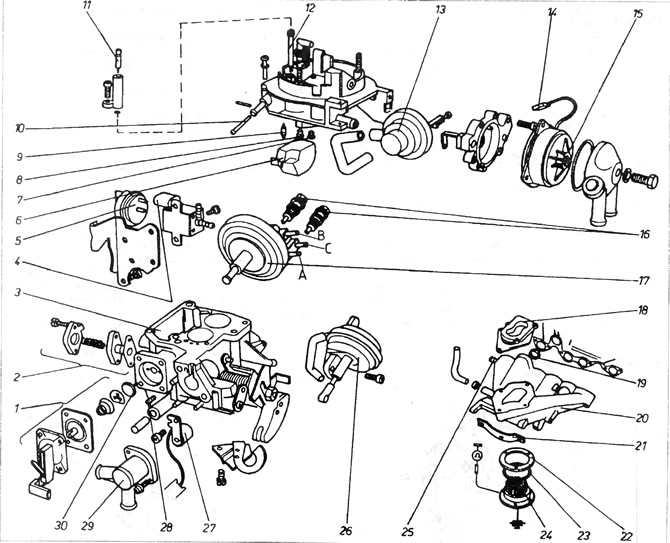
Figure 3.27. Carburetor 2E2
1 - accelerator pump unit; 2 - mixture enrichment valve when the throttle is partially opened (once the valve is removed, it must be replaced with a new one); 3 - float chamber; 4 - valve that controls the disconnection of the idle system and at speeds higher than idle speed; 5 - thermo-time valve; 6 - float; 7 - first pass main jet; 8 - main jet of the second pass; 9 - needle valve; 10 - filter; 11 - exhaust gas composition adjusting bolt; 12 - idle jet; 13 - servomotor; 14 - plug; 15 - Automatic start equipment cover; 16 - valves for adjusting idle speed (the lower one is only available with a four-output servomotor); 17 - servo motor with three outputs; 18 - A, B, C - servomotor connection nipples (four outputs have servomotors in cars with automatic transmission); 18 - shock-absorbing cuff; 19-additional gasket type o-ring (ring) between the collector and the head, 20-drive manifold; 21 - holder; 22 - washer; 23 - gasket; 24 - mixture heater; 25 - nipple for connecting servo; 26 - servomotor controlling the opening of the second passage; 27 - partial throttle opening channel heater; 28 - adjusting bolt; 29 - valve cover with coolant fittings; 30 - mushroom valve.
b) To remove the heating element, you must disconnect the electrical wire from it, then unscrew the bolts at the bottom of the drive manifold and remove the element.
c) Remove the sealing ring 22 and gasket 23. They must always be replaced with new ones during assembly.
d) The heating element is controlled by a thermal switch located in the elastic coolant supply pipe to the drive manifold (engines 1.1 and 1.3) or on top of the fitting 10, installed on the side of the cylinder head, engine 1.6 and 1.8) (figure 2.5)
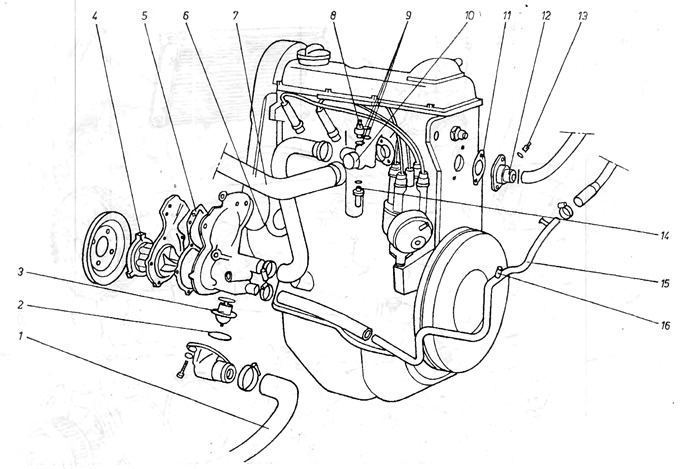
Figure 2.5. Cooling system - 1.6 and 1.8 l engines
1 - radiator/water pump hose; 2 - thermostat cover washer; 3 - thermostat; 4 - front cover with blades; 5 - gasket; 6 - input channel into the engine housing; 7 - head/radiator pipe; 8 - thermal switch; 9 - gasket; 10 - outlet fitting on the radiator; 11 - gasket: 12 - outlet fitting from the head; 13 - temperature sensor; 14 - thermal switch; 15 - return pipe from the heater; 16 - connection point of the pipe from the expansion tank.
d) To check the thermal switch, you need to disconnect the clamp of the end of the electrical connection, unscrew the bolts, remove the switch from the housing and plug the hole of the switch to stop the leakage of coolant.
e) Connect the ohmmeter to the ends of the thermal switch and gradually heat the base of the switch in hot water. The resistance should be zero (i.e. the internal contacts must be closed) at the following temperatures:
engine 1.1 - 65°C
engines 1.3 and 1.6 and 1.8 - 55°C
g) The resistance must be maximum (i.e. the internal contacts must be open) at the following temperatures
engine 1.1 - 75°C
engines 1.3 and 1.6 and 1.8 - 65°C
If the switch is faulty, it must be replaced with a new one. The heating element turns off when the engine reaches the normal operating temperature specified above.
2. Heating of the drive manifold with coolant is performed in order to improve the conditions for evaporation of the fuel flowing through the manifold.
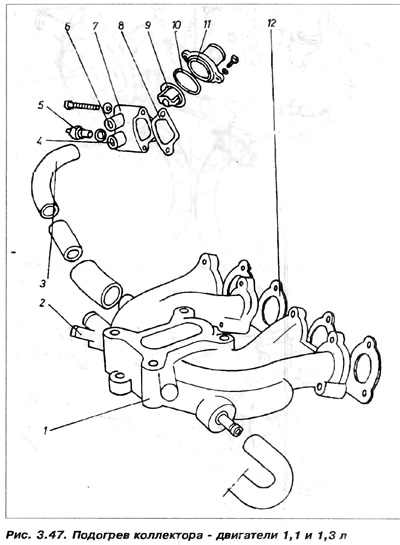
Heated coolant leaking from thermostat housing (engines 1.1 and 1.3, figure 3.47) or from the outlet fitting of the head (engines 1.6 and 1.8). The liquid, flowing through the manifold, gives off heat to the walls, which heat the flowing fuel-air mixture.
Visitor comments