
English Русский
Български
Беларускі
Український
Српски
Hrvatski
Română
Polski
Slovenský
Magyar
  |  Articles  |  Sitemap  |  Contacts  |    |
Car maintenance Ford Car maintenance Hyundai Car maintenance Chevrolet Car maintenance BMW Car maintenance Audi Car maintenance Opel Car maintenance AvtoVAZ
VWmanual.ru


Main   Passat   Golf   Polo   Touareg   Tiguan   Sharan   Transporter   Others  
Golf 1 (1974-1984, diesel) Golf 1 (1974-1984, petrol) Golf 2 (1984-1993, petrol) Golf 2 (1984-1993) Golf 3 (1991-1997) Golf 4 (1997-2004) Golf 5 (2003-2008)

Carburetor Zenith 1B3 (VW Golf 2)

  • Main
  • Golf
  • Golf 2
  • Power unit
  • Power and exhaust system
  • Carburetor Zenith 1B3
            0


1. Adjusting the engine speed on the suction side:

a) Remove the air filter assembly.

b) Connect a speed meter to the engine.

c) Turn the intake speed cam 1 so that the adjusting bolt 2 is on the highest tooth of the cam (figure 3.19).
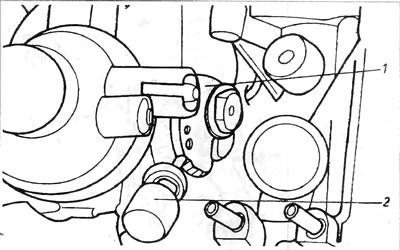
Figure 3.19. Carburetor 1B3

1 - suction speed cam; 2 - adjusting bolt.


d) Start the engine without pressing the gas pedal and record the suction speed.

d) If the suction speed does not correspond to the technical data, remove the safety cap and adjust the speed by turning the adjusting bolt 2 (figure 3.19).

2. The position of the adjusting screws is shown in Figure 3.20A and 3.20B.
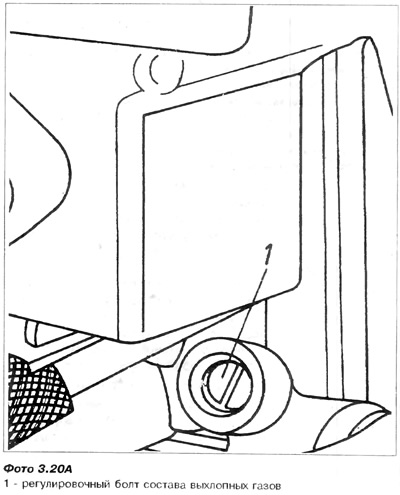
2. The position of the adjusting screws is shown in Figure 3.20A and 3.20B.
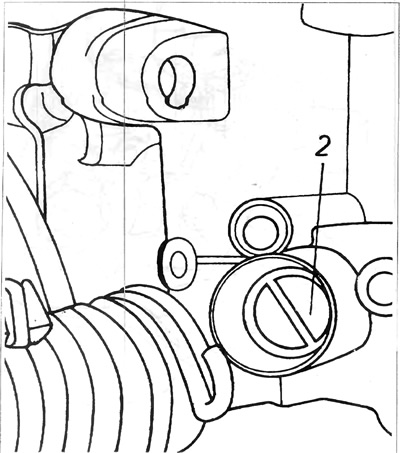

Photo 3.20B. Carburetor 1B3

2 - idle speed adjusting bolt.


3. Adjusting the starting diaphragm gap.


a) Remove the water chamber cover and the bimetallic spring assembly of the starting equipment. There is no need to disconnect the electrical wire and elastic water pipes from the cover assembly,

b) Rotating the throttle, set the intake speed cam 1 so that the adjusting bolt 2 is on the highest tooth (figure 3.19).

c) Pressing the adjusting screw 1 of the diaphragm gap with a screwdriver, move the diaphragm control lever towards the low pressure servomotor unit to the stop (figure 3.21).
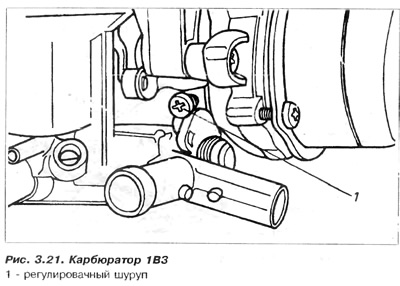
c) Pressing the adjusting screw 1 of the diaphragm gap with a screwdriver, move the diaphragm…


d) In this position of the lever, check the gap between the edge of the diaphragm and the wall of the carburetor neck using a drill with a diameter of 4.3 mm.

d) If necessary, adjust the gap by turning screw 1.

e) After completing the adjustment, install the starter equipment cover. The marking on the cover must match the corresponding marking on the starter equipment body.

4. Launch equipment servomotor unit.

The operation of the low pressure servomotor unit can be checked as follows:

a) With the air filter assembly removed, start the engine at idle speed.

b) Manually close the start diaphragm and observe the operation of the servomotor. If the diaphragm can be easily closed to a gap of approximately 4 mm, and then a certain resistance is felt, then the servomotor is working correctly. If the diaphragm can be completely closed without any resistance, this indicates damage to the diaphragm of the servomotor or a leak in the low-pressure system.


c) If the diaphragm is ruptured or torn, it must be replaced.

d) If the diaphragm is normal, it is necessary to check the reduced pressure at the entrance to the servomotor.

5. Pre-heater in the drive manifold:

6. There is a pre-heater in the drive manifold. It serves to pre-heat the fuel-air mixture flowing through the manifold. This is done to facilitate the evaporation of fuel at low temperatures. Its operation can be checked as follows:

a) Disconnect the preheater assembly electrical wire from the connection near the carburetor. This is the wire that goes to the drive manifold below.

b) Check the resistance between the end of the pre-heater wire and ground. It should be 0.25-0.50 Ohm. If the resistance is different, the pre-heater unit must be replaced with a new one (figure 3.22).
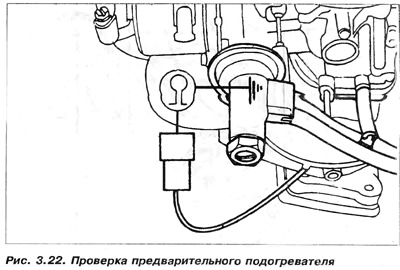
b) Check the resistance between the end of the pre-heater wire and ground. It should be 0.25-0.50…


6. Thermal switch:

Two thermal switches screwed into the engine cooling system control the current supply to the automatic suction heater unit and the pre-heater in the drive manifold depending on the coolant temperature. The red one controls the automatic suction, and the transparent one controls the pre-heater in the manifold.

The operation of the thermal switches can be checked using a test light (figure 3.22)

a) Before removing the switch on a cold engine, disconnect the wiring connections and connect a test lamp in series between the end of the electrical wire supplying the thermal switch and the end of the thermal switch. With the ignition on, the test lamp should light. If the lamp does not light, the switch is faulty and must be replaced. If the lamp lights, remove the switch and hang it in a container of water. The test lamp should be connected to the positive terminal of the battery and the end of the thermal switch, and the negative terminal of the battery to the body of the thermal switch. Heat the water, the lamp should go out when the temperature is between 30-40°C (red switch) or between 50-55°C (transparent switch), otherwise the corresponding switch must be replaced.

This article is available at russian, bulgarian, belarusian, ukrainian, serbian, croatian, romanian, polish, slovak, hungarian
The text has been checked: Semenova Anna

Share information:

Previous articles
Engine speed control — PICT carburetor with automatic choke
Engine speed control — PIC carburetor with manual choke
Carburetor — 31 PIC-7
Carburetor — removal and installation
Starter Cable — 1.1L Engine
Gas pedal
Next articles
Carburetor Zenith 2B5
Carburetor 2E2
Adjusting the gap of the diaphragm of the carburetor 2E2
Carburetor 2EZ
Preheating of underwater manifold
Collectors — intake and exhaust


Similar articles from other manuals for VW cars:
Carburetor adjustment Passat B3 (1988-1993)
Carburetor / fuel injection device Transporter T3 (1979-1992)
Carburetor — design description Beetle (1960-1986)
Link to this page in different formats


Visitor comments


No comments yet


How much will 47 + 27 =


Golf 5 
  • General information
  • User manual
  • Maintenance
  • Troubleshooting
  • Power unit
  • Engine repair
  • Cooling and ventilation system
  • Fuel system
  • Ignition system
  • Transmission
  • Clutch
  • Mechanical gearbox
  • Automatic gearbox
  • Chassis
  • Brake system
  • Car suspension
  • Steering
  • Body
  • Interior (internal elements)
  • Exterior (external elements)
  • Doors and covers
  • Electrical equipment
  • Power devices
  • Washers and wipers
  • Lighting and appliances
  • Electrical circuits
Golf 4 
  • General information
  • User manual
  • Weekly checks
  • Maintenance
  • Power unit
  • Petrol engines
  • Diesel engines
  • Cooling system
  • Fuel system (petrol)
  • Control system (petrol)
  • Fuel system (diesel)
  • Exhaust system
  • Transmission
  • Clutch
  • Car gearbox
  • Drive shafts
  • Chassis
  • Car suspension
  • Steering
  • Wheels and tires
  • Brake system
  • Body
  • Exterior (external elements)
  • Interior (internal elements)
  • Ventilation and heating
  • Car doors and sunroof
  • Washers and glass cleaners
  • Electrical equipment
  • Power devices
  • Lighting and appliances
  • Electrical circuits
Golf 3 
  • Petrol engine
  • Engine repair
  • Lubrication system
  • Cooling system
  • Ignition system
  • Diesel engine
  • Engine repair
  • Diesel injection system
  • Pre-glow system
  • Transmission
  • Clutch
  • Gearbox and drive shafts
  • Chassis
  • Steering
  • Wheels and suspension
  • Brake system
  • Electrical equipment
  • Lighting and appliances
  • Electrical circuits
Golf 2 
  • General information
  • Introduction to guide
  • User manual
  • Petrol engines 1.3 l
  • Engine repair
  • Lubrication system
  • Cooling system
  • Carburetors
  • Supply system
  • Ignition system
  • Petrol engines 1.6/1.8 l
  • Engine repair
  • Supply system
  • Ignition system
  • Diesel engines
  • Engine repair
  • Lubrication system
  • Cooling system
  • Power and exhaust system
  • Transmission
  • Clutch
  • 4-speed gearbox 084
  • 5-speed gearbox 085
  • 4-speed gearbox 020/4R
  • 5-speed gearbox 020/4T
  • Automatic gearbox
  • Drive shafts
  • Chassis
  • Steering
  • Car suspension
  • Brake system
  • Body
  • Body elements
  • Doors, locks and windows
  • Electrical equipment
  • Equipment and devices
  • Power devices
Golf 2 (petrol) 
  • General information
  • Characteristics
  • Car care
  • Maintenance
  • Power unit
  • Engine repair
  • Engine 1.05/1.30
  • Engine 1.60/1.80
  • Cooling and lubrication system
  • Power and exhaust system
  • Transmission
  • Clutch
  • Car gearbox
  • Drive shafts
  • Chassis
  • Brake system
  • Steering
  • Suspension
  • Body
  • Body and equipment
  • Electrical equipment
  • Lighting and appliances
  • Electrical circuits
Golf 1 (petrol) 
  • General information
  • Characteristics
  • User manual
  • Maintenance
  • Power unit
  • Engine adjustment
  • Engine 1.1/1.3
  • Engine 1.5/1.6/1.8
  • Engine electrical equipment
  • Cooling system
  • Fuel system
  • Transmission
  • Clutch and manual gearbox
  • Automatic gearbox
  • Chassis
  • Steering
  • Front suspension
  • Rear suspension
  • Brake system
  • Electrical equipment
  • Lighting and appliances
  • Electrical circuits
  • Body
  • Body and equipment
  • Optional equipment
Golf 1 (diesel) 
  • General information
  • Specifications
  • Maintenance
  • Power unit
  • Engine repair
  • Exhaust and turbocharger
  • Cooling system
  • Fuel system
  • Fuel injection system
  • Transmission
  • Clutch and drive shafts
  • Car gearbox
  • Chassis
  • Suspension and wheels
  • Steering
  • Brake system
  • Wheels and tires
  • Body
  • Heating and ventilation
  • Exterior (external elements)
  • Interior (internal elements)
  • Doors and windows
  • Electrical equipment
  • Equipment and devices
  • Lighting system
  • Power devices
  • Electrical circuits
VWmanual.ru © 2016-2026 | Mobile version | News and articles | Sitemap: EN BG BY UA RS HR RO PL SK HU | Write message | Site search
Passat B2 • Passat B3 • Passat B4 • Passat B5 • Passat B6 • Golf 1, diesel • Golf 1, petrol • Golf 2, petrol • Golf 2 • Golf 3 • Golf 4 • Golf 5 • Polo 3 • Polo 4 • Touareg 1 • Tiguan 1 • Sharan 1 • Transporter T3 • Transporter T4 • LT 28 • LT 2D • Beetle • Caddy 3 •
Our website uses cookies to ensure functionality and convenience.