



2. Remove the screws from the carburetor cover.
3. Lift the carburetor cover and remove the gasket.
4. Lift the locking element (above the float axis) and remove the float from the carburetor float chamber.
5. Clean the float chamber with fuel.
6. If it is necessary to further disassemble the carburetor, use Figure 3.13.
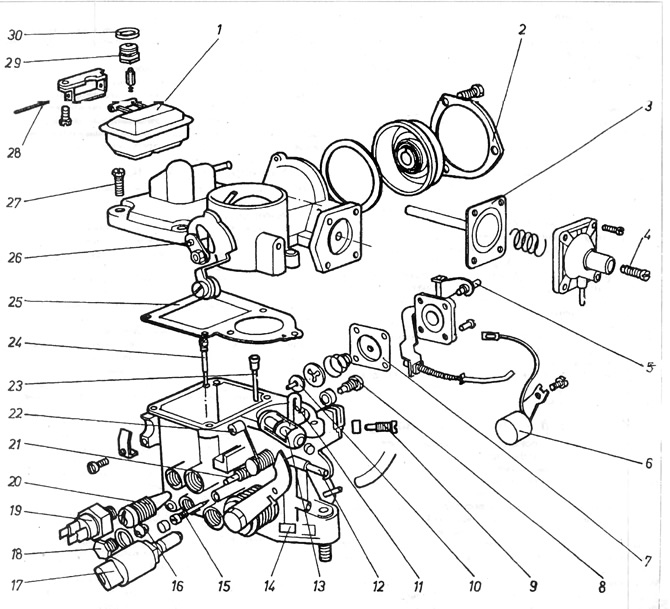
Figure 3.13. Carburetor 31 PIC-7
1 - float; 2 - fastening ring; 3 - servomotor diaphragm, 4 - diaphragm gap adjusting screw; 5 - accelerator pump flow adjusting bolt; 6 - partial throttle opening channel heater; 7 - pump diaphragm; 8 - additional fuel jet 9 - idle jet; 10 - mushroom valve; 11 - accelerator pump nozzle; 12 - nipple for connection to the air filter temperature regulator; 13 - diaphragm clearance adjusting bolt; 14 - designation of the carburetor type; 15 - mixture composition adjusting bolt, 16 - main fuel jet; 17 - side air valve; 18 - cork; 19 - Thermal switch of the partial throttle opening channel heater; 20 - idle speed adjusting bolt; 21 - nipple for connecting the low pressure pipe of the ignition timing regulator; 22 - roller of the engine uniform operation lever; 23 - Air brake jet with emulsion tube; 24 - additional air jet; 25 - gasket; 26 - eccentric kingpin; 27 - carburetor cover bolt; 28 - float axis; 29 - needle valve; 30 - adjusting washer for needle valve
7. After removal, the side air valve 17 can be checked as follows. Press the needle into it by 3-4 mm. Then connect the power supply and touch the body to the ground, a crack should be heard, and the kingpin should extend.
8. If the carburetor is equipped with a main jet shut-off valve (looks like valve 17), it can be checked in the same way. When voltage is connected, a crackling sound should be heard.
9. The idle shut-off valve has electromagnetic control. It cuts off the fuel supply to the system and the occurrence of spontaneous combustion after the engine is turned off. There is a second reason for using the shut-off valve.
In an engine without a shut-off valve, from the moment the key is turned until the engine stops, fuel is wasted from the idle system. While the engine is off, the fuel evaporates and escapes, polluting the environment.
The valve is screwed into the side wall of the carburetor body just below the idle adjustment bolts and can be checked in the following way:
After the ignition is turned on, the valve should make an audible cracking sound. This indicates that the valve needle is moving through the electromagnet when voltage is applied. The valve must be removed if it is not working properly.
10. The carburetor installed on models of cars with 1.1 and 1.3 engines has an installed electric heating element for heating the partial load channel. It is located below the housing of the starting system next to the accelerator pump. To check the heating element, it is necessary to disconnect its wire from the clamp on top of the carburetor.
A test lamp must be connected between the clamp of the heating element and the positive pole of the battery. The lamp should light up, otherwise the heating element has a break and must be replaced with a new one.
11. Install the carburetor in the reverse order of removal. It is necessary to replace all gaskets and rubber sealing rings. Adjust the carburetor.
12. To adjust the diaphragm clearance of the launch equipment, it is necessary:
a) In PIC carburetors with manual choke, remove the choke cable tip completely to set the choke speed cam to its highest position. Remove the cover with the bimetallic spring from the starting equipment housing (figure 3.13).
b) In PICT carburetors with automatic choke, remove the cover of the water chamber of the starting equipment with the bimetallic spring assembly and close the diaphragm.
c) Press the pin 1 of the diaphragm inward until it stops in the body (figure 3.14).
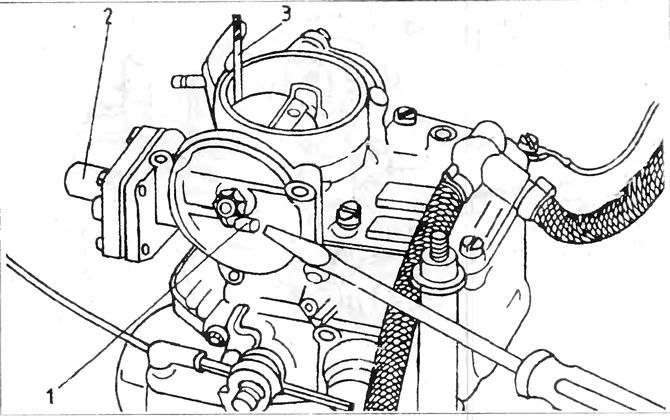
Figure 3.14. Checking the diaphragm clearance - PIC and PICT carburetors
1 - diaphragm pin; 2 - diaphragm clearance adjusting bolt housing; 3 - drill.
d) Using a drill 3 of the appropriate diameter, check the gap between the upper edge of the diaphragm plate and the wall of the neck (figure 3.14).
d) If the clearance value exceeds the limits specified in the technical data, adjust the clearance by tightening the diaphragm clearance adjusting bolt 4 (figure 3.13)
e) In building 2 (figure 3.14) after completing the adjustment, install the starter equipment cover and the bimetallic spring assembly, ensuring that the bimetallic spring is correctly positioned on the diaphragm lever. Install the cover so that the marking on the cover matches the marking on the carburetor body.
Visitor comments