



If the plate moves freely in the throat, then with the increase in pressure the plate moves in the cone of the throat, and the surface between the edge of the plate and the cone increases until the moment when the pressure force and the reaction force of the plate are equalized. Thus, the measure of the amount of air entering the engine is the deflection of the plate. The air flow meter consists of an air throat with a sensor plate mounted on a lever, which is rotatedly supported. The weight of the air flow sensor plate and the weight of its lever are compensated by a counterweight, and the force acting upward on the sensor plate is compensated by the weight of the movable piston. The piston, which moves up and down under the action of air, is surrounded by a sleeve with longitudinal vertical slits. The vertical movement of the piston causes the slits to open to a greater or lesser length, and thus the corresponding amount of fuel directed to the injectors is measured. The side surface of the throat is not a normal cone, since optimum engine operation requires a different air-to-fuel ratio under different conditions, such as: idle, partial load and full load. By making the throat part steeper than required in a normal cone, a richer mixture can be obtained at idle and at full engine load. By making the throat flatter than the shape of a normal cone, a leaner mixture can be obtained.
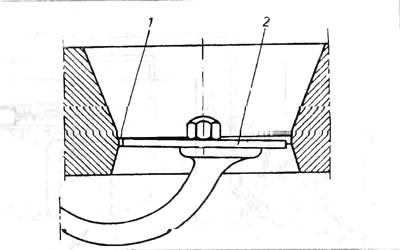
Figure 3.49. Air flow meter
1 - neck edge; 2 plate.
[The original article is available at: www.vwmanual.ru]
Visitor comments