



Basic positions and fluctuations of the vacuum gauge needle when diagnosing engine faults
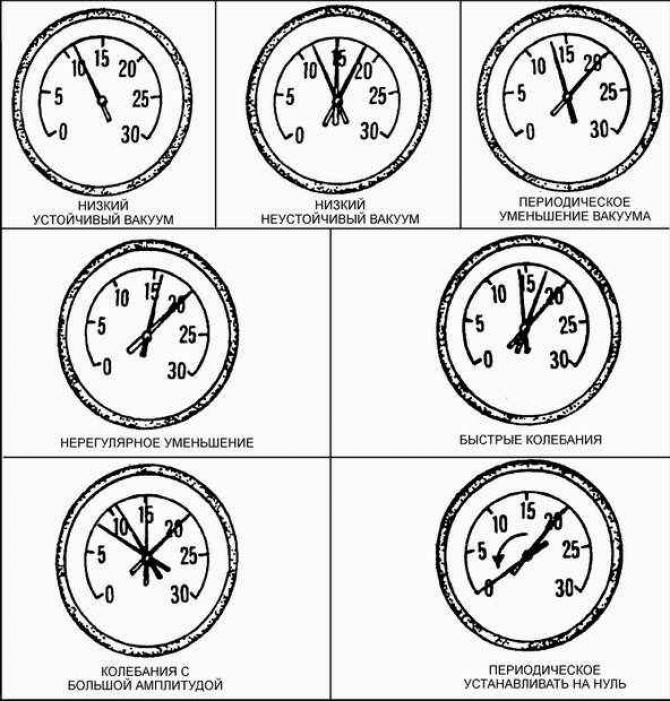
Using a vacuum gauge, you can get information about the condition of the engine and determine if the cylinder head gasket is blown, the rings are damaged, the fuel system is incorrectly adjusted, the valves are damaged, etc. Unfortunately, the readings of the vacuum gauge can be misinterpreted, so these measurements should only be used in combination with other engine testing methods. For a correct determination, both the absolute value of the vacuum gauge readings and the rate of their change are important.
Execution order
1. Connect a vacuum gauge to the intake manifold. Start and warm up the engine to normal operating temperature.
2. Read the vacuum gauge. If the engine is in normal condition, the vacuum gauge should read 430–560 mm Hg, and the vacuum gauge needle should remain in place.
Low constant readings of the vacuum meter indicate that the gasket between the intake manifold and the throttle body is damaged, the vacuum hose is damaged, the ignition timing is incorrectly set, or the valve timing is incorrectly set.
If the vacuum gauge readings are 80–200 mm Hg below normal and fluctuate, the intake manifold gasket near the inlet may be damaged or the injector may be faulty.
If the readings constantly drop by 50-100 mm Hg relative to the stable value, then the valves may be damaged. In this case, it is necessary to measure the compression in the engine cylinders.
If the readings drop, but not regularly, then the valve may be stuck or there is an ignition failure.
Small fluctuations of about 25 mm Hg are usually associated with problems in the ignition system.
If the readings fluctuate greatly, the head gasket or cylinder may be damaged.
If the needle moves slowly over a wide range of values, the positive crankcase ventilation system may be clogged, the intake manifold gasket or the gasket between the throttle body and manifold may be damaged.
3. Check how quickly the vacuum gauge readings recover after the throttle valve is opened sharply and fully and returned to its original position. If the engine is in normal condition, the readings will drop to almost zero, then increase by about 130 mm Hg above normal and again decrease to the previous values at constant idle speed. If the readings recover slowly and pass through the maximum after closing the throttle valve, then the piston rings may be damaged. If there is a long delay, then the exhaust system may be clogged.
Visitor comments