



Contents: Removal ↓ Installation ↓ Removal ↓ Installation ↓ Removal ↓ Installation ↓ Removal ↓ Installation ↓ Removal ↓ Installation ↓ Removal ↓ Installation ↓
Belt arrangement on four-cylinder petrol engines
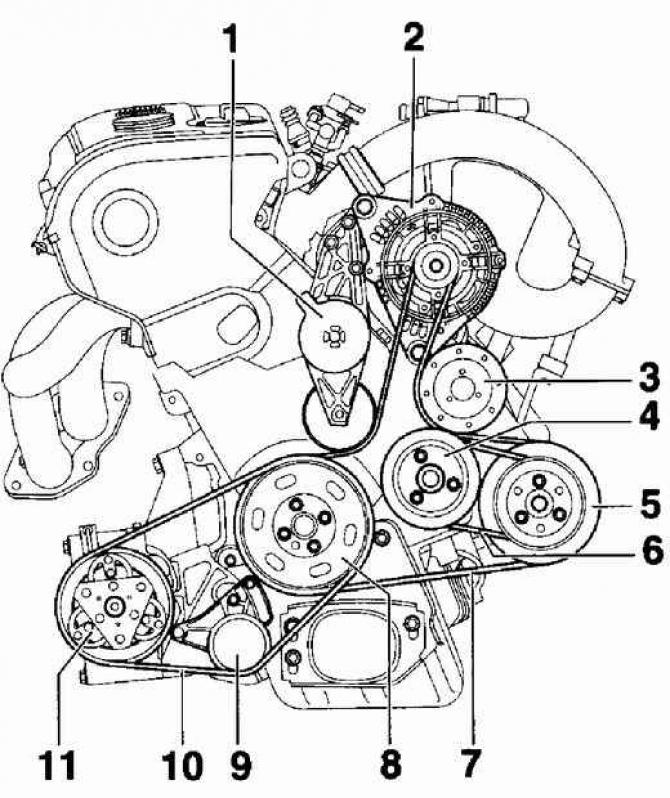
- 1 - belt tensioner,
- 2 - generator,
- 3 - fan,
- 4 - water pump,
- 5 - power steering pump,
- 6 - water pump belt,
- 7 - belt of power steering fan and generator,
- 8 - vibration damper,
- 9 - air conditioning compressor belt tensioning mechanism,
- 10 - air conditioning compressor belt,
- 11 - air conditioning compressor
A poly V-belt is essentially a flat belt with ribs on one side. The poly V-belt drives the alternator, power steering pump, radiator fan, air conditioning compressor and water pump depending on the engine modification. On models with four-cylinder engines with air conditioning, a separate belt is used to drive the air conditioning compressor.
Air conditioning compressor belt on four-cylinder engines with air conditioning
Removal
1. Remove the poly V-belts for the power steering pump, alternator and radiator fan drive.
2. If the belt is to be reinstalled, use a marker or paint to mark the direction of rotation with an arrow.
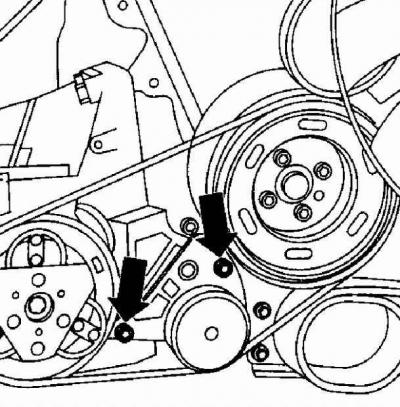
3. Loosen the screws securing the poly V-belt tensioning mechanism and, after loosening the tension of the poly V-belt, remove it from the pulleys.
Installation
1. Install the poly V-belt onto the pulleys. When reinstalling the poly V-belt, install it in accordance with the arrow previously applied.
2. Check that the poly V-belt is positioned correctly on the pulleys.
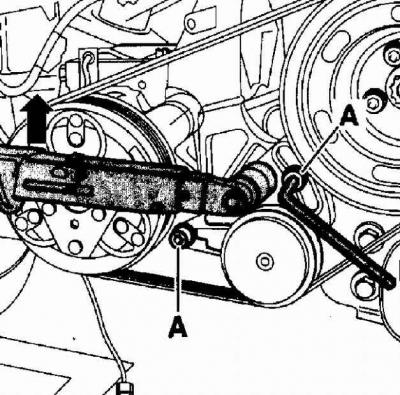
3. Place a torque wrench on the poly V-belt tension roller bracket and turn it to a torque of 25 Nm and in this position tighten the tensioner mounting bolts (A).
4. Install the power steering pump, alternator and radiator fan drive belt.
Drive belt for power steering pump, alternator and radiator fan on four-cylinder gasoline engines
Removal
1. If the belt is to be reinstalled, use a marker or paint to mark the direction of belt rotation.
2. Move the belt cover forward.
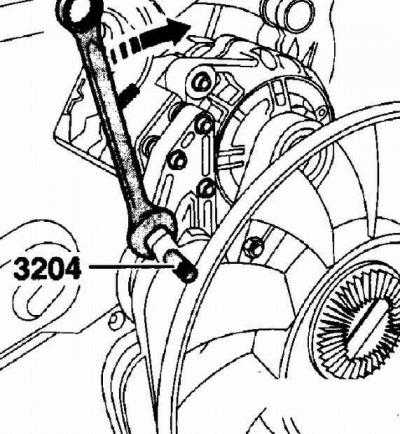
3. To loosen the belt tension, use a wrench to turn the tensioner clockwise and secure it with a 5mm diameter steel rod.
4. Remove the belt from the pulleys.
Installation
1. Check that all pulleys are securely fastened, otherwise tighten the pulley mounting bolts.
2. Install the belts on the engine pulleys. When reinstalling the belts, install them in accordance with the previously applied arrows.
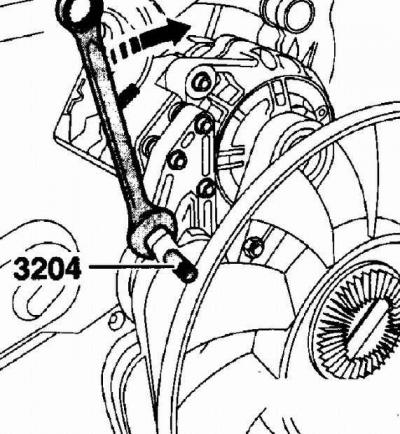
3. Press the belt tensioner clockwise with the wrench and remove the steel rod that secures the tensioner. Slowly release the belt tensioner, and the belt will be tensioned automatically.
4. Replace the belt cover.
5. Start the engine and check the operation of the belts.
Drive belt for power steering pump, alternator, water pump and radiator fan on diesel engines
Removal
Warning: The belt removal and installation procedures are the same as for a four-cylinder petrol engine. This subsection only covers the procedures specific to diesel engines.
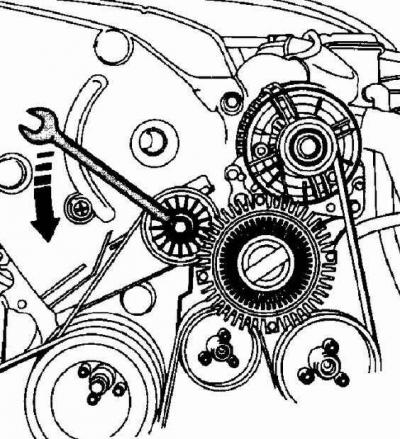
1. Using a wrench on the bolt head, turn the tension roller counterclockwise and remove the belt. The bolt has a left-hand thread, so turning it counterclockwise will not unscrew it.
Installation
Using a wrench, turn the belt tension roller clockwise by the bolt head and install the belt on the pulleys. Slowly release the tension roller, and the belt tension will be adjusted automatically.
Five-cylinder engine
Removal
1. Unscrew the four bolts securing the radiator fan from the hub and remove it.
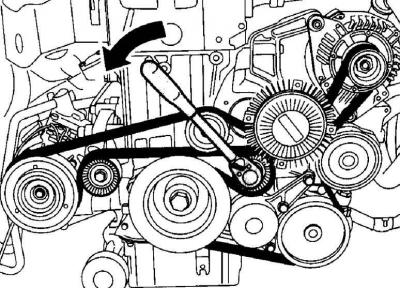
2. using a 15mm socket wrench, turn the tensioner mounting bolt counterclockwise and remove the belt.
Installation
Using a spanner, turn the tension roller clockwise and put on the drive belt. Slowly release the tension roller, this will automatically tighten the drive belt.
Six-cylinder engine
Location of auxiliary drive belt on a six-cylinder engine
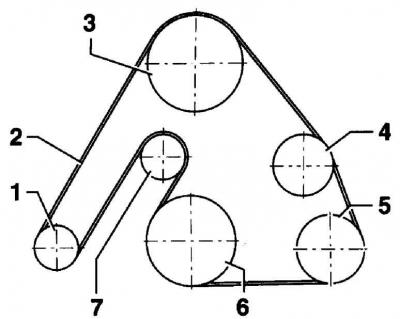
- 1 - generator,
- 2 - belt,
- 3 - Power steering pump
- 4 - radiator fan,
- 5 - air conditioning compressor,
- 6 - crankshaft,
- 7 - belt tension roller
Caution: On vehicles without air conditioning, the auxiliary drive belt is installed from pulley 6 to pulley 4.
Removal
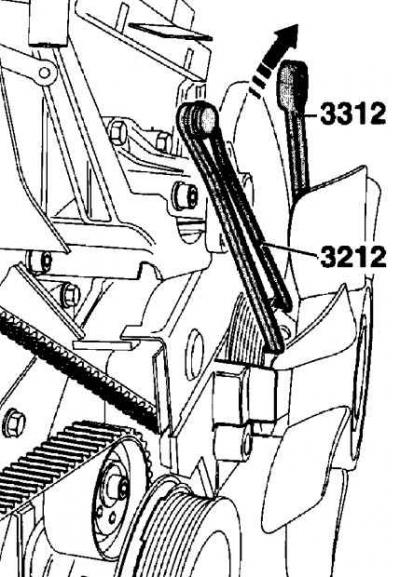
1. While holding the radiator fan pulley from turning, use a special VW-3212 key or a regular key to unscrew the pulley mounting bolt. Keep in mind that the bolt has a left-hand thread, so to unscrew it, you need to turn it clockwise.
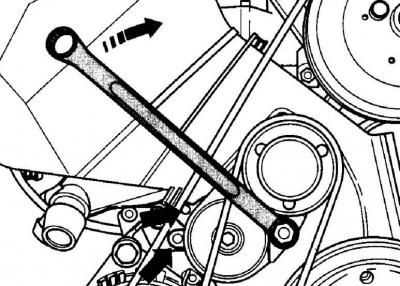
2. Using a wrench, turn the belt tensioner clockwise until the holes align. Lock the tensioner in this position by inserting a 5 mm steel rod into the hole.
Installation
1. Place the drive belt in a counterclockwise direction first on the crankshaft pulley, then on the tension roller.
2. Remove the steel rod that secures the tensioning mechanism.
3. Install the radiator fan pulley and secure it with the bolt, tightening it to a torque of 40 Nm.
Warning: The radiator fan pulley mounting bolt has a left-hand thread, so tighten the bolt by turning it counterclockwise.
V-belt on four-cylinder petrol engines, except for AHL 1.6-I engines
A V-belt is used to drive the water pump. On 1.6-I AHL engines, the water pump is driven by a toothed belt.
Removal
1. If the belt is to be reinstalled, use a marker or paint to mark the direction of belt rotation with an arrow.
2. Move the belt cover forward.
3. Reduce the tension of the power steering pump, alternator and radiator fan drive belt. Using a steel rod, fix the belt tension roller in the retracted position.
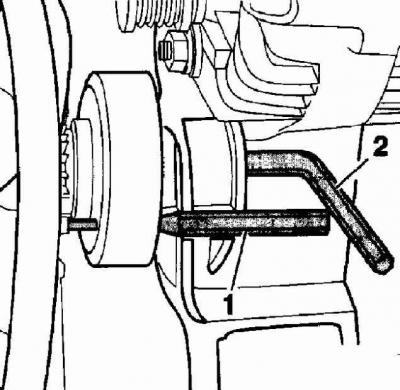
4. Using a steel rod (1) with a diameter of 5 mm, fix the radiator fan pulley from turning, unscrew it from the back of the pulley with a key (2) and remove the radiator fan.
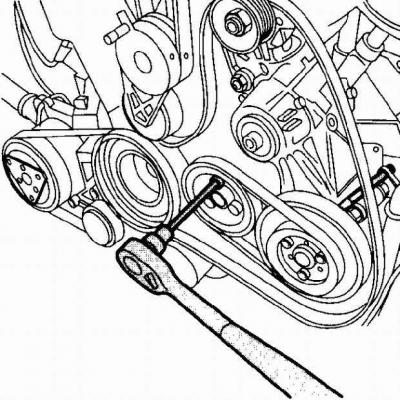
5. Unscrew the water pump V-belt pulley. To prevent the pulley from turning, use a steel rod or screwdriver to secure the power steering pump pulley while unscrewing the bolts.
6. Remove the V-belt.
Installation
1. Install the V-belt.
2. Gradually and evenly tighten the V-belt pulley onto the water pump.
3. Rotate the water pump pulley to properly install the V-belt into the pulley grooves.
4. Tighten the water pump pulley mounting bolts to 25 Nm. · It is not necessary to adjust the V-belt tension.
5. Install the radiator fan and place the V-belt on the radiator fan pulley.
6. Screw the radiator fan with a bolt, tightening it to a torque of 45 Nm.
7. Install the belt and adjust its tension.
Visitor comments