



Special tool: not required.
Necessary consumables/replacement parts when replacing the belt:
- Poly V-belt for the corresponding engine version.
Checking the status
- Shift the gearbox into neutral.
Safety instructions
There is a risk of accident when lifting the vehicle! Please read the section "Lifting the vehicle" beforehand.
- Raise the car onto jack stands.
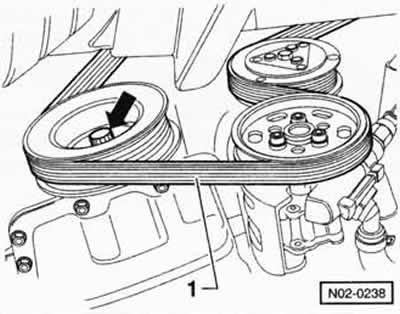
- On the poly V-belt "1" in a clearly visible place, apply a transverse mark with chalk.
- From the underside of the vehicle, using a socket head, slowly turn the engine crankshaft in the direction of its rotation with stops on the belt pulley mounting bolt until the chalk mark appears again, and check the condition of the poly V-belt section by section.
Check the poly V-belt for the following damage:
- Traces of oil and grease.
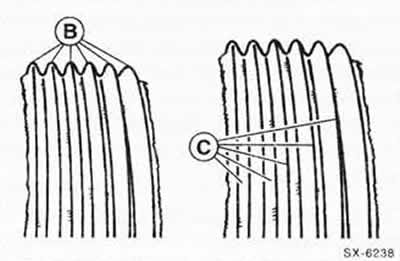
- Wear of the side surfaces of the wedges: the wedges are worn to a pointed state "B", the wedges of the new belt have a trapezoidal shape in cross-section. At the base of the belt wedges, a cord is visible, appearing as light spots "C".
- Hardening of the side surfaces, their lightening.
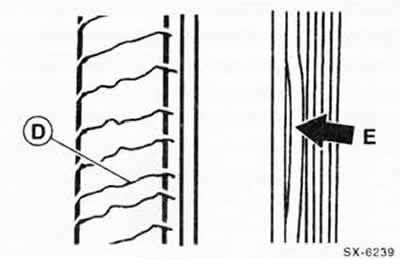
- Transverse "D" cracks on the back of the belt.
- Individual "E" wedges have come away from the base of the belt.
(The article is published on this resource: «VWManual.ru»)
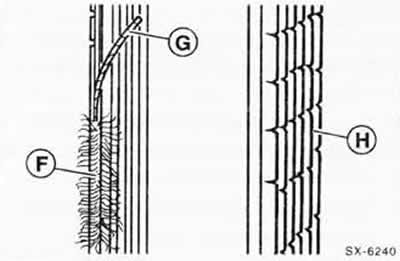
- Fringing "F" on the outer side of the belt cord.
- Breaks in the "G" cord threads on the sides of the belt.
- Transverse "H" cracks on many wedges.
- Damage to wedges, individual transverse cracks in wedges. Dirt and stone deposits between wedges. Rubber pellets at the base of wedges.
- If at least one of these several types of damage is detected, then the poly V-belt needs to be replaced.
Visitor comments