



Contents: Engines 1.6-I ↓ Diesel engine ↓
Using a compression tester to check the compression in diesel engine cylinders
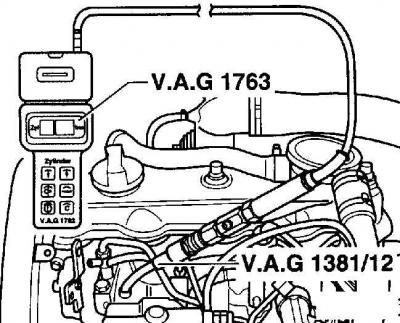
The engine condition can be checked by measuring the compression pressure in the engine cylinders. If this check is carried out regularly, it is possible to know in advance the beginning of engine wear, without waiting for the moment when engine wear manifests itself in low engine efficiency.
Warm up the engine to operating temperature. The battery must be fully charged.
Remove all spark plugs.
Engines 1.6-I
Disconnect the electrical connector from the ignition coil.
Five-cylinder engines
Remove the air duct located between the air filter and the air intake by loosening the clamps and disconnecting the electrical connector from the air flow meter. Remove the air duct together with the crankcase ventilation valve.
Five and six cylinder engines
Disconnect the electrical connector from the ignition control unit. The ignition control unit is in the electrical circuit between the control unit and the ignition coil.
Six-cylinder engines
Disconnect all electrical connectors from the fuel injectors or remove fuse #28 located in the fuel pump power supply circuit.
Shift into neutral and apply the handbrake.
Install a compression gauge or compression pressure tester into the spark plug hole of the first cylinder.
The assistant should press the accelerator pedal all the way down and turn the engine over with the starter. After turning the crankshaft one or two revolutions, the compression pressure should increase to the maximum and then stabilize. Record the maximum result obtained.
Check the compression in the remaining cylinders in the same way.
The compression pressure in all cylinders of petrol engines should not differ by more than 3.0 bar, and on a diesel engine - 5.0 bar. Note that the compression value should increase quickly on a serviceable engine. Low compression pressure on the first revolution of the crankshaft, followed by a gradual increase in pressure on subsequent revolutions of the crankshaft indicates wear of the piston rings.
A low pressure reading on the first revolution of the crankshaft, which increases slightly thereafter, indicates a loose valve fit, a broken cylinder head gasket, or a crack in the cylinder head. Worn valve stem ends can also cause low compression pressure.
If the pressure in one cylinder is low, then perform the following tests. Pour some engine oil into the cylinder through the spark plug hole and check the compression pressure.
If pouring oil into the cylinder increases the compression pressure, this indicates that the cylinder or piston rings are worn.
Low pressure in two adjacent cylinders indicates a burnt-out gasket between the cylinders.
If the pressure in one cylinder is 20% less than the others and the engine idles rough, this indicates a worn camshaft lobe.
If the compression pressure is too high, this indicates that the combustion chamber is covered with a thick layer of carbon deposits.
After this check, screw in the spark plugs.
Connect the electrical connector to the ignition coil control module. On a six-cylinder engine, connect the connectors to the fuel injectors or install a fuse in the fuel pump circuit.
Five-cylinder engines
Reinstall the air duct and secure it with clamps. Connect the electrical connector to the air flow meter.
Warning: When the ignition and fuel injection electrical connectors are disconnected, a fault message is stored in the electronic engine control unit. It is recommended that the stored fault information be erased at a Volkswagen specialist workshop as soon as possible.
Diesel engine
Disconnect the electrical connector from the engine shut-off valve.
Disconnect the electrical connector from the flow meter on the fuel pump.
Remove all glow plugs.
Instead of glow plugs, screw in a compression tester with a flexible adapter hose, see Fig. Using a compression tester to check compression in diesel engine cylinders.
Turn the engine crankshaft with the starter until the pressure recorded by the measuring device stabilizes. Record the result obtained.
Check the compression in the remaining cylinders in the same way.
Screw in the glow plugs, tightening them to a torque of 15 Nm and connect the voltage supply bus to the plugs.
Reconnect all previously removed electrical connectors.
Visitor comments