
English Русский
Български
Беларускі
Український
Српски
Hrvatski
Română
Polski
Slovenský
Magyar
  |  Articles  |  Sitemap  |  Contacts  |    |
Car maintenance Ford Car maintenance Hyundai Car maintenance Chevrolet Car maintenance BMW Car maintenance Audi Car maintenance Opel Car maintenance AvtoVAZ
VWmanual.ru


Main   Passat   Golf   Polo   Touareg   Tiguan   Sharan   Transporter   Others  
Transporter T3 (1979-1992) Transporter T4 (1990-2003)

Checking the compression in the cylinders (VW Transporter T4)

  • Main
  • Transporter
  • Transporter T4
  • Power unit
  • Engine repair
  • Checking the compression in the cylinders
            0


Contents: Gasoline engine ↓ Diesel engine ↓
Compression testing allows you to draw conclusions about the engine condition. Based on the results of the test, you can determine the degree of wear of the valves or pistons (piston rings), and also the need for engine repair. To check, you need a compression gauge, which for gasoline engines can be bought in auto stores.

Attention! For a diesel engine, a compression tester with a large measuring scale is required.


The difference in pressure between individual cylinders must not exceed 3.0 bar (diesel engine 5.0 bar). If one or more cylinders have a pressure difference of more than 3.0 bar (diesel engine 5.0 bar), then this indicates defective valves, wear of piston rings or cylinder walls. When the wear limit is reached, the engine must be overhauled or replaced.

Engine type
Compression pressure, bar
New
Wear limit
Gasoline engine
9 – 12
7,0
Diesel engine
34,0
26,0

Gasoline engine


1. When checking compression, the engine must be at operating temperature. Oil temperature must be at least 30°C.

2. Turn off the ignition.

3. Disconnect the plug from the Hall sensor on the ignition distributor.

4. Remove fuse #15 from the fuse box.

5. Disconnect all spark plug connectors. There are special pliers for this, for example HAZET 1849. They grip the connector only by the metal sleeve.

6. Blow dirt out of the spark plug recesses in the cylinder head with compressed air and remove all spark plugs with a suitable spark plug wrench.


7. Turn the engine over several times with the starter to remove combustion products.

Attention! Gearbox in neutral position, handbrake applied.


8. Fix or screw the compression gauge into the spark plug hole in the cylinder, according to the instructions for use.

9. Press the gas pedal all the way down and hold it in this position during the entire test. An assistant is needed for this.

10. Crank the engine approximately 8 revolutions until the compression gauge shows a constant pressure.

11. Check all cylinders in sequence and compare the readings with the required values.

12. Tighten the spark plugs and connect the high-tension wires.

13. Connect the plug to the Hall sensor.

14. Install fuse #15.

Diesel engine


Compression measurement
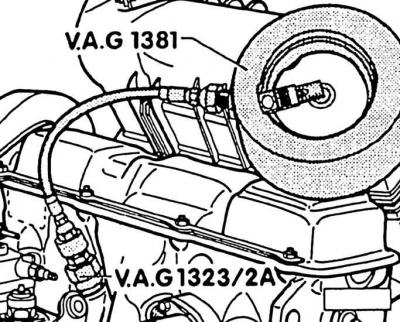


Compression Tester VW-1381

Compression Tester VW-1381
Adapter VW1323/2A


Thermal insulator
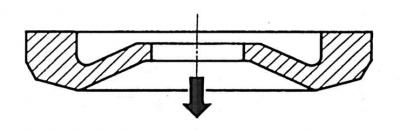


Thermal insulator


1. Warm up the engine while driving until the coolant temperature reaches 80°C.


2. Disconnect the electrical wire from the fuel injection pump switch, insulate it and set it aside.

3. Clean the injection pipes with cold cleaning agent and remove without changing their curved shape.

4. Remove the injectors (see subsection 2.17.7.5).

5. Screw the compression gauge in place of the injector, while installing an old heat insulator between the compression gauge and the cylinder head.

Attention! The pressure data given are valid only when measured with the VW-1381 compression tester with the VW1323/2A adapter. Other devices can only measure the pressure difference between individual cylinders (see fig. Compression measurement).


(The original can be viewed on the portal: «vwmanual.ru»)

6. Turn the engine over approximately 8 revolutions until the instrument reading stabilizes.

7. Screw in the injectors and tighten to a torque of 70 Nm.

Caution! Always replace the heat insulators between the cylinder head and the injectors. The recess must be installed upwards (see fig. Thermal insulator).


8. Tighten the injection pipes to 25 Nm.

9. Connect the wire to the fuel supply switch.

This article is available at russian, bulgarian, belarusian, ukrainian, serbian, croatian, romanian, polish, slovak, hungarian
The text has been checked: Orlov Dmitry

Share information:

Previous articles
Lapping of valve seats
Finishing the valve seat in the cylinder head
Checking the valve guides
Removal and installation valves
Replacing the valve stem seals
Hydraulic disc tappets
Next articles
V-belt for alternator or alternator and water pump
Power steering pump V-belt
Removal, installation and tensioning the V-belt
Engine fault diagnostics


Similar articles from other manuals for VW cars:
Checking the compression in the engine cylinders Passat B5 (1996-2005)
Checking the compression in the engine cylinders Golf 4 (1997-2004)
Checking the levels of the main working fluids Polo 3 (1995-2003)
Checking the condition of the poly V-belt Touareg 1 (2002-2006)
Checking the operation of the intake manifold flap Tiguan 1 (2007-2015)
Checking the compression in the engine cylinders Sharan 1 (1995-2000)
Checking the compression in the cylinders Beetle (1960-1986)
Link to this page in different formats


Visitor comments


No comments yet


How much will 31 + 34 =


Transporter T4 
  • General information
  • User manual
  • Maintenance
  • Power unit
  • Engine repair
  • Ignition system
  • Lubrication system
  • Cooling system
  • Fuel system (petrol)
  • Fuel system (diesel)
  • Injection system (petrol)
  • Exhaust system
  • Transmission
  • Clutch
  • Car gearbox
  • Chassis
  • Car suspension
  • Steering
  • Brake system
  • Wheels and tires
  • Body
  • Exterior
  • Interior
  • Doors and windows
  • Heating system
  • Electrical equipment
  • Equipment and devices
  • Lighting and signaling
  • Power devices
  • Electrical circuits
Transporter T3 
  • General information
  • Maintenance
  • Petrol engines
  • Engine repair
  • Lubrication system
  • Cooling system
  • Power and exhaust system
  • Carburetor 34 PICT
  • Carburetors 2E3 and 2E4
  • Fuel injection system
  • Ignition system
  • Diesel engines
  • Engine repair
  • Lubrication system
  • Cooling system
  • Power and exhaust system
  • Transmission
  • Clutch
  • Car gearbox
  • Chassis
  • Front suspension
  • Rear suspension
  • Steering
  • Brake system
  • Body
  • Body and interior elements
  • Doors, locks and windows
  • Electrical equipment
  • Lighting system
  • Equipment and devices
  • Power devices (diesel)
  • Power devices (petrol)
  • Wiring diagrams (diesel)
  • Wiring diagrams (petrol)
VWmanual.ru © 2016-2026 | Mobile version | News and articles | Sitemap: EN BG BY UA RS HR RO PL SK HU | Write message | Site search
Passat B2 • Passat B3 • Passat B4 • Passat B5 • Passat B6 • Golf 1, diesel • Golf 1, petrol • Golf 2, petrol • Golf 2 • Golf 3 • Golf 4 • Golf 5 • Polo 3 • Polo 4 • Touareg 1 • Tiguan 1 • Sharan 1 • Transporter T3 • Transporter T4 • LT 28 • LT 2D • Beetle • Caddy 3 •
Our website uses cookies to ensure functionality and convenience.