



Contents: Operation of the plate pusher ↓ Examination ↓
All VW T4 engines are equipped with hydraulic plate tappets, which reduce valve train noise and, in addition, do not require valve clearance adjustment as part of maintenance.
Operation of the plate pusher
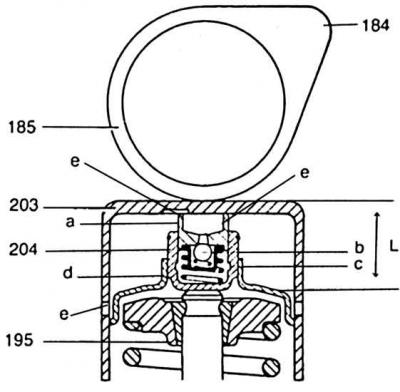
When the engine is running, the plate tappet 203 is unloaded if the cam 184 of the camshaft 185 is located at the top. In this case, the spring (d) expands the compensator 204 so that it rests against the valve stem 195 at the bottom, and at the top, the pressure pin (a) presses the plate tappet 203 against the camshaft.
In this position, all openings (e) are closed and engine oil can neither flow in nor out of the working chamber (c). As soon as the plate tappet is loaded by the cam of the rotating camshaft, the ball valve (b) closes and the oil in the working chamber, due to its incompressibility, will work as a single solid body. Thus, the distance (L) with each revolution of the camshaft will be adjusted accordingly to the changing dimensions of the mating parts.
The external feature of a hydraulic disc tappet is a running oil groove and the absence of adjusting washers.
Caution! Noises in the valve train when starting the engine are normal. When the engine is stopped, depending on the position of the cam, more or less oil is squeezed out of the tappet. This leads to noise that does not stop until the hydraulic tappet, with the engine running, is filled with oil again. Depending on the circumstances, this process can continue until the engine warms up to operating temperature.
Attention! To ensure flawless operation of the hydraulic tappets, the cylinder head is equipped with an oil leakage blocker that prevents the oil from completely leaking out of the cylinder head when the engine is stopped.
Examination
Hydraulic tappets should be checked if the valve train noise does not disappear when the engine reaches operating temperature.
1. Warm up the engine while driving, leave it to idle until the radiator fan turns on.
2. Within 2 minutes, increase the engine speed to 2500 rpm.
3. If the hydraulic tappets continue to make loud noises, turn off the engine and remove the cylinder head cover. Turn the camshaft until the cams of the cylinder being checked point upwards. To do this, set the gearbox to neutral, apply the handbrake and turn the crankshaft clockwise using the belt pulley mounting bolt with a suitable wrench.
Caution! Do not turn the camshaft drive gear mounting bolt, as this will overload the timing belt. The crankshaft and camshafts can also be turned as follows: engage 5th gear and push the car forward or backward.
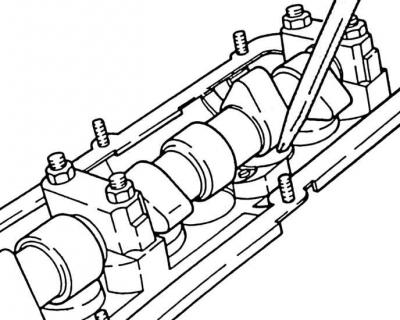
4. Press the plate tappet down with a wooden or plastic wedge. If you feel a play of more than 0.1 mm, replace the plate tappet.
Attention! After installing a new hydraulic tappet, the engine must not be started for about 30 minutes, otherwise the valve will collide with the piston, which may lead to their breakage.
Visitor comments