



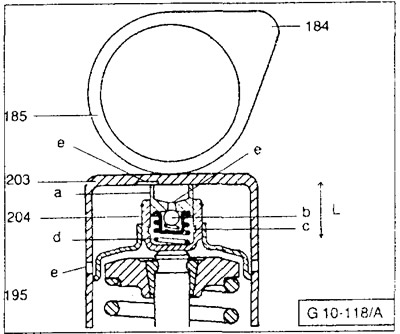
When the engine is running, the poppet -203- is unloaded when the cam -184- of the camshaft -185- points upwards.
The spring -d- then presses the compensating element -204- so that it rests at the bottom against the end face of the valve -195- and at the top the pressure pin -a- presses the poppet pusher against the camshaft. In this position, engine oil can flow into or out of the working volume -c- through small holes -e-. As soon as the poppet is loaded by the cam of the rotating camshaft, the ball valve -b- closes and the oil is closed in the working volume. since it does not compress, it behaves like a solid body. In this way, the length -L- with each revolution of the camshaft adapts to the corresponding changes in the size of the assembly in the valve drive.
Distinguishing features of hydraulic tappets are the lubricating groove with circulating oil and the absence of shims.
Attention: Noise in the valve actuator when starting the engine is normal. When the engine is stopped, depending on the position of the cam, more or less oil is squeezed out of a separate pusher. This leads to noise until the hydraulic tappets are refilled with oil while the engine is running. To ensure that the hydraulic tappet functions flawlessly, a non-return valve is installed in the cylinder head, which prevents the oil from completely escaping from the oil grooves when the engine is stopped.
Examination
Hydraulic valve lifters must be checked if the valve actuator becomes noisy after reaching operating temperature.
Warm up the engine, then idle until the fan turns off.
For 2 minutes, raise the engine speed to 2500 rpm.
If the hydraulic tappets still make noise, stop the engine and remove the cylinder head cover.
Turn the camshaft so that the cams of the cylinder to be checked point upwards. To do this, shift the gearbox to neutral gear, apply the handbrake and turn the crankshaft clockwise using the central bolt of the belt pulley with a suitable wrench.
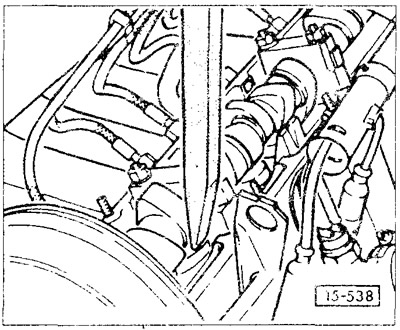
Push the poppet down using a wooden or plastic wedge. If more than 0.1 mm free play is felt before the valve moves, replace the poppet.
Attention: After installing a new hydraulic tappet, the engine must not be started for about 30 minutes, otherwise the valve may hit the piston, causing damage to the piston and / or valve.
Visitor comments