



Contents: Removal ↓ Installation ↓
Cylinder Head Bolt Tightening Sequence
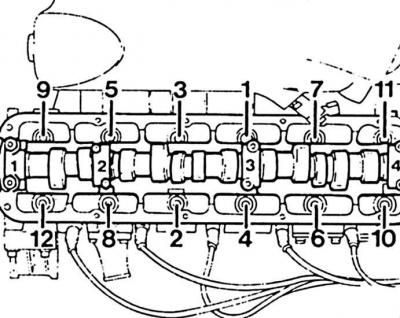
Remove the cylinder head only when the engine is cool (room temperature). The exhaust and intake manifolds are not removed.
The cylinder head can be removed without removing the engine.
The features of removing and installing the cylinder head of a diesel engine are described in subsection 2.6.1.4. A defective cylinder head gasket can be identified by one or more of the following signs:
- loss of power;
- coolant leak (white plumes of exhaust gases when the engine is warm);
- oil leak;
- coolant in engine oil (oil level does not decrease but increases, gray color of engine oil, foam bubbles on the oil level indicator, liquid oil);
- engine oil in coolant;
- strong bubbling of the coolant;
- lack of compression between two adjacent cylinders.
Removal
1. Disconnect the negative (-) cable from the battery.
Attention! This will erase the anti-theft code and tuned radio stations from the radio receiver's memory. Disconnect the battery only when the ignition is off, otherwise the fuel injection system control unit will fail.
2. Remove the upper part of the intake manifold.
3. Remove all vacuum hoses. To facilitate assembly, mark them with adhesive tape beforehand.
(The article is posted on this website: VWManual.ru)
4. Disconnect the throttle control cable from the throttle valve nipple and stop.
5. Disconnect and unplug all wires.
6. To make assembly easier, mark the wires with tape.
Attention! Open the cable clamps and cut them if necessary. Do not remove the cable clamps so that new clamps can be installed in the old places during assembly.
7. Remove the spark plug wires.
8. Remove the distributor cap. To do this, open the two plate clamps with a screwdriver.
9. Remove the distributor runner.
10. Mark all fuel lines with tape and remove them.
11. Drain the coolant completely.
12. Loosen the clamps and remove all coolant hoses from the cylinder head.
13. Place the machine on supports.
14. Remove the lower engine compartment cover.
15. Unscrew the exhaust pipe from the exhaust manifold and the gearbox bracket. Lower the exhaust system down a little and hang it on a wire.
16. Remove the upper timing belt cover.
17. Loosen the toothed belt and remove it from the top of the camshaft.
18. Unscrew the cylinder head cover.
19. Remove the cylinder head gasket.
20. Loosen 1/2 turn and then unscrew the cylinder head bolts in reverse order of their numbering from 12 to 1 (see Fig. Cylinder Head Bolt Tightening Sequence).
21. Check that all wires and hoses leading to the cylinder head are disconnected.
22. Remove the cylinder head, having first unscrewed the screws of the rear timing belt cover and bent it to the side.
23. Place the cylinder head on two wooden blocks.
24. Remove the cylinder head gasket.
Installation
1. Before installation, clean the mating surfaces of the cylinder head and cylinder block from gasket residues using a suitable scraper. Make sure that dirt does not get into the cylinder block holes. Cover the holes with a rag.
2. Check for oil in the cylinder head screw holes, remove oil if necessary. To do this, insert a clean rag into the hole and collect the oil.
Caution! Any oil remaining in the holes when tightening the bolts may cause damage to the cylinder block.
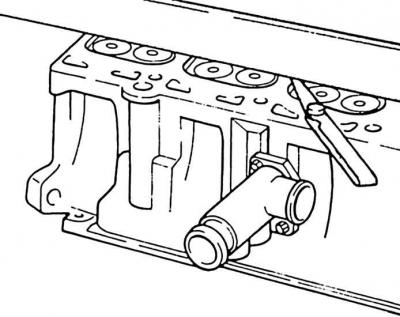
3. Check the cylinder head for flatness using a steel ruler and a petal feeler gauge in various places. The flatness should not exceed 0.1 mm.
Caution! If the cylinder head sealing surfaces are to be finished, the minimum permissible head height must not be reduced (see subsection 2.10.3).
4. A cylinder head with breaks in valve seats or valve seat rings, as well as the beginning of the threaded entries of spark plugs, can be used further without reducing their service life and overhauling if the width of the breaks does not exceed a = max 0.5 mm.
5. Always replace the cylinder head gasket. The inscription "oben" should point to the cylinder head. Install the gasket without sealant so that it does not cover any holes.
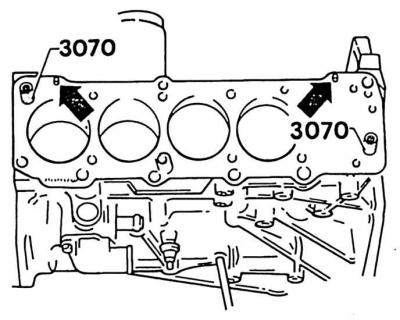
6. To center the cylinder head, screw the cylinder head bolts into holes 9 and 10 (see fig. Cylinder head bolt tightening order) vAG-3070 guide pins(the arrows indicate the locations of the pins). If you don't have fingers at hand, make the guide pins yourself. To do this, cut off the heads of the old cylinder head bolts and cut a slot for a screwdriver on their end.
7. Turn the crankshaft by the belt pulley so that all pistons are at approximately the same height.
8. Install the cylinder head, paying attention to the guide pins.
9. Install the remaining 10 bolts with washers and tighten them finger tight. Always replace the cylinder head bolts.
10. Unscrew the guide pins with a screwdriver and screw in the remaining two bolts with washers. Tighten by hand.
Caution! Tighten the cylinder head bolts with great care. Before tightening, check the accuracy of the torque wrench. Tighten the cylinder head bolts on a cold engine.
11. The cylinder head bolts are tightened with a torque wrench in sequence from 1 to 12 in two steps: first with a force of 40 N·m, and then 60 N·m. After this, additional tightening is performed with a rigid wrench: 1/2 turn (180°). Additional tightening of 90° x 2 (2 times 90° each) is allowed. When tightening the cylinder head bolts, evaluate the rotation angle by the position of the wrench handle relative to the engine: 1/4 turn (90°) corresponds to the position of the handle across the engine.
Attention! For petrol engines, additional tightening of cylinder head bolts on a warm engine during maintenance or repair is not permitted.
12. Install the timing belt.
Attention! When replacing the cylinder head with the camshaft installed, it is necessary to lubricate the contact surfaces between the plate tappets and the working surface of the cams with oil after installing the head.
13. Install the cylinder head cover with the gasket and tighten to 10 Nm. Replace the damaged gasket.
14. Install the exhaust pipe onto the exhaust manifold.
15. Install the engine splash guard.
16. Remove the car from the supports.
17. Install the coolant hoses and secure with clamps.
18. Connect all electrical wires according to the marks with adhesive tape.
19. Install the distributor runner. Check the reliability of the fastening by moving it back and forth.
20. Install the distributor cap and secure with two plate clamps.
21. Install the spark plug wires in the firing order of cylinders 1-2-4-5-3. The first cylinder is located at the toothed belt.
22. Connect all fuel lines and secure with clamps.
23. Connect all vacuum hoses according to the marks with adhesive tape.
24. Connect the throttle control cable to the throttle valve and stop.
25. Place the heating hose onto the front exhaust pipe casing and secure with a clamp.
26. Install the intake manifold.
27. Connect the ground (-) wire to the battery. Enter the anti-theft code, program the radio stations and set the exact time on the clock.
Caution! Connect the battery only when the ignition is off, otherwise the fuel injection system control unit will fail.
28. Fill with coolant. Always replace coolant.
29. Check the engine oil level. If the cylinder head gasket was defective, replace the oil and filter.
30. Warm up the engine to operating temperature, check the coolant level and the tightness of the hose connections.
31. Check the ignition timing (see subsection 2.14.6).
32. Check idle speed and CO content (see subsection 2.18.1).
33. Check compression (see subsection 2.11).
Visitor comments