



Contents: Removal ↓ Installation ↓
Removal
Caution! Aluminum wheels are coated with a protective varnish layer to prevent corrosion. When replacing wheels, be careful not to damage the protective varnish layer. If necessary, restore it with clear varnish.
8. Mark the direction of rotation of the wheel with chalk.
9. Ensure the vehicle is stable and immobile. To do this, apply the parking brake and engage first or reverse gear.
For vehicles with an automatic transmission, move the transmission control lever to position P. In addition, place a stop shoe diagonally located in relation to the wheel being removed.
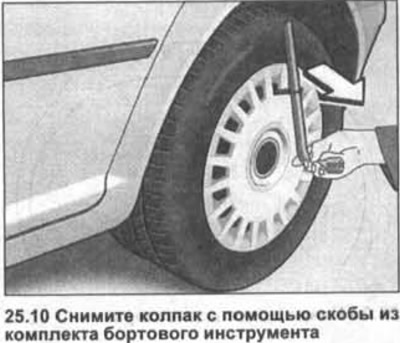
10. Remove the wheel cap. To do this, use the wire clip from the on-board tool kit. Secure the wire clip to the cap and remove it by inserting the wheel wrench into the clip (see illustration).
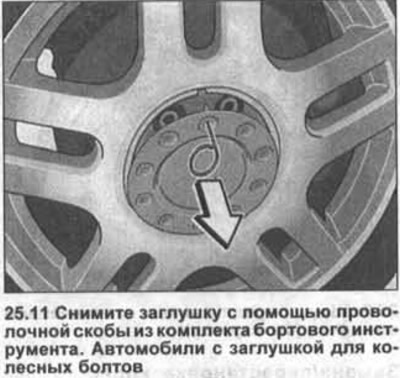
11. Vehicles with a wheel bolt cover. Remove the cover using the wire clip provided in the vehicle tool kit (see illustration).
12. Vehicles with protective caps on the wheel bolt heads: Remove the protective caps from the bolt heads using the wire clip from the vehicle tool kit.
13. Vehicles with wheel bolts with anti-theft protection. Attach the adapter, which is included in the on-board tool kit, to the wheel bolt.
The original article is available at vwmanual.ru
14. Loosen the wheel bolts by 1/2 turn. Perform the operation with the vehicle parked on its wheels. To do this, apply the parking brake and engage the gear. Use a torque wrench to loosen the wheel bolts.
Warning! Jacking up a vehicle and placing it on jack stands is associated with danger. Therefore, it is recommended that you familiarize yourself with the safety measures set out in Chapter "Jacking up a car".
15. Jack up the car enough to remove the wheel.
16. Unscrew the wheel bolts and remove the wheel.
Installation
17. Lubricate the seat of the wheel disk on the hub with a thin layer of bearing grease. This will prevent the disk from "growing" to the hub.
18. Clean dirty wheel bolts with a wire brush.
Attention! Replace rusty or damaged bolts with new ones.
19. Install the wheel on the hub in accordance with the marks made during removal.
20. Screw in the wheel bolts and tighten them in a crosswise pattern to approximately 50 Nm.
21. Lower the car onto its wheels.
22. Tighten the wheel bolts in a crisscross pattern in several passes. Always use a torque wrench to tighten the wheel bolts. This will ensure that the bolts are tightened securely and to the specified torque.
The tightening torque of bolts for all types of wheel rims is 120 Nm.
Caution! If the bolts were not tightened with a torque wrench, you should contact a workshop at the earliest opportunity to check the tightening torque. Tightening the bolts on one side or with different forces can cause the hub to become skewed or jammed.
23. Cars with wheel covers. Secure the cover near the valve, then push it down until it locks into place. If necessary, tap it around the circumference with your hands.
24. Vehicles with a wheel bolt cap. Install the cap in place and secure it. When installing, make sure that the protrusion on the cap fits into the recess on the wheel rim.
25. Vehicles with protective caps on the wheel bolt heads. Place the protective caps on the bolt heads.
Attention! Wheel rims and wheel bolts are matched to each other. If tires are remounted on other rims, for example, from aluminum rims to steel rims or if wheels with winter tires are installed, the wheels must be secured with bolts designed for steel rims and vice versa. The bolts must match the rim in length and shape. This affects the fit of the wheels and the functioning of the braking system.
After changing tires, be sure to check the pressure and, if necessary, bring it up to normal.
Visitor comments