



Contents: Tire cleaning ↓ Tire storage ↓ Tire running-in ↓ Wheel replacement/replacement ↓ Incorrect tire wear ↓
Tires have a kind of "memory", and improper handling of them, and this includes, for example, fast or frequent driving over curbs or rails, often results in their failure. Moreover, this happens only some time later and at the most inopportune moment.
Tire cleaning
Do not wash your tires with a steam jet. If the nozzle of this device is held too close to the tire, its rubber layer is irreversibly destroyed within a few seconds, which cannot be corrected even with cold water.
Tires cleaned in this way must be replaced for safety reasons.
Tires that have been in contact with oil or grease for a long time should also be replaced.
In this case, the tire first swells and then takes its normal shape and looks undamaged, but the load-bearing capacity of the tire decreases.
Tire storage
Tires should be stored in a cool, dark and dry place. They should not come into contact with lubricants, oils or fuel.
Store wheels lying down or hanging on wheel rims in the garage or basement. If the tires are not mounted on rims, they should be stored standing up.
Before removing the wheels, increase the tire pressure slightly (approximately 0.3-0.5 bar). For winter tires, use your own rims, since remounting tires to summer rims is not justified in terms of savings.
Tire running-in
New tires have a particularly smooth surface. This is due to the manufacturing process. For this reason, new tires, including a new spare tire, must be run in.
During the running-in process, as a result of the onset of abrasion, the smooth surface becomes rough.
Until the first 300 km have been driven with new tires, the driver should be especially careful when driving on wet roads.
Wheel replacement/replacement
Attention! Do not change tires individually, but at least tires on both wheels of one axle. In this case, tires with a greater residual tread depth should always be installed at the front, on the front wheels. Only tires of the same type and, if possible, with the same tread pattern and from the same manufacturer should be installed on all 4 wheels. Tires that have been manufactured for more than 6 years should only be installed in cases of extreme necessity and, in doing so, exercise extreme caution when driving; never install used tires whose origin is unknown. When replacing rims and tires, be sure to also change the valve.
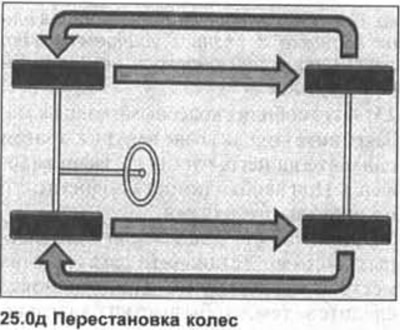
If the front wheels are noticeably more worn, it is recommended to swap them with the rear wheels. This ensures approximately equal service life for all 4 wheels.
It is not advisable to change the direction of rotation of the tires when rotating the wheels, since the tires are adjusted to the new direction of rotation only after significant wear. On some tire models, the direction of movement is indicated by an arrow on the sidewall of the tire. In these cases, the indicated direction of movement must be strictly observed.
Tyres with a specified direction of rotation, which can be identified by an arrow on the sidewall indicating the direction of travel, must always be installed in the direction of travel (see illustration).
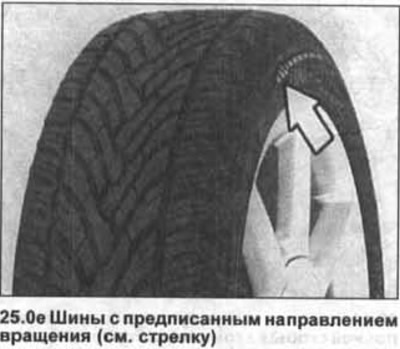
This ensures optimum tyre performance in terms of aquaplaning, road grip, driving noise and wear.
If it is necessary to install a spare wheel with the prescribed direction of rotation instead of a flat one, but the prescribed direction will not be maintained, then such a replacement must be temporary.
In this case, it is recommended, especially on a wet road, to observe the speed limit.
Incorrect tire wear
First of all, you need to maintain the prescribed pressure in your tires. Moreover, the pressure should be checked at least once every four weeks and without fail - before each long trip.
Check the pressure only when the tires are cold. When driving fast, it increases due to the heating of the tires. However, you should not deflate hot tires, of course.
For the front wheels, slightly greater wear of the tread shoulder compared to the wear of its middle part is normal. Moreover, due to the slope of the road, the wear of the tread shoulder facing the middle of the road (for the left wheel - the outer shoulder, for the right - the inner shoulder), may be more pronounced (see illustration 25.0zh).
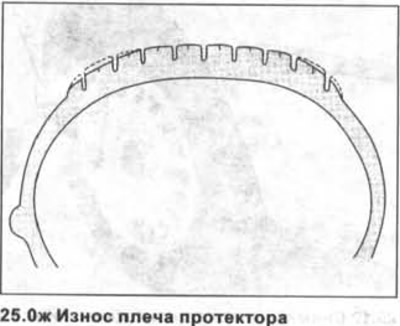
Uneven tire wear is mostly caused by too little or too much tire pressure. Uneven wear can be caused by improper wheel alignment, poor wheel balancing, and defective shock absorbers and wheels.
If the pressure is too high, the middle of the tread wears out more because the tread bends under the influence of high internal pressure.
If the pressure is too low, a lot of stress is placed on the tread shoulder and the middle of the tread bends inward, resulting in more wear on the tread shoulder.
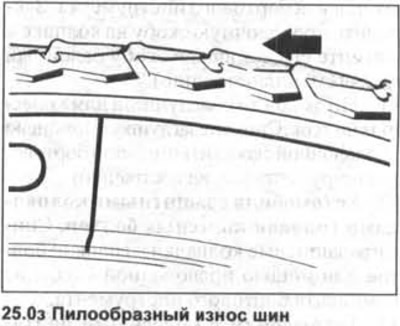
Saw-tooth tread wear is usually caused by overloading the vehicle.
Visitor comments