



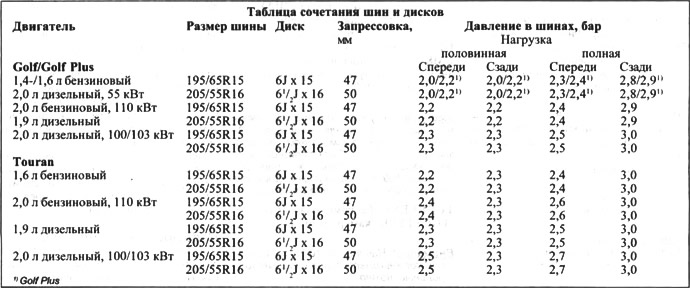
Golf/Touran vehicles are permitted to have wheels with different tire and rim diameters (see table).
It is important to maintain the correct pressure in the tires of the correct size. The required tire pressure is indicated on the plate, which is attached to the inside of the fuel filler flap (see illustration 25.0b).
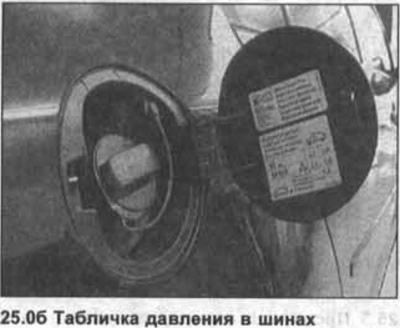
Maintaining the prescribed tire pressure is of great importance for ensuring safe driving and for the service life of the tires. For this reason, it is recommended to check the tire pressure at least once every two weeks and before each long trip (including the spare tire).
Tools needed: pressure gauge. You can use it at a gas station.
1. Check the pressure only when the tires are cold. Increased tire pressure resulting from a long journey cannot be released. The tire pressure increases by approximately 0.2-0.4 bar during long-term driving.
Winter tyres are generally operated with excess pressure, i.e. approximately 0.2 bar higher than summer tyres.
It is necessary to observe the values recommended by the winter tire manufacturer. If the winter tires have a speed limit, the corresponding maximum permissible speed must be indicated on a sticker that must be visible to the driver.
When driving with a trailer, the tire pressure should be brought to the values specified in the "Full load" column.
The prescribed tire pressure is given in the vehicle's operating instructions.
When checking the tire pressure as part of the maintenance, the pressure in the spare tire should also be checked. The air pressure in the spare tire should correspond to the maximum load of the vehicle.
(The original can be seen on the portal: «VWmanual»)
Tools needed: pump or compressor (at the gas station).
2. Unscrew the protective cap of the tire valve.
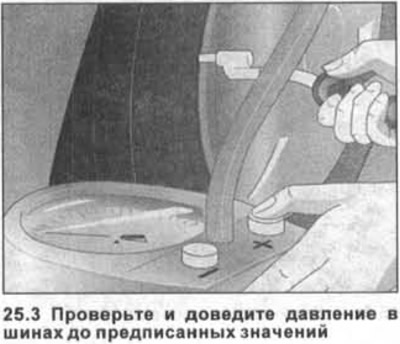
3. Check and adjust tire pressure to specified values (see illustration).
Checking the tire valve
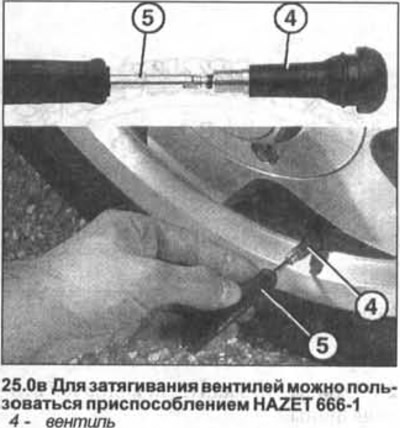
Required tools: metal protective cap or HAZET 666-1 device.
4. Unscrew the protective cap of the tire valve.
5. Lubricate the valve opening with soapy water or spit on it. If a bubble forms, tighten the valve 3 with the other end of the protective cap 2 (see illustration).
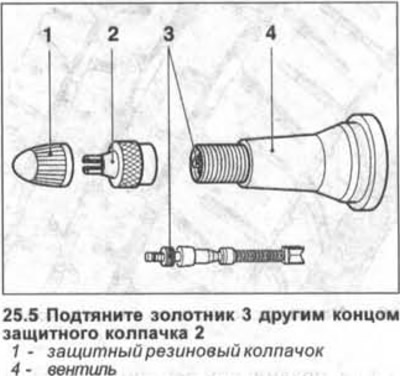
Attention! To tighten the valves, use only metal protective caps 2 valves Metal protective caps can be purchased at gas stations.
Attention! To tighten the valves you can use the HAZET666-1 device (see 5 in illustration 25.0v).
6. Check the valve again. If bubbles still form and the valve no longer tightens, replace it. Have the work done by a workshop.
7. Screw the protective cap onto the valve.
Visitor comments