



Contents: Ball joints and tie rod ends -…↓ Ball joints - checking protective…↓ Ball joint play - check ↓ Replacement ↓ Ball joint protective caps of the…↓ CV joint seals of drive shafts -…↓
Tie rod ends. Check the fastening and clearance, as well as the condition of the dust caps of the tip supports.
Ball joints. Check the condition of the dust caps.
CV joint cuffs. Inspect and ensure there are no leaks or damage.
Ball joints and tie rod ends - inspection and replacement
Necessary tools and equipment:
- garage lift;
- electric flashlight.
Ball joints - checking protective caps
Warning! Jacking up a vehicle and placing it on stands may pose a risk of injury. Before starting work, it is recommended that you familiarize yourself with the safety precautions in Chapter "Jacking up a car".
1. Place the front of the vehicle on jack stands. The wheels of the vehicle should hang freely when it is on the jack stands.
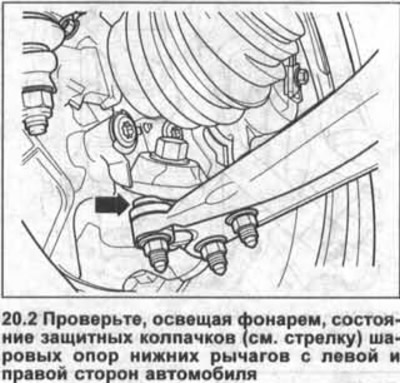
2. Check the condition of the protective caps using a flashlight (see arrow in illustration) ball joints of the lower arms on the left and right sides of the car.
Ball joint play - check
3. Press the control arm upwards with sufficient force, and then push it downwards, keeping an eye on the ball joint (see illustration).
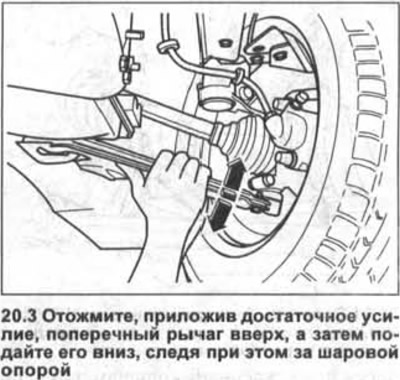
4. Press the wheel, holding it by the bottom, outward and toward the center of the car, also watching the ball joint. In both cases, the ball joint should not have any play.
Caution! When performing this check, do not forget to check and take into account possible play in the hub bearing or play in the upper shock absorber strut mount.
Replacement
5. Remove the axle shaft end from the hub, see the relevant chapter.
6. Mark the position of the three mounting nuts on the wishbone by tracing the locations where they fit with a scriber, then unscrew the nuts.
7. Remove the transverse arm by pushing it down, and press the ball joint pin out of the steering knuckle 2 using puller 1, for example, HAZET 779-1 (see illustration).
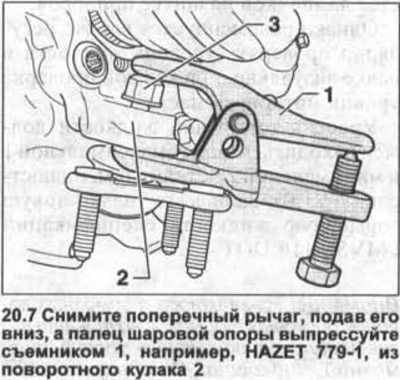
Attention! When pressing out the pin, leave nut 3 on the upper threads.
Attention! Mark and take into account the installation position of the ball joint. If installed incorrectly, the wheel alignment changes.
8. Secure the ball joint to the steering knuckle with a new self-locking nut, screwing it on by hand.
9. Secure the drive shaft end into the hub.
10. Tighten the ball joint nut to 60 Nm, holding the support pin from turning with a socket wrench.
11. Secure the ball joint to the wishbone, making sure not to twist the ball joint boot or damage it.
12. Secure the wishbone with new self-locking nuts and tighten them to 75 Nm.
13. Screw in and tighten the bolt that secures the drive shaft end to the hub, see the relevant chapter.
14. Replace the wheel, maintaining the same direction of rotation, and screw in the wheel bolts.
15. Lower the vehicle onto its wheels and only then tighten the wheel bolts in a cross pattern to 120 Nm.
Ball joint protective caps of the ends and the cuffs of the transverse steering rod - inspection
16. Check the condition of the protective caps using a flashlight (see arrow in illustration) ball joints of the left and right tie rod ends.
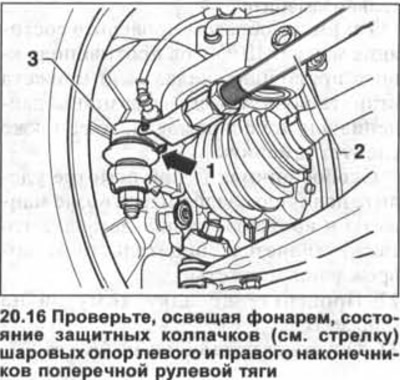
If the protective cap of the ball joint is damaged, it is recommended to contact a workshop to replace the ball joint itself, because dirt that gets through the damaged cap will eventually break the ball joint.
17. Check for play in the transverse steering rods. To do this, grab the rod with your 2nd hand and move it to one side and then to the opposite side. There should be no play.
Otherwise, replace the corresponding tip 3 (see illustration 20.16).
18. Check the fit of the lock nut and the nut securing the tip to the tie rod. Do not turn either nut.
19. Check the condition of the steering gear bellows. If damaged, replace the bellows.
CV joint seals of drive shafts - inspection
Special devices and tools:
- garage lift;
- electric flashlight.
Warning! Jacking up a vehicle and placing it on stands may pose a risk of injury. Before starting work, it is recommended that you familiarize yourself with the safety precautions in Chapter "Jacking up a car".
20. Jack up the car and place it on jack stands.
21. Shine a light on the CV joint cuffs (see arrows in the illustration) and inspect them for porosity or cracks. Replace torn cuffs immediately.
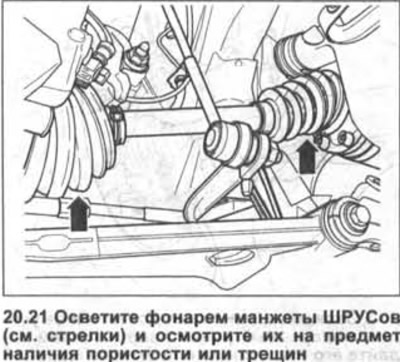
In the same way, check the condition of the CV joint seals of the opposite drive shaft. If the seal is pulled inward due to the pressure difference or is damaged, it should also be replaced.
When inspecting, pay special attention to the presence of traces of oil near the cuff and on nearby parts, which is also evidence of damage to the cuff.
22. Check the fit of the clamps on the cuffs.
23. Lower the car onto its wheels.
[The original material is available on the portal: www.VWmanual.ru]
Visitor comments