



Warning! Jacking up a vehicle or placing it on stands may pose a risk of injury. Therefore, it is recommended that you familiarize yourself with the safety precautions set out in Chapter "Jacking up a car".
1. Jack up the car and place it on jack stands.
2. Clean the brake lines.
Attention! The brake system pipes are made of metal and are coated with a layer of polymer material to prevent corrosion. If the protective polymer layer is damaged, the pipe may rust. Therefore, cleaning the brake pipes with a metal brush or sandpaper is not allowed.
3. Using a flashlight, check the tightness of the brake lines running from the master cylinder to the ABS, as well as to all four wheel brakes.
The brake master cylinder is located in the engine compartment under the brake fluid expansion tank.
The brake system pipes must not have any kinks or dents. They must not have any corrosion pits or worn areas.
Otherwise, the pipeline up to the next joint should be replaced with a new one.
Brake hoses connect the pipelines to the wheel brake cylinders and are laid near the moving parts of the car.
They are made of a material that can withstand high pressure, but over time they can become porous, swell, or be cut by sharp objects.
If at least one of the above defects is present, the brake hose must be replaced.
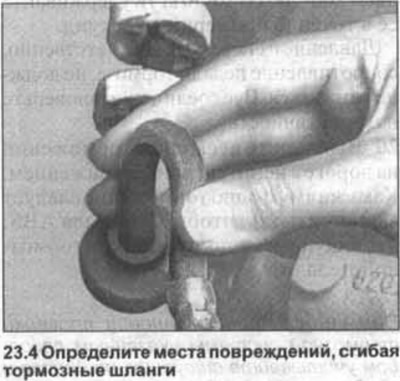
4. Identify the damaged areas by bending the brake hoses (see illustration). The hoses must not be twisted.
Follow the color markings on the hoses, if any.
Joints between pipes and hoses must not be wet.
The presence of moisture is evidence of a brake fluid leak.
5. Turn the steering wheel all the way to the left and then to the right. The brake hoses should not touch other parts of the car in any position of the wheels.
6. Lower the car onto its wheels.
7. Turn the steering wheel all the way to the left again, then to the right. The brake hoses should not touch other parts of the car in any position of the wheels.
Visitor comments