



- surface-mounted wrench for the brake hydraulic bleed nipple;
- transparent hose and container for collecting brake fluid.
Materials needed: 1.2L of DOT 4 brake fluid.
Brake fluid absorbs moisture from the air through the pores in the brake hoses. Over time, this leads to a decrease in the boiling point of the brake fluid.
In such cases, when the brakes are subject to heavy loads, vapor locks may form in the pipelines, which significantly impairs the functioning of the brake system.
Brake fluid should be replaced every 2 years, preferably in the spring.
If you frequently drive in mountainous areas, the brake fluid should be replaced at shorter intervals.
Attention! The procedure for replacing brake fluid is generally almost the same as for removing air (bleeding) from the brake system. For this reason, only the differences are given below.
1. Mark the brake fluid level on the reservoir with a marker so that after replacing the old one, the level of the fresh one remains the same. This technique prevents brake fluid from leaking out of the reservoir when installing new brake pads (see illustration).
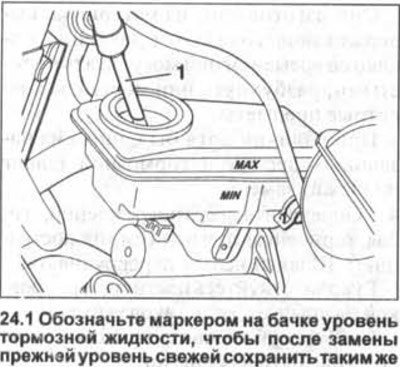
2. With the help of syringe 1, remove the maximum amount of brake fluid from the expansion tank. The tank should not be completely empty. A certain amount of brake fluid of at least 10 mm thickness should be left in it (see illustration 24.1).
Caution! It is not allowed to remove the sieve from the brake fluid reservoir. Reusing the collected brake fluid is also not allowed.
3. Fill the reservoir with fresh brake fluid to the maximum mark.
4. Pump out the old brake fluid from all wheel brake cylinders/calipers, bleeding one at a time until clear, bubble-free fluid comes out of the caliper. Approximately 250 cm³ (1/4 l) of brake fluid should flow out of the nipple of each caliper.
Attention! As the fluid is removed through the fittings, add it to the expansion tank. Do not allow it to empty, because in this case air will get into the brake system. If this does happen, then bleed the brake system in a workshop, because to bleed the ABS hydraulics, you need a tester connected to the diagnostic connector.
(The information is available on the website: VWMANUAL)
5. Check the free travel of the brake pedal after replacing the brake fluid. The free travel of the pedal should not exceed 1/3 of the total pedal travel.
Removal brake fluid from the clutch drive
Since the clutch drive is also driven by brake fluid, the old fluid from the clutch drive should also be removed.
6. Remove the protective cap from the bleed nipple of the clutch slave cylinder 1 and clean the nipple (see illustration).
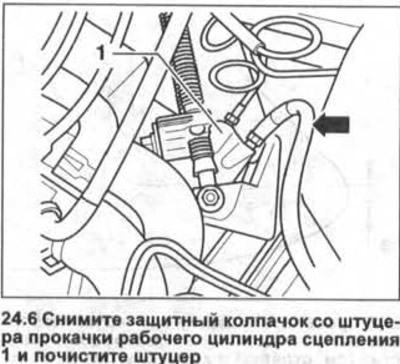
7. Place a clean transparent hose on the fitting (see arrow in illustration 24.6), the other end of which you lower into a bottle half filled with brake fluid.
8. Open the nipple and ask an assistant to press the clutch pedal. About 0.1 l of brake fluid should flow out of the drive.
9. Tighten the nipple while keeping the clutch pedal depressed.
10. Release the clutch pedal.
11. Slowly press the clutch pedal 10-15 times until it stops and release.
12. Open the nipple and ask an assistant to press the clutch pedal. In this case, approximately 0.05 l should flow out of the drive (50 cm³ or 50 ml) brake fluid.
13. Tighten the nipple while keeping the clutch pedal depressed.
14. Release the clutch pedal.
15. Press the clutch pedal all the way down several times and release it.
16. Remove the hose from the fitting and place the bottle away from the work area.
17. Add brake fluid to the reservoir up to the mark that indicated its previous level.
18. Screw the lid onto the tank.
Attention! Make sure that:
- a) the brake hoses are securely connected;
- b) there is a sufficient volume of brake fluid in the expansion tank.
19. Perform a brake system leak test by starting the engine, pressing the brake pedal with a force of 200-300 N (20-30 kg) and holding it for about 10 seconds.
The pressure in the system and, accordingly, the resistance of the brake pedal, should not decrease. Check all connections for leaks.
20. Perform several braking tests on a road with light traffic. At least one braking test should be performed so that the ABS engages, which is felt by the pulsation of the brake pedal.
Caution! When checking the brake system in the manner described, take into account the situation on the road and watch the traffic behind you.
Visitor comments